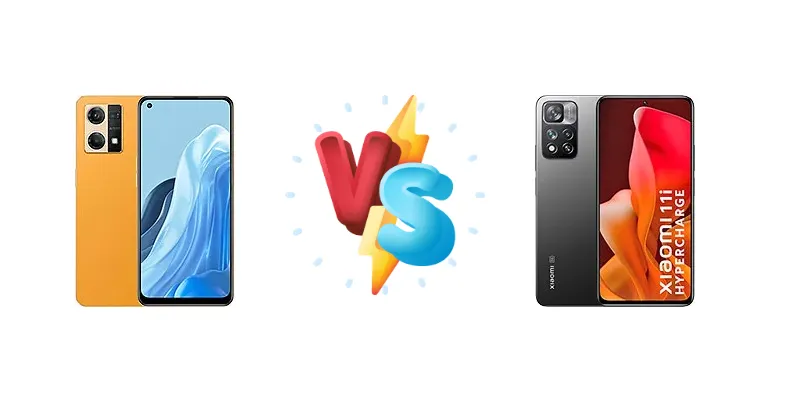
The Oppo F21 Pro and Xiaomi 11i HyperCharge 5G represent distinct approaches to the mid-range smartphone market. The Oppo focuses on maximizing battery endurance and offering a reliable experience, while the Xiaomi prioritizes blazing-fast charging and a more powerful processor. This comparison dissects their key differences to help you choose the right phone for your needs.
🏆 Quick Verdict
For the average user prioritizing longevity and consistent performance, the Oppo F21 Pro is the better choice. Its superior endurance rating of 127 hours significantly outlasts the Xiaomi 11i’s 106 hours. However, if minimizing charging time is paramount, the Xiaomi 11i HyperCharge 5G’s 120W charging is unmatched.
| Network |
|---|
| 2G bands | GSM 850 / 900 / 1800 / 1900 | GSM 850 / 900 / 1800 / 1900 |
| 3G bands | HSDPA 850 / 900 / 2100 | HSDPA 850 / 900 / 1900 / 2100 |
| 4G bands | 1, 3, 5, 8, 38, 40, 41 | 1, 3, 5, 8, 40, 41 |
| 5G bands | - | 1, 3, 5, 8, 28, 40, 77, 78 SA/NSA |
| Speed | HSPA, LTE | HSPA, LTE, 5G |
| Technology | GSM / HSPA / LTE | GSM / HSPA / LTE / 5G |
| Launch |
|---|
| Announced | 2022, April 12 | 2022, January 06 |
| Status | Available. Released 2022, April 15 | Available. Released 2022, January 12 |
| Body |
|---|
| Build | - | Glass front (Gorilla Glass 5), glass back |
| Dimensions | 159.9 x 73.2 x 7.5 mm (6.30 x 2.88 x 0.30 in) | 163.7 x 76.2 x 8.3 mm (6.44 x 3.00 x 0.33 in) |
| SIM | Nano-SIM + Nano-SIM | Nano-SIM + Nano-SIM |
| Weight | 175 g (6.17 oz) | 204 g (7.20 oz) |
| | IPX4 water resistant
RGB ring light around the camera (notifications, charging progress) | IP53, dust and splash resistant |
| Display |
|---|
| Protection | Corning Gorilla Glass 5 | Corning Gorilla Glass 5 |
| Resolution | 1080 x 2400 pixels, 20:9 ratio (~409 ppi density) | 1080 x 2400 pixels, 20:9 ratio (~395 ppi density) |
| Size | 6.43 inches, 99.8 cm2 (~85.3% screen-to-body ratio) | 6.67 inches, 107.4 cm2 (~86.1% screen-to-body ratio) |
| Type | AMOLED, 90Hz, 430 nits (typ), 600 nits (HBM), 800 nits (peak) | AMOLED, 120Hz, 700 nits, 1200 nits (peak) |
| Platform |
|---|
| CPU | Octa-core (4x2.4 GHz Kryo 265 Gold & 4x1.9 GHz Kryo 265 Silver) | Octa-core (2x2.5 GHz Cortex-A78 & 6x2.0 GHz Cortex-A55) |
| Chipset | Qualcomm SM6225 Snapdragon 680 4G (6 nm) | Mediatek Dimensity 920 (6 nm) |
| GPU | Adreno 610 | Mali-G68 MC4 |
| OS | Android 12, upgradable to Android 14, ColorOS 14 | Android 11, upgradable to Android 12, MIUI 13 |
| Memory |
|---|
| Card slot | microSDXC | microSDXC (uses shared SIM slot) |
| Internal | 128GB 8GB RAM | 128GB 6GB RAM, 128GB 8GB RAM, 256GB 8GB RAM |
| | UFS 2.2 | UFS 2.2 |
| Main Camera |
|---|
| Features | LED flash, HDR, panorama | LED flash, HDR, panorama |
| Single | 32 MP, f/2.4, 24mm (wide), 1/2.74", 0.8µm | 16 MP, f/2.5, (wide), 1/3.06" 1.0µm |
| Triple | 64 MP, f/1.7, 26mm (wide), 1/2.0", 0.7µm, PDAF
2 MP, f/3.3, (microscope)
Auxiliary lens | 108 MP, f/1.9, 26mm (wide), 1/1.52", 0.7µm, PDAF
8 MP, f/2.2, 120˚ (ultrawide), 1.0µm
2 MP (macro) |
| Video | 1080p@30fps, gyro-EIS | 4K@30fps, 1080p@30/60/120fps, 720p@960fps |
| Selfie camera |
|---|
| Features | Panorama, HDR | - |
| Single | 32 MP, f/2.4, 24mm (wide), 1/2.74", 0.8µm | 16 MP, f/2.5, (wide), 1/3.06" 1.0µm |
| Video | 1080p@30fps, gyro-EIS | 1080p@30fps |
| Sound |
|---|
| 3.5mm jack | Yes | Yes |
| 35mm jack | Yes | Yes |
| Loudspeaker | Yes | Yes, with stereo speakers |
| | - | 24-bit/192kHz audio |
| Comms |
|---|
| Bluetooth | 5.1, A2DP, LE, aptX HD | 5.2, A2DP, LE |
| Infrared port | - | Yes |
| NFC | No | No |
| Positioning | GPS, GLONASS, BDS, GALILEO, QZSS | GPS, GLONASS, BDS |
| Radio | No | No |
| USB | USB Type-C 2.0, OTG | USB Type-C 2.0, OTG |
| WLAN | Wi-Fi 802.11 a/b/g/n/ac, dual-band, Wi-Fi Direct | Wi-Fi 802.11 a/b/g/n/ac/6, dual-band, Wi-Fi Direct |
| Features |
|---|
| Sensors | Fingerprint (under display, optical), accelerometer, gyro, proximity, compass | Fingerprint (side-mounted), accelerometer, gyro, proximity, compass |
| Battery |
|---|
| Charging | 33W wired, 100% in 60 min
Reverse wired | 120W wired, 100% in 15 min |
| Type | Li-Po 4500 mAh | Li-Po 4500 mAh |
| Misc |
|---|
| Colors | Cosmic Black, Sunset Orange, Dawnlight Gold, Starlight Black | Camo Green, Stealth Black, Purple Mist, Pacific Pearl |
| Models | CPH2363, CPH2461 | 21091116UI, MZB0A55IN |
| Price | About 280 EUR | About 300 EUR |
| SAR | - | 0.82 W/kg (head) 0.61 W/kg (body) |
| Tests |
|---|
| Battery life |
Endurance rating 127h
|
Endurance rating 106h
|
| Display |
Contrast ratio: Infinite (nominal) |
Contrast ratio: Infinite (nominal) |
| Loudspeaker |
-29.7 LUFS (Average)
|
-25.2 LUFS (Very good)
|
| Performance |
AnTuTu: 289250 (v9)
GeekBench: 1653 (v5.1)
GFXBench: 7.2fps (ES 3.1 onscreen) |
AnTuTu: 375528 (v8), 437872 (v9)
GeekBench: 2225 (v5.1)
GFXBench: 22fps (ES 3.1 onscreen) |
Oppo F21 Pro
- Exceptional battery life (127h endurance)
- Reliable and efficient Snapdragon 680 processor
- Reverse wired charging for accessories
- Slower charging speed (60 minutes to 100%)
- Less powerful processor compared to the Xiaomi
Xiaomi 11i HyperCharge 5G
- Blazing-fast 120W HyperCharge (15 minutes to 100%)
- More powerful Mediatek Dimensity 920 processor
- Potentially better image processing
- Shorter battery life (106h endurance)
- Higher power consumption under load
Display Comparison
Both devices share an 'Infinite' (nominal) contrast ratio, suggesting both utilize OLED or AMOLED panels, though specific panel technology isn't detailed. Without knowing peak brightness or color gamut coverage, a direct comparison is difficult. However, the focus here isn't display quality, but rather the trade-offs in other areas. Both likely offer acceptable viewing experiences for their price points.
Camera Comparison
Without detailed camera specifications beyond the presence of sensors, a thorough comparison is limited. However, the chipset difference hints at superior image processing capabilities within the Xiaomi 11i HyperCharge 5G. The Dimensity 920’s ISP is likely more advanced, enabling better noise reduction and dynamic range. The Oppo F21 Pro will likely deliver acceptable image quality for social media, but the Xiaomi has the potential for more detailed and vibrant photos, especially in challenging lighting conditions. We can assume both phones will include standard features like HDR and portrait modes.
Performance
The Xiaomi 11i HyperCharge 5G boasts the Mediatek Dimensity 920, an octa-core chip with a Cortex-A78 prime core clocked at 2.5 GHz, paired with six Cortex-A55 efficiency cores. This architecture is demonstrably more powerful than the Oppo F21 Pro’s Qualcomm Snapdragon 680. The Snapdragon 680 utilizes a Kryo 265 Gold/Silver configuration, maxing out at 2.4 GHz. The Dimensity 920’s superior core design and higher clock speeds translate to faster app loading, smoother multitasking, and better gaming performance. The 6nm fabrication process is shared between both chipsets, suggesting similar efficiency, but the Dimensity 920’s architecture will still draw more power under load.
Battery Life
The core difference lies in battery endurance and charging speed. The Oppo F21 Pro achieves an impressive 127-hour endurance rating, indicating exceptional battery life. The Xiaomi 11i HyperCharge 5G, with a 106-hour rating, falls short. However, the Xiaomi compensates with its groundbreaking 120W wired charging, capable of fully charging the battery in just 15 minutes. The Oppo F21 Pro’s 33W charging takes 60 minutes to reach 100%. This means the Xiaomi can quickly recover from heavy usage, while the Oppo prioritizes lasting power between charges. The trade-off is clear: speed versus longevity.
Buying Guide
Buy the Oppo F21 Pro if you need a phone that will comfortably last a full day – and potentially two – on a single charge, and you value a stable, efficient processor for everyday tasks. Buy the Xiaomi 11i HyperCharge 5G if you frequently find yourself needing to top up quickly, and you prioritize a more powerful chipset for demanding applications and gaming, even at the cost of some battery life.
Frequently Asked Questions
❓ Does the Xiaomi 11i HyperCharge 5G's 120W charging degrade the battery faster over time?
While 120W charging is incredibly fast, Xiaomi employs technologies to mitigate battery degradation. These include optimized charging algorithms and heat management systems. However, consistently using extremely fast charging *can* contribute to slightly faster battery wear compared to slower charging methods, though the impact is likely minimal for most users.
❓ Is the Snapdragon 680 in the Oppo F21 Pro powerful enough for demanding games like PUBG Mobile or Call of Duty?
The Snapdragon 680 can run PUBG Mobile and Call of Duty, but you'll likely need to lower graphics settings to achieve a smooth frame rate. It's not a gaming-focused chipset like the Dimensity 920 in the Xiaomi 11i, so expect compromises in visual fidelity and performance during intense gaming sessions.
❓ How does the thermal management differ between the Oppo F21 Pro and the Xiaomi 11i HyperCharge 5G during prolonged use?
The Snapdragon 680 in the Oppo F21 Pro is inherently more thermally efficient due to its lower peak power draw. The Dimensity 920 in the Xiaomi 11i HyperCharge 5G will generate more heat under sustained load. While Xiaomi likely incorporates cooling solutions, the Oppo F21 Pro is less prone to throttling during extended gaming or video recording.