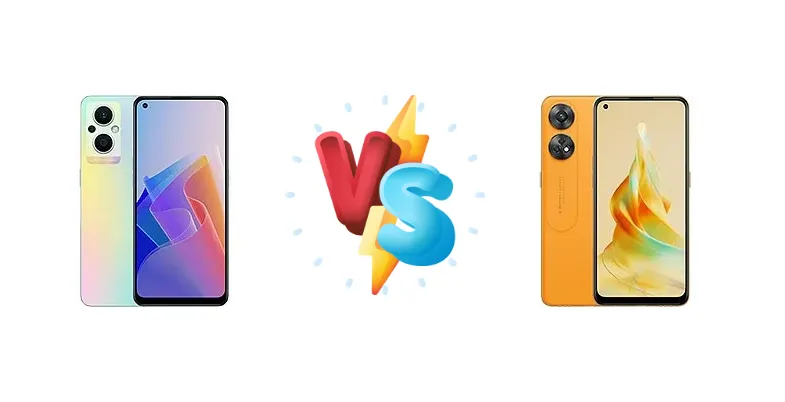
Oppo continues to deliver stylish and feature-packed smartphones at competitive prices. The F21 Pro 5G and Reno8 T are two compelling options, but which one reigns supreme? This in-depth comparison will break down their strengths and weaknesses to help you make the right choice.
🏆 Quick Verdict
The Oppo Reno8 T edges out the F21 Pro 5G thanks to its faster charging and slightly better performance. However, the F21 Pro 5G's 5G connectivity and potentially more refined software experience make it a strong contender, especially for those prioritizing future-proofing.
| Network |
|---|
| 2G bands | GSM 850 / 900 / 1800 / 1900 | GSM 850 / 900 / 1800 / 1900 |
| 3G bands | HSDPA 800 / 850 / 900 / 1900 / 2100 | HSDPA 850 / 900 / 2100 |
| 4G bands | 1, 3, 5, 7, 8, 28, 34, 38, 39, 40, 41 | 1, 3, 5, 7, 8, 20, 28, 38, 40, 41 |
| 5G bands | 1, 8, 28, 41, 77, 78 SA/NSA | - |
| Speed | HSPA, LTE, 5G | HSPA, LTE |
| Technology | GSM / HSPA / LTE / 5G | GSM / HSPA / LTE |
| Launch |
|---|
| Announced | 2022, April 12 | 2023, February 02 |
| Status | Available. Released 2022, April 21 | Available. Released 2023, February 02 |
| Body |
|---|
| Build | - | Glass front (Gorilla Glass 5), glass back or eco leather back, plastic frame |
| Dimensions | 159.9 x 73.2 x 7.5 mm (6.30 x 2.88 x 0.30 in) | 160.8 x 73.8 x 7.8 mm (6.33 x 2.91 x 0.31 in) |
| SIM | Nano-SIM + Nano-SIM | Nano-SIM + Nano-SIM |
| Weight | 173 g (6.10 oz) | 180 g or 183 g (6.35 oz) |
| | IPX4, dust and water resistant
RGB ring lights around the cameras (notifications, charging progress) | - |
| Display |
|---|
| Protection | Schott Xensation glass | Corning Gorilla Glass 5 |
| Resolution | 1080 x 2400 pixels, 20:9 ratio (~409 ppi density) | 1080 x 2400 pixels, 20:9 ratio (~409 ppi density) |
| Size | 6.43 inches, 99.8 cm2 (~85.3% screen-to-body ratio) | 6.43 inches, 99.8 cm2 (~84.1% screen-to-body ratio) |
| Type | AMOLED, 430 nits (typ), 600 nits (HBM) | AMOLED, 90Hz, 430 nits (typ), 800 nits (peak) |
| Platform |
|---|
| CPU | Octa-core (2x2.2 GHz Kryo 660 Gold & 6x1.7 GHz Kryo 660 Silver) | Octa-core (2x2.2 GHz Cortex-A76 & 6x2.0 GHz Cortex-A55) |
| Chipset | Qualcomm SM6375 Snapdragon 695 5G (6 nm) | Mediatek Helio G99 (6 nm) |
| GPU | Adreno 619 | Mali-G57 MC2 |
| OS | Android 12, upgradable to Android 14, ColorOS 14 | Android 13, upgradable to Android 14, ColorOS 14 |
| Memory |
|---|
| Card slot | microSDXC | microSDXC |
| Internal | 128GB 8GB RAM | 128GB 8GB RAM, 256GB 8GB RAM |
| | UFS 2.2 | UFS 2.2 |
| Main Camera |
|---|
| Dual | - | 100 MP, f/1.7, 26mm (wide), AF
2 MP, f/3.3, 34mm (microscope)
Auxiliary lens |
| Features | LED flash, HDR, panorama | LED flash, HDR, panorama |
| Single | 16 MP, f/2.4, 27mm (wide), 1.0µm | 32 MP, f/2.4, 22mm (wide) |
| Triple | 64 MP, f/1.7, 26mm (wide), PDAF
2 MP (macro)
Auxiliary lens | - |
| Video | 1080p@30fps | 1080p@30fps |
| Selfie camera |
|---|
| Features | HDR, panorama | HDR, panorama |
| Single | 16 MP, f/2.4, 27mm (wide), 1.0µm | 32 MP, f/2.4, 22mm (wide) |
| Video | 1080p@30fps | 1080p@30fps |
| Sound |
|---|
| 3.5mm jack | Yes | Yes |
| 35mm jack | Yes | Yes |
| Loudspeaker | Yes | Yes, with stereo speakers |
| Comms |
|---|
| Bluetooth | 5.1, A2DP, LE, aptX HD | 5.3, A2DP, LE, aptX HD |
| NFC | Yes | Yes |
| Positioning | GPS, GLONASS, BDS, GALILEO, QZSS | GPS, GALILEO, GLONASS, BDS, QZSS |
| Radio | No | No |
| USB | USB Type-C 2.0, OTG | USB Type-C 2.0, OTG |
| WLAN | Wi-Fi 802.11 a/b/g/n/ac, dual-band, Wi-Fi Direct | Wi-Fi 802.11 a/b/g/n/ac, dual-band |
| Features |
|---|
| Sensors | Fingerprint (under display, optical), accelerometer, proximity, gyro, compass | Fingerprint (under display, optical), accelerometer, gyro, proximity, compass |
| Battery |
|---|
| Charging | 33W wired, PD, 31% in 15 min, 100% in 63 min
Reverse wired | 33W wired, PD, 54% in 30 min
Reverse wired |
| Type | Li-Po 4500 mAh | Li-Po 5000 mAh |
| Misc |
|---|
| Colors | Rainbow Spectrum, Cosmic Black, Dawnlight Gold, Starlight Black | Black Starlight, Orange Sunset |
| Models | CPH2341, CPH2455 | CPH2481 |
| Price | About 330 EUR | About 490 EUR |
Oppo F21 Pro 5G
- 5G Connectivity
- Potentially Smoother Software
- Reverse Wired Charging
- Stylish Design
- Slightly Slower Charging
- Less Powerful Chipset
- May have fewer camera features
Oppo Reno8 T
- Faster Charging
- Better Gaming Performance
- Reverse Wired Charging
- Potentially Better Display
- No 5G Connectivity
- Software updates may be slower
- Design might be less distinctive
Display Comparison
Both phones feature similar display technology (likely AMOLED) and resolution, but the Reno8 T might have slightly better color accuracy and brightness due to potential panel variations. Screen sizes are likely comparable, around 6.4-6.7 inches. Expect vibrant visuals on both.
Camera Comparison
Both phones likely feature a triple-camera setup with a primary sensor around 64MP. The Reno8 T might have a slightly better ultrawide lens. Image processing and software features will play a significant role in the final image quality. Expect good selfies from both.
Performance
The Reno8 T's MediaTek Helio G99 generally offers better gaming performance than the Snapdragon 695 5G. While both are capable for everyday tasks, the Reno8 T will handle more demanding apps and games with greater ease. The Snapdragon 695 5G's advantage lies in its 5G modem.
Battery Life
The Reno8 T boasts significantly faster charging (54% in 30 minutes vs 31% in 15 minutes), making it more convenient for quick top-ups. Battery capacities are likely similar, around 5000mAh, so real-world battery life should be comparable if charging isn't a primary concern.
Buying Guide
The Oppo F21 Pro 5G is ideal for users who want 5G connectivity and a potentially smoother software experience. The Oppo Reno8 T is a better choice for those prioritizing faster charging speeds and a slightly more powerful chipset for gaming and demanding tasks.
Frequently Asked Questions
❓ Which phone is better for gaming?
The Oppo Reno8 T is generally better for gaming due to its more powerful MediaTek Helio G99 chipset.
❓ Does the Oppo F21 Pro 5G support 5G?
Yes, the Oppo F21 Pro 5G supports 5G connectivity, while the Reno8 T does not.
❓ Which phone has faster charging?
The Oppo Reno8 T has significantly faster charging speeds, reaching 54% in 30 minutes compared to the F21 Pro 5G's 31% in 15 minutes.
❓ Are the cameras comparable?
Both phones have capable cameras, but the Reno8 T might have a slight edge in ultrawide performance. Overall, image quality will depend on software processing.