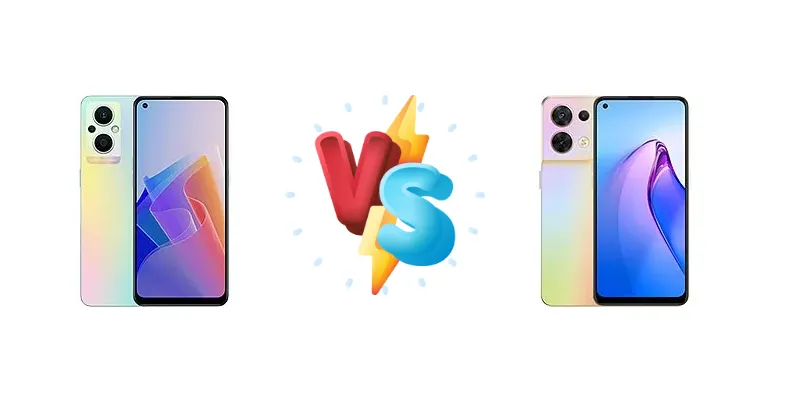
Oppo consistently delivers stylish and feature-packed smartphones. The F21 Pro 5G and Reno8 are two compelling options, each targeting a slightly different audience. But which one offers the best overall experience? Let's dive into a comprehensive comparison to help you make the right choice.
🏆 Quick Verdict
The Oppo Reno8 emerges as the stronger contender thanks to its significantly faster charging, more powerful chipset, and impressive battery life. While the F21 Pro 5G offers a more budget-friendly entry point, the Reno8's performance and charging speed justify its higher price for most users.
| Network |
|---|
| 2G bands | GSM 850 / 900 / 1800 / 1900 | GSM 850 / 900 / 1800 / 1900 |
| 3G bands | HSDPA 800 / 850 / 900 / 1900 / 2100 | HSDPA 800 / 850 / 900 / 1700(AWS) / 1900 / 2100 |
| 4G bands | 1, 3, 5, 7, 8, 28, 34, 38, 39, 40, 41 | 1, 2, 3, 4, 5, 7, 8, 12, 17, 18, 19, 20, 26, 28, 38, 39, 40, 41 |
| 5G bands | 1, 8, 28, 41, 77, 78 SA/NSA | 1, 3, 5, 7, 8, 20, 28, 38, 40, 41, 77, 78 SA/NSA |
| Speed | HSPA, LTE, 5G | HSPA, LTE, 5G |
| Technology | GSM / HSPA / LTE / 5G | GSM / HSPA / LTE / 5G |
| Launch |
|---|
| Announced | 2022, April 12 | 2022, July 18 |
| Status | Available. Released 2022, April 21 | Available. Released 2022, July 25 |
| Body |
|---|
| Build | - | Glass front (Gorilla Glass 5), plastic back, plastic frame |
| Dimensions | 159.9 x 73.2 x 7.5 mm (6.30 x 2.88 x 0.30 in) | 160.6 x 73.4 x 7.7 mm (6.32 x 2.89 x 0.30 in) |
| SIM | Nano-SIM + Nano-SIM | Nano-SIM + Nano-SIM |
| Weight | 173 g (6.10 oz) | 179 g (6.31 oz) |
| | IPX4, dust and water resistant
RGB ring lights around the cameras (notifications, charging progress) | - |
| Display |
|---|
| Protection | Schott Xensation glass | Corning Gorilla Glass 5 |
| Resolution | 1080 x 2400 pixels, 20:9 ratio (~409 ppi density) | 1080 x 2400 pixels, 20:9 ratio (~411 ppi density) |
| Size | 6.43 inches, 99.8 cm2 (~85.3% screen-to-body ratio) | 6.4 inches, 98.9 cm2 (~83.9% screen-to-body ratio) |
| Type | AMOLED, 430 nits (typ), 600 nits (HBM) | AMOLED, 90Hz, 430 nits (typ), 600 nits (HBM), 800 nits (peak) |
| Platform |
|---|
| CPU | Octa-core (2x2.2 GHz Kryo 660 Gold & 6x1.7 GHz Kryo 660 Silver) | Octa-core (1x3.0 GHz Cortex-A78 & 3x2.6 GHz Cortex-A78 & 4x2.0 GHz Cortex-A55) |
| Chipset | Qualcomm SM6375 Snapdragon 695 5G (6 nm) | Mediatek Dimensity 1300 (6 nm) |
| GPU | Adreno 619 | Mali-G77 MC9 |
| OS | Android 12, upgradable to Android 14, ColorOS 14 | Android 12, upgradable to Android 14, ColorOS 14 |
| Memory |
|---|
| Card slot | microSDXC | No |
| Internal | 128GB 8GB RAM | 128GB 8GB RAM, 256GB 8GB RAM, 256GB 12GB RAM |
| | UFS 2.2 | UFS 3.1 |
| Main Camera |
|---|
| Features | LED flash, HDR, panorama | Dual-LED flash, HDR, panorama |
| Single | 16 MP, f/2.4, 27mm (wide), 1.0µm | 32 MP, f/2.4, 23mm (wide), 1/2.74", 0.8µm |
| Triple | 64 MP, f/1.7, 26mm (wide), PDAF
2 MP (macro)
Auxiliary lens | 50 MP, f/1.8, 23mm (wide), 1/1.56", 1.0µm, multi-directional PDAF
8 MP, f/2.2, 16mm, 112˚ (ultrawide), 1/4.0", 1.12µm
2 MP (macro) |
| Video | 1080p@30fps | 4K@30fps, 1080p@30/60/120fps, gyro-EIS |
| Selfie camera |
|---|
| Features | HDR, panorama | Panorama, HDR |
| Single | 16 MP, f/2.4, 27mm (wide), 1.0µm | 32 MP, f/2.4, 23mm (wide), 1/2.74", 0.8µm |
| Video | 1080p@30fps | 1080p@30fps, gyro-EIS |
| Sound |
|---|
| 3.5mm jack | Yes | No |
| 35mm jack | Yes | No |
| Loudspeaker | Yes | Yes |
| Comms |
|---|
| Bluetooth | 5.1, A2DP, LE, aptX HD | 5.3, A2DP, LE, aptX HD |
| NFC | Yes | Yes |
| Positioning | GPS, GLONASS, BDS, GALILEO, QZSS | GPS, GLONASS, BDS, GALILEO, QZSS |
| Radio | No | No |
| USB | USB Type-C 2.0, OTG | USB Type-C 2.0, OTG |
| WLAN | Wi-Fi 802.11 a/b/g/n/ac, dual-band, Wi-Fi Direct | Wi-Fi 802.11 a/b/g/n/ac/6, dual-band, Wi-Fi Direct |
| Features |
|---|
| Sensors | Fingerprint (under display, optical), accelerometer, proximity, gyro, compass | Fingerprint (under display, optical), accelerometer, gyro, proximity, compass |
| Battery |
|---|
| Charging | 33W wired, PD, 31% in 15 min, 100% in 63 min
Reverse wired | 80W wired, 50% in 11 min, 100% in 28 min
Reverse wired |
| Type | Li-Po 4500 mAh | Li-Po 4500 mAh |
| Misc |
|---|
| Colors | Rainbow Spectrum, Cosmic Black, Dawnlight Gold, Starlight Black | Shimmer Gold, Shimmer Black |
| Models | CPH2341, CPH2455 | CPH2359 |
| Price | About 330 EUR | £ 279.99 / € 158.14 / ₹ 24,999 |
| Tests |
|---|
| Battery life | - |
Endurance rating 105h
|
| Camera | - |
Photo / Video |
| Display | - |
Contrast ratio: Infinite (nominal) |
| Loudspeaker | - |
-28.7 LUFS (Average)
|
| Performance | - |
AnTuTu: 619610a (v9)
GeekBench: 2694 (v5.1)
GFXBench: 42fps (ES 3.1 onscreen) |
Oppo F21 Pro 5G
- More affordable
- 5G Connectivity
- Decent Camera
- Slower Performance
- Slower Charging
- Less Premium Build
Oppo Reno8
- Faster Performance
- Incredibly Fast Charging (80W)
- Excellent Battery Life
- Premium Design
- Higher Price
- Nominal 'Infinite' Contrast Ratio Claim
Display Comparison
Both phones feature vibrant displays, but the Reno8 boasts a measured peak brightness of 633 nits, offering better visibility in direct sunlight. The Reno8's 'infinite' contrast ratio (nominal) suggests excellent black levels and image depth, though this is a marketing term. The F21 Pro 5G likely has a good display, but lacks specific brightness data.
Camera Comparison
While both phones offer capable camera systems, the Reno8 likely holds an edge due to its superior image processing capabilities stemming from its more powerful chipset. Specific camera specs are missing for both, but generally, Reno series phones have a reputation for good image quality. The F21 Pro 5G's camera is likely decent, but not exceptional.
Performance
The Reno8's Mediatek Dimensity 1300 chipset significantly outperforms the F21 Pro 5G's Snapdragon 695 5G. The Dimensity 1300's Cortex-A78 cores provide a noticeable boost in processing power, making the Reno8 smoother for demanding tasks like gaming and video editing. The F21 Pro 5G is adequate for everyday use, but will struggle with heavier workloads.
Battery Life
The Reno8 shines in this category with an endurance rating of 105 hours, indicating exceptional battery life. The F21 Pro 5G's battery life is likely good, but not in the same league. Furthermore, the Reno8's 80W charging is a game-changer, allowing for incredibly fast top-ups compared to the F21 Pro 5G's 33W charging.
Buying Guide
The Oppo F21 Pro 5G is ideal for budget-conscious users who prioritize 5G connectivity and a decent camera system. The Oppo Reno8 is a better choice for those seeking flagship-like performance, incredibly fast charging, and a premium overall experience.
Frequently Asked Questions
❓ Is the Oppo F21 Pro 5G good for gaming?
The F21 Pro 5G can handle casual games, but it may struggle with demanding titles due to its less powerful chipset. The Reno8 is a better choice for serious mobile gamers.
❓ How long does it take to fully charge each phone?
The Oppo Reno8 charges from 0% to 100% in approximately 28 minutes with its 80W charger, while the F21 Pro 5G takes around 63 minutes with its 33W charger.