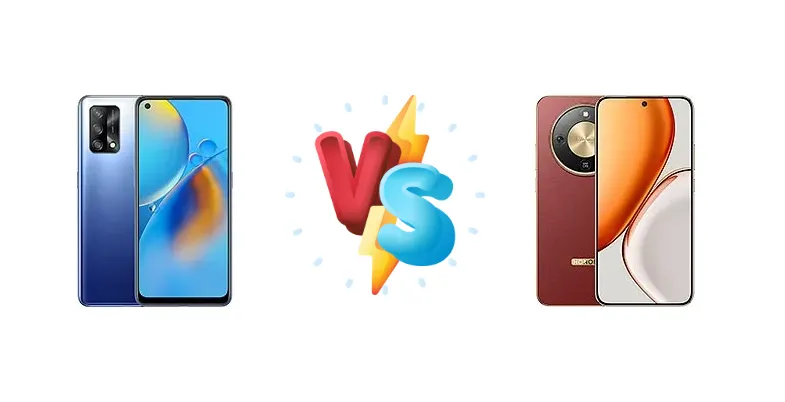
The Oppo F19 and Honor X9d represent different approaches to the budget smartphone market. The F19, powered by the older Snapdragon 662, aims for affordability, while the X9d leverages the newer, more efficient Snapdragon 6 Gen 4. This comparison dissects the key differences to help you determine which device delivers the best value for your needs.
🏆 Quick Verdict
For most users, the Honor X9d is the superior choice. Its Snapdragon 6 Gen 4 chipset offers a significant performance uplift and improved power efficiency compared to the Oppo F19’s Snapdragon 662. The 66W charging is a game-changer, drastically reducing charge times, making it ideal for users on the go.
| Network |
|---|
| 2G bands | GSM 850 / 900 / 1800 / 1900 | GSM 850 / 900 / 1800 / 1900 |
| 3G bands | HSDPA 850 / 900 / 2100 | HSDPA 850 / 900 / 1700(AWS) / 1900 / 2100 |
| 4G bands | 1, 3, 5, 8, 38, 40, 41 | LTE |
| 5G bands | - | SA/NSA |
| Speed | HSPA, LTE | HSPA, LTE, 5G |
| Technology | GSM / HSPA / LTE | GSM / HSPA / LTE / 5G |
| Launch |
|---|
| Announced | 2021, April 01 | 2025, September 24 |
| Status | Available. Released 2021, April 08 | Available. Released 2025, October 09 |
| Body |
|---|
| Dimensions | 160.3 x 73.8 x 8 mm (6.31 x 2.91 x 0.31 in) | 161.9 x 76.1 x 7.8 mm (6.37 x 3.00 x 0.31 in) |
| SIM | Nano-SIM + Nano-SIM | Nano-SIM + Nano-SIM |
| Weight | 175 g (6.17 oz) | 193 g (6.81 oz) |
| Display |
|---|
| Protection | - | Aluminosilicate glass |
| Resolution | 1080 x 2400 pixels, 20:9 ratio (~409 ppi density) | 1200 x 2640 pixels (~427 ppi density) |
| Size | 6.43 inches, 99.8 cm2 (~84.4% screen-to-body ratio) | 6.79 inches, 112.1 cm2 (~90.9% screen-to-body ratio) |
| Type | AMOLED, 430 nits (typ), 800 nits (peak) | AMOLED, 1B colors, 120Hz, 3840Hz PWM, HDR, 800 nits (typ), 1800 nits (HBM), 6000 nits (peak) |
| Platform |
|---|
| CPU | Octa-core (4x2.0 GHz Kryo 260 Gold & 4x1.8 GHz Kryo 260 Silver) | Octa-core (1x2.3 GHz Cortex-A720s & 3x2.2 GHz Cortex-A720s & 4x1.8 GHz Cortex-A520s) |
| Chipset | Qualcomm SM6115 Snapdragon 662 (11 nm) | Qualcomm Snapdragon 6 Gen 4 (4 nm) |
| GPU | Adreno 610 | Adreno 810 |
| OS | Android 11, ColorOS 11.1 | Android 15, Magic OS 9 |
| Memory |
|---|
| Card slot | microSDXC (dedicated slot) | No |
| Internal | 128GB 6GB RAM | 256GB 8GB RAM, 256GB 12GB RAM, 512GB 12GB RAM |
| Main Camera |
|---|
| Dual | - | 108 MP, f/1.8, (wide), PDAF, OIS
5 MP, f/2.2, (ultrawide) |
| Features | LED flash, panorama | LED flash, panorama, HDR |
| Single | 16 MP, f/2.4, 27mm (wide), 1/3.09", 1.0µm | - |
| Triple | 48 MP, f/1.7, 26mm (wide), 1/2.0", 0.8µm, PDAF
2 MP (macro)
Auxiliary lens | - |
| Video | 1080p@30fps | 4K@30fps, 1080p@30fps, gyro-EIS |
| Selfie camera |
|---|
| Features | Panorama | - |
| Single | 16 MP, f/2.4, 27mm (wide), 1/3.09", 1.0µm | 16 MP, f/2.5, (wide) |
| Video | 1080p@30fps | 1080p@30fps |
| Sound |
|---|
| 3.5mm jack | Yes | - |
| 35mm jack | Yes | No |
| Loudspeaker | Yes | Yes, with stereo speakers |
| Comms |
|---|
| Bluetooth | 5.0, A2DP, LE, aptX | 5.2, A2DP, LE, aptX HD, aptX Adaptive |
| NFC | No | Yes |
| Positioning | GPS, GLONASS, GALILEO, BDS | GPS, GALILEO, GLONASS, BDS |
| Radio | FM radio | No |
| USB | USB Type-C 2.0, OTG | USB Type-C 2.0, OTG |
| WLAN | Wi-Fi 802.11 a/b/g/n/ac, dual-band, Wi-Fi Direct | Wi-Fi 802.11 a/b/g/n/ac/6, dual-band, Wi-Fi Direct |
| Features |
|---|
| Sensors | Fingerprint (under display, optical), accelerometer, gyro, proximity, compass | Fingerprint (under display, optical), accelerometer, compass, gyro, proximity |
| Battery |
|---|
| Charging | 33W wired, 54% in 30 min | 66W wired
7.5W reverse wired |
| Type | Li-Po 5000 mAh | Si/C Li-Ion 8300 mAh |
| Misc |
|---|
| Colors | Prism Black, Midnight Blue | Reddish Brown, Midnight Black, Sunrise Gold, Forest Green |
| Models | CHP2219, CPH2219 | MTN-NX1 |
| Price | About 220 EUR | About 300 EUR |
| SAR | 0.92 W/kg (head) 0.84 W/kg (body) | - |
Oppo F19
- Lower price point (likely)
- Proven Snapdragon 662 platform
- Familiar Android experience
- Slower charging (33W)
- Less powerful chipset
- Lower performance in demanding tasks
Honor X9d
- Faster Snapdragon 6 Gen 4 chipset
- Significantly faster 66W charging
- Improved power efficiency
- Reverse wired charging
- Potentially higher price
- Newer chipset may have initial software quirks
Display Comparison
Neither device boasts a standout display. While specific panel details (like OLED vs LCD) are missing, the focus here is on the underlying performance. Both will likely feature 1080p+ resolution displays common in this segment. The real difference lies in the processing power needed to drive them, where the Snapdragon 6 Gen 4 in the X9d has a clear advantage, potentially leading to smoother animations and faster response times. Bezels are likely comparable, given the price points.
Camera Comparison
Without detailed camera specs, it’s difficult to make a definitive judgment. However, the chipset plays a crucial role in image processing. The Snapdragon 6 Gen 4’s improved ISP (Image Signal Processor) in the X9d will likely result in better image quality, particularly in low-light conditions. Expect faster image capture and more effective noise reduction. The Oppo F19’s camera will be functional, but likely won’t match the X9d’s processing capabilities. The presence of OIS (Optical Image Stabilization) would be a significant advantage for either device, but is unknown.
Performance
The core difference is the chipset. The Oppo F19’s Snapdragon 662 (11nm) is a capable but aging processor. Its octa-core configuration (4x2.0 GHz Kryo 260 Gold & 4x1.8 GHz Kryo 260 Silver) is adequate for everyday tasks. However, the Honor X9d’s Snapdragon 6 Gen 4 (4nm) represents a substantial leap forward. The 4nm process node is significantly more efficient, resulting in better thermal management and sustained performance. The X9d’s CPU configuration (1x2.3 GHz Cortex-A720s & 3x2.2 GHz Cortex-A720s & 4x1.8 GHz Cortex-A520s) also features newer core designs, offering improved single-core and multi-core performance. This translates to faster app loading, smoother multitasking, and a more responsive overall experience.
Battery Life
The Honor X9d’s 66W wired charging is a major advantage. Achieving 54% charge in 30 minutes (Oppo F19) is slow compared to the X9d’s potential to reach a full charge in under an hour. While battery capacity isn’t specified, the Snapdragon 6 Gen 4’s superior power efficiency means the X9d will likely offer comparable or better battery life despite potentially having a similar or even smaller battery. The X9d also includes 7.5W reverse wired charging, a feature absent on the F19, allowing it to top up other devices.
Buying Guide
Buy the Oppo F19 if you prioritize a proven, if somewhat dated, platform and are on an extremely tight budget, accepting compromises in performance and charging speed. Buy the Honor X9d if you value a smoother user experience, faster charging, and a more future-proof chipset, even if it means spending slightly more upfront. The X9d is the better option for gamers and heavy app users.
Frequently Asked Questions
❓ Will the Snapdragon 6 Gen 4 in the Honor X9d handle demanding games like PUBG Mobile smoothly?
Yes, the Snapdragon 6 Gen 4 is a significant upgrade over the Snapdragon 662 and should provide a much smoother gaming experience in PUBG Mobile. While it won't match flagship-level performance, you can expect playable frame rates at medium to high settings. The improved GPU and thermal management will prevent excessive throttling during extended gaming sessions.
❓ How much faster is the 66W charging on the Honor X9d compared to the Oppo F19's 33W charging in real-world use?
The 66W charging on the Honor X9d will dramatically reduce charging times. While the Oppo F19 takes approximately 30 minutes to reach 54%, the X9d can potentially reach a full charge in under an hour. This is a substantial difference, especially for users who frequently need to top up their phones quickly.
❓ Is the difference in chipset performance between the Snapdragon 662 and 6 Gen 4 noticeable for everyday tasks like browsing and social media?
Yes, the difference is noticeable. While both chipsets can handle basic tasks, the Snapdragon 6 Gen 4 offers a snappier and more responsive experience. App loading times will be faster, multitasking will be smoother, and animations will be more fluid. This is particularly evident when switching between apps or scrolling through content-heavy websites.