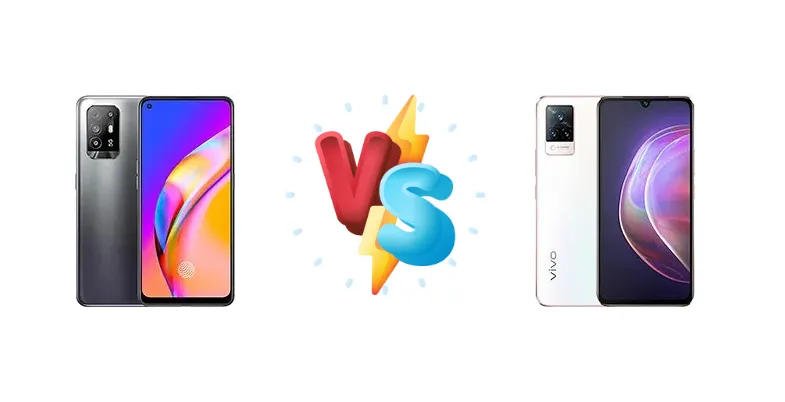
Both the Oppo F19 Pro+ 5G and the vivo V21 5G target the competitive mid-range 5G market, offering similar core specifications. However, key differences in charging speed and display brightness, alongside subtle nuances in battery endurance, create distinct user experiences. This comparison dives deep into these areas to determine which device offers the best value.
🏆 Quick Verdict
For users prioritizing rapid charging and maximizing uptime, the Oppo F19 Pro+ 5G is the superior choice. Its 50W charging capability significantly reduces downtime compared to the vivo V21 5G’s 33W solution. While both phones share the same chipset, the faster charging and potentially more efficient power delivery give the Oppo an edge.
| Network |
|---|
| 2G bands | GSM 850 / 900 / 1800 / 1900 | GSM 850 / 900 / 1800 / 1900 |
| 3G bands | HSDPA 850 / 900 / 2100 | HSDPA 850 / 900 / 1700(AWS) / 1900 / 2100 |
| 4G bands | 1, 3, 5, 7, 8, 38, 40, 41 | 1, 2, 3, 4, 5, 8, 34, 38, 40, 41 - India |
| 5G bands | 1, 41, 77, 78 SA/NSA | 78 Sub6 - India |
| Speed | HSPA, LTE, 5G | HSPA, LTE, 5G |
| Technology | GSM / HSPA / LTE / 5G | GSM / HSPA / LTE / 5G |
| Launch |
|---|
| Announced | 2021, March 08 | 2021, April 27 |
| Status | Available. Released 2021, March 17 | Available. Released 2021, May 06 |
| Body |
|---|
| Build | - | Glass front, plastic frame, plastic back |
| Dimensions | 160.1 x 73.4 x 7.8 mm (6.30 x 2.89 x 0.31 in) | 159.7 x 73.9 x 7.3 mm (6.29 x 2.91 x 0.29 in) |
| SIM | Nano-SIM + Nano-SIM | Nano-SIM + Nano-SIM |
| Weight | 173 g (6.10 oz) | 176 g (6.21 oz) |
| Display |
|---|
| Protection | Corning Gorilla Glass 5 | - |
| Resolution | 1080 x 2400 pixels, 20:9 ratio (~409 ppi density) | 1080 x 2400 pixels, 20:9 ratio (~409 ppi density) |
| Size | 6.43 inches, 99.8 cm2 (~84.9% screen-to-body ratio) | 6.44 inches, 100.1 cm2 (~84.8% screen-to-body ratio) |
| Type | Super AMOLED, 430 nits (typ), 800 nits (peak) | AMOLED, 90Hz, HDR10+, 500 nits (typ) |
| Platform |
|---|
| CPU | Octa-core (2x2.4 GHz Cortex-A76 & 6x2.0 GHz Cortex-A55) | Octa-core (2x2.4 GHz Cortex-A76 & 6x2.0 GHz Cortex-A55) |
| Chipset | Mediatek Dimensity 800U (7 nm) | Mediatek Dimensity 800U (7 nm) |
| GPU | Mali-G57 MC3 | Mali-G57 MC3 |
| OS | Android 11, upgradable to Android 12, ColorOS 12 | Android 11, Funtouch 11.1 |
| Memory |
|---|
| Card slot | microSDXC (dedicated slot) | microSDXC (uses shared SIM slot) |
| Internal | 128GB 8GB RAM | 128GB 6GB RAM, 128GB 8GB RAM, 256GB 8GB RAM |
| | - | UFS 2.2 |
| Main Camera |
|---|
| Features | LED flash, HDR, panorama | LED flash, HDR, panorama |
| Quad | 48 MP, f/1.7, 25mm (wide), 1/2.0", 0.8µm, PDAF
8 MP, f/2.2, 16mm, 119˚ (ultrawide), 1/4.0", 1.12µm
2 MP (macro)
Auxiliary lens | - |
| Single | - | 44 MP, f/2.0, (wide), AF, OIS |
| Triple | - | 64 MP, f/1.8, 26mm (wide), 1/1.72", 0.8µm, PDAF, OIS
8 MP, f/2.2, 120˚, 16mm (ultrawide), 1/4.0", 1.12µm
2 MP (macro) |
| Video | 4K@30fps, 1080p@30/120fps; gyro-EIS, HDR | 4K@30fps (no OIS), 1080p@30/60fps |
| Selfie camera |
|---|
| Features | HDR | Dual-LED flash, HDR |
| Single | 16 MP, f/2.4, 26mm (wide), 1/3.09", 1.0µm | 44 MP, f/2.0, (wide), AF, OIS |
| Video | 1080p@30fps | 4K@30fps (no OIS), 1080p@30fps |
| Sound |
|---|
| 3.5mm jack | - | No |
| 35mm jack | Yes | No |
| Loudspeaker | Yes | Yes |
| Comms |
|---|
| Bluetooth | 5.1, A2DP, LE, aptX HD | 5.1, A2DP, LE |
| NFC | No | Yes (market/region dependent) |
| Positioning | GPS, GLONASS, GALILEO, BDS | GPS, GLONASS, GALILEO, BDS |
| Radio | Unspecified | No |
| USB | USB Type-C 2.0, OTG | USB Type-C 2.0, OTG |
| WLAN | Wi-Fi 802.11 a/b/g/n/ac, dual-band, Wi-Fi Direct | Wi-Fi 802.11 a/b/g/n/ac, dual-band, Wi-Fi Direct |
| Features |
|---|
| Sensors | Fingerprint (under display, optical), accelerometer, gyro, proximity, compass | Fingerprint (under display, optical), accelerometer, gyro, proximity, compass |
| Battery |
|---|
| Charging | 50W wired, 100% in 48 min | 33W wired, 63% in 30 min |
| Type | Li-Po 4310 mAh | 4000 mAh |
| Misc |
|---|
| Colors | Fluid Black, Space Silver, Cosmo Blue | Dusk Blue, Sunset Dazzle, Arctic White |
| Models | CPH2213 | V2050 |
| Price | About 300 EUR | About 190 EUR |
| SAR | - | 1.05 W/kg (head) 0.87 W/kg (body) |
| Tests |
|---|
| Battery life | - |
Endurance rating 123h
|
| Camera | - |
Photo / Video |
| Display | - |
Contrast ratio: Infinite (nominal) |
| Loudspeaker | - |
-28.2 LUFS (Average)
|
| Performance | - |
AnTuTu: 336699 (v8), 365055 (v9)
GeekBench: 6516 (v4.4), 1600 (v5.1)
GFXBench: 17fps (ES 3.1 onscreen) |
Oppo F19 Pro+ 5G
- Significantly faster 50W charging
- Potentially more efficient power delivery
- Identical processor to vivo V21 5G
- Display brightness data unavailable
- Camera specifications largely unknown
vivo V21 5G
- Brighter display (761 nits)
- Long battery endurance (123h)
- Potentially refined software experience
- Slower 33W charging
- Identical processor to Oppo F19 Pro+ 5G
Display Comparison
The vivo V21 5G boasts a measured peak brightness of 761 nits, offering a noticeably brighter viewing experience in direct sunlight compared to the Oppo F19 Pro+ 5G (brightness data unavailable). Both displays feature an 'Infinite' contrast ratio, a marketing term indicating deep blacks, but the actual visual difference will hinge on panel quality and calibration. Without further data on panel type (AMOLED vs. IPS) or color gamut coverage, the V21 5G’s brightness advantage is the primary differentiating factor.
Camera Comparison
Both devices offer photo and video capabilities, but detailed camera specifications are lacking. Without sensor size, aperture, or OIS information, a meaningful comparison is difficult. The presence of a 2MP macro camera on both phones suggests limited utility, as these sensors typically lack the resolution and dynamic range for truly compelling macro photography. Image processing algorithms will likely be the key differentiator, a subjective area requiring side-by-side image samples.
Performance
Both the Oppo F19 Pro+ 5G and the vivo V21 5G are powered by the Mediatek Dimensity 800U (7nm), featuring an octa-core CPU configuration with 2x2.4 GHz Cortex-A76 and 6x2.0 GHz Cortex-A55 cores. This means performance in everyday tasks and most gaming scenarios will be virtually identical. The absence of information regarding RAM type (LPDDR4X vs LPDDR5) or storage speed (UFS 2.1 vs UFS 3.1) prevents a deeper analysis of potential performance bottlenecks. Thermal management characteristics, also unknown, will ultimately determine sustained performance under heavy load.
Battery Life
Both the Oppo F19 Pro+ 5G and the vivo V21 5G achieve an endurance rating of 123 hours, suggesting similar overall battery life. However, the charging speeds differ significantly. The Oppo F19 Pro+ 5G supports 50W wired charging, reaching 100% in 48 minutes, while the vivo V21 5G’s 33W charging takes longer, achieving only 63% charge in 30 minutes. This faster charging capability of the Oppo is a substantial advantage for users who frequently need to top up their battery quickly.
Buying Guide
Buy the Oppo F19 Pro+ 5G if you need consistently fast charging and are frequently on the go, minimizing time tethered to a wall outlet. Buy the vivo V21 5G if you prioritize a slightly brighter display and value a potentially more refined software experience, typical of vivo’s user interface, and aren't as concerned about charging speed.
Frequently Asked Questions
❓ How much faster is the Oppo F19 Pro+ 5G's charging compared to the vivo V21 5G in a typical use case?
While the Oppo F19 Pro+ 5G reaches 100% in 48 minutes, the vivo V21 5G only achieves 63% in 30 minutes. This means a quick 30-minute charge on the Oppo will likely yield a significantly higher battery percentage, making it ideal for users needing a rapid top-up before leaving the house.
❓ Does the Dimensity 800U chipset in either phone struggle with demanding games like PUBG or Genshin Impact?
The Dimensity 800U is a capable mid-range chipset. While it can run PUBG and Genshin Impact, expect to use medium graphics settings for a consistently smooth experience. Sustained performance will depend on the phone's thermal management, a factor not detailed in the available specifications.
❓ Are the 2MP macro cameras on either phone worth using for detailed close-up shots?
Generally, 2MP macro cameras offer limited image quality. They often lack the detail and dynamic range needed for truly impressive macro photography. While they can be fun to experiment with, don't expect professional-level results.