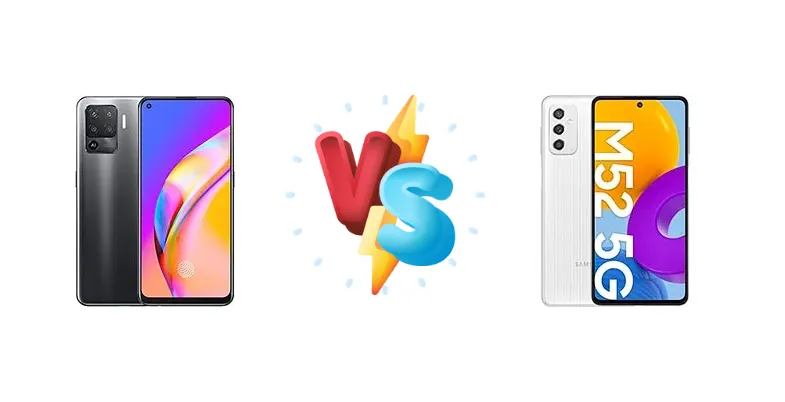
The Oppo F19 Pro and Samsung Galaxy M52 5G represent compelling options in the competitive mid-range smartphone market. While both aim to deliver a balanced experience, they diverge significantly in their core hardware, particularly in chipset choice. This comparison dissects these differences to determine which device offers the best overall package for various user needs.
🏆 Quick Verdict
For most users, the Samsung Galaxy M52 5G emerges as the stronger contender. Its Snapdragon 778G 5G chipset provides a substantial performance advantage over the Oppo F19 Pro’s Helio P95, translating to smoother multitasking, faster app loading, and a better gaming experience. While charging is slightly slower, the comparable battery life and superior processing power make it the better all-rounder.
| Network |
|---|
| 2G bands | GSM 850 / 900 / 1800 / 1900 | GSM 850 / 900 / 1800 / 1900 |
| 3G bands | HSDPA 850 / 900 / 2100 | HSDPA 850 / 900 / 1700(AWS) / 1900 / 2100 |
| 4G bands | 1, 3, 5, 8, 38, 40, 41 | 1, 2, 3, 4, 5, 7, 8, 12, 17, 20, 26, 28, 38, 40, 41, 66 |
| 5G bands | - | SA/NSA/Sub6 |
| Speed | HSPA, LTE | HSPA, LTE, 5G |
| Technology | GSM / HSPA / LTE | GSM / HSPA / LTE / 5G |
| Launch |
|---|
| Announced | 2021, March 08 | 2021, September 24 |
| Status | Available. Released 2021, March 17 | Available. Released 2021, October 03 |
| Body |
|---|
| Build | - | Glass front (Gorilla Glass 5), plastic frame, plastic back |
| Dimensions | 160.1 x 73.2 x 7.8 mm (6.30 x 2.88 x 0.31 in) | 164.2 x 76.4 x 7.4 mm (6.46 x 3.01 x 0.29 in) |
| SIM | Nano-SIM + Nano-SIM | Nano-SIM + Nano-SIM |
| Weight | 172 g (6.07 oz) | 173 g (6.10 oz) |
| Display |
|---|
| Protection | - | Corning Gorilla Glass 5 |
| Resolution | 1080 x 2400 pixels, 20:9 ratio (~409 ppi density) | 1080 x 2400 pixels, 20:9 ratio (~393 ppi density) |
| Size | 6.43 inches, 99.8 cm2 (~85.2% screen-to-body ratio) | 6.7 inches, 108.4 cm2 (~86.4% screen-to-body ratio) |
| Type | Super AMOLED, 430 nits (typ), 800 nits (peak) | Super AMOLED Plus, 120Hz |
| Platform |
|---|
| CPU | Octa-core (2x2.2 GHz Cortex-A75 & 6x2.0 GHz Cortex-A55) | Octa-core (1x2.4 GHz Cortex-A78 & 3x2.2 GHz Cortex-A78 & 4x1.9 GHz Cortex-A55) |
| Chipset | Mediatek MT6779V Helio P95 (12 nm) | Qualcomm SM7325 Snapdragon 778G 5G (6 nm) |
| GPU | PowerVR GM9446 | Adreno 642L |
| OS | Android 11, ColorOS 11.1 | Android 11, upgradable to Android 13, One UI 5.1 |
| Memory |
|---|
| Card slot | microSDXC (dedicated slot) | microSDXC (uses shared SIM slot) |
| Internal | 128GB 8GB RAM, 256GB 8GB RAM | 128GB 6GB RAM, 128GB 8GB RAM |
| | UFS 2.1 | - |
| Main Camera |
|---|
| Features | LED flash, HDR, panorama | LED flash, panorama, HDR |
| Quad | 48 MP, f/1.7, 25mm (wide), 1/2.0", 0.8µm, PDAF
8 MP, f/2.2, 16mm, 119˚ (ultrawide), 1/4.0", 1.12µm
2 MP (macro)
Auxiliary lens | - |
| Single | 16 MP, f/2.4, 26mm (wide), 1/3.09", 1.0µm | 32 MP, f/2.2, 26mm (wide) |
| Triple | - | 64 MP, f/1.8, 26mm (wide), 1/1.97", 0.7um, PDAF
12 MP, f/2.2, 123˚, (ultrawide), 1/3.06", 1.12µm
5 MP (macro) |
| Video | 4K@30fps, 1080p@30/120fps; gyro-EIS | 4K@30fps, 1080p@30/60fps |
| Selfie camera |
|---|
| Features | HDR | - |
| Single | 16 MP, f/2.4, 26mm (wide), 1/3.09", 1.0µm | 32 MP, f/2.2, 26mm (wide) |
| Video | 1080p@30fps | 4K@30fps, 1080p@30fps |
| Sound |
|---|
| 3.5mm jack | Yes | No |
| 35mm jack | Yes | No |
| Loudspeaker | Yes | Yes |
| Comms |
|---|
| Bluetooth | 5.1, A2DP, LE, aptX HD | 5.0, A2DP, LE |
| NFC | No | Yes |
| Positioning | GPS, GLONASS, GALILEO, BDS, QZSS | GPS, GLONASS, GALILEO, BDS, QZSS |
| Radio | Unspecified | Unspecified |
| USB | USB Type-C, OTG | USB Type-C 2.0, OTG |
| WLAN | Wi-Fi 802.11 a/b/g/n/ac, dual-band, Wi-Fi Direct | Wi-Fi 802.11 a/b/g/n/ac/6, dual-band, Wi-Fi Direct |
| Features |
|---|
| Sensors | Fingerprint (under display, optical), accelerometer, gyro, proximity, compass | Fingerprint (side-mounted), accelerometer, gyro, proximity, compass |
| Battery |
|---|
| Charging | 30W wired | 25W wired |
| Type | Li-Po 4310 mAh | Li-Ion 5000 mAh |
| Misc |
|---|
| Colors | Fluid Black, Space Silver | Icy Blue, Blazing Black, White |
| Models | CPH2285 | SM-M526BR, SM-M526BR/DS, SM-M526B, SM-M526B/DS |
| Price | About 250 EUR | About 300 EUR |
| SAR EU | - | 0.79 W/kg (head) 1.40 W/kg (body) |
| Tests |
|---|
| Battery life | - |
Endurance rating 123h
|
| Camera | - |
Photo / Video |
| Display | - |
Contrast ratio: Infinite (nominal) |
| Loudspeaker | - |
-30.0 LUFS (Average)
|
| Performance | - |
AnTuTu: 504424 (v9)
GeekBench: 2796 (v5.1)
GFXBench: 28fps (ES 3.1 onscreen) |
Oppo F19 Pro
- Potentially more affordable price point.
- Sleek design (based on brand reputation).
- Faster 30W wired charging.
- Significantly weaker processor performance.
- Less efficient chipset (Helio P95).
- Likely inferior display quality.
Samsung Galaxy M52 5G
- Superior performance with Snapdragon 778G 5G.
- Brighter and more vibrant display.
- More efficient chipset for longer battery life.
- Slightly slower 25W charging.
- Potentially higher price.
- Larger form factor (typical for Samsung M series).
Display Comparison
The Samsung Galaxy M52 5G boasts a significantly brighter display, reaching a measured 777 nits, compared to an unspecified brightness for the Oppo F19 Pro. This higher peak brightness ensures better visibility outdoors under direct sunlight. While both displays have an 'infinite' contrast ratio (typical for AMOLED panels), the M52 5G’s superior brightness is a tangible benefit. The lack of information regarding the F19 Pro’s panel technology makes a direct comparison difficult, but Samsung’s display is likely to offer a more premium viewing experience.
Camera Comparison
Both devices offer photo and video capabilities, but detailed sensor information is lacking for both. However, the Snapdragon 778G’s image signal processor (ISP) is more advanced, offering superior image processing capabilities. This likely results in better dynamic range, noise reduction, and overall image quality on the Samsung Galaxy M52 5G, especially in challenging lighting conditions. Without specific sensor size or aperture details, it’s difficult to make a definitive judgment, but the processing power advantage favors Samsung.
Performance
The core difference lies in the chipsets. The Samsung Galaxy M52 5G’s Qualcomm Snapdragon 778G 5G (6nm) is a clear upgrade over the Oppo F19 Pro’s MediaTek Helio P95 (12nm). The Snapdragon 778G features a more modern CPU architecture – a 1x2.4 GHz Cortex-A78 prime core alongside 3x2.2 GHz Cortex-A78 cores and 4x1.9 GHz Cortex-A55 cores – versus the F19 Pro’s 2x2.2 GHz Cortex-A75 and 6x2.0 GHz Cortex-A55 configuration. The 6nm process node of the Snapdragon 778G also contributes to better power efficiency and reduced thermal throttling during sustained workloads. This translates to a noticeably smoother experience in demanding apps and games.
Battery Life
Both phones achieve an endurance rating of 123 hours, suggesting comparable real-world battery life despite the Oppo F19 Pro having a 30W charging capability versus the Samsung Galaxy M52 5G’s 25W. The Snapdragon 778G’s improved power efficiency partially offsets the slightly slower charging speed. Users can expect a full charge in a similar timeframe, and both devices should comfortably last a full day of moderate use.
Buying Guide
Buy the Oppo F19 Pro if you prioritize a sleek design and are primarily focused on everyday tasks like social media, calls, and light web browsing, and are on a very tight budget. Buy the Samsung Galaxy M52 5G if you value performance, 5G connectivity, and a brighter, more vibrant display for media consumption and gaming. The M52 5G is the better choice for power users and those planning to keep their phone for several years.
Frequently Asked Questions
❓ Will the Snapdragon 778G in the Galaxy M52 5G handle demanding games like Genshin Impact or Call of Duty Mobile?
Yes, the Snapdragon 778G is a capable chipset for gaming. It can run Genshin Impact at medium settings and Call of Duty Mobile at high settings with stable frame rates. The 6nm process also helps to mitigate thermal throttling during extended gaming sessions, providing a more consistent experience than the Helio P95.
❓ Is the 25W charging on the Samsung Galaxy M52 5G significantly slower than the 30W charging on the Oppo F19 Pro?
While 30W is technically faster, the difference in real-world charging times is minimal. Both phones achieve comparable endurance ratings, suggesting efficient power management. The slightly slower charging speed on the M52 5G is unlikely to be a major inconvenience for most users.
❓ Does the Samsung Galaxy M52 5G support carrier aggregation for faster 5G speeds?
Yes, the Snapdragon 778G supports carrier aggregation, allowing it to combine multiple 5G channels for significantly faster download and upload speeds, provided your carrier supports it. This is a key advantage for users in areas with strong 5G coverage.
❓ How does the Helio P95 in the Oppo F19 Pro perform with multitasking and switching between apps?
The Helio P95 is adequate for basic multitasking, but it will struggle with numerous apps open simultaneously. Expect some lag and slowdown when switching between resource-intensive applications. The Snapdragon 778G in the M52 5G offers a much smoother and more responsive multitasking experience.