
Oppo A98 vs Samsung Galaxy A50s: A Detailed Comparison
| Phones Images | |||||
|---|---|---|---|---|---|
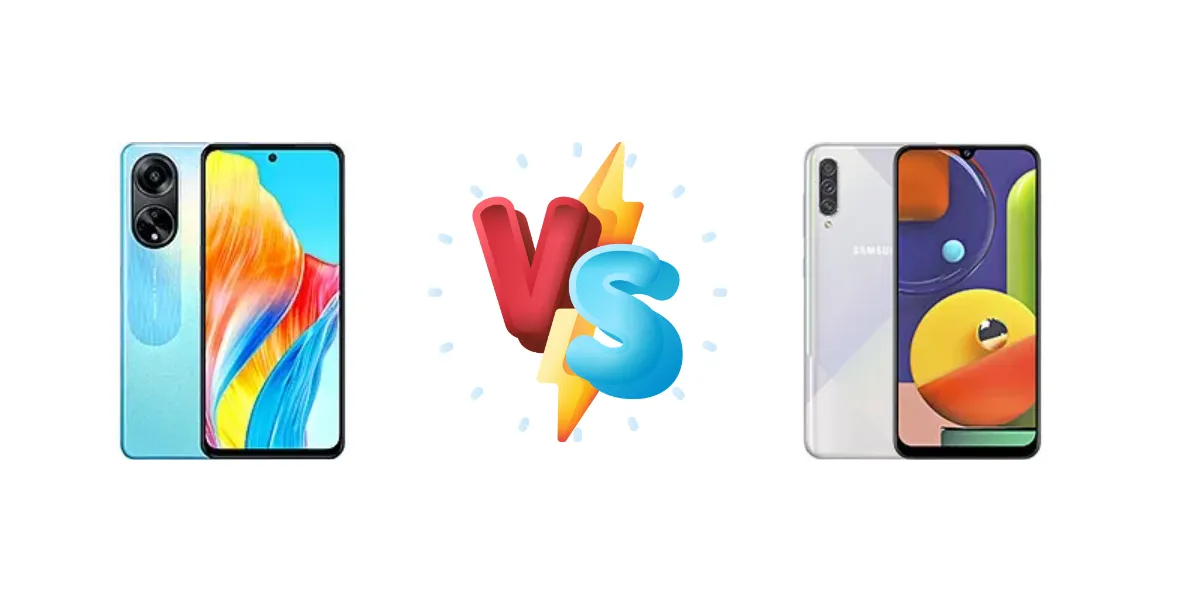
|
🏆 Quick Verdict
The Oppo A98 takes the lead with its significantly faster charging, more modern chipset, and generally improved performance. While the Galaxy A50s boasts Samsung's reliable software and a decent camera, the A98 offers a more future-proof and powerful experience for the price.
| PHONES | ||
|---|---|---|
| Phone Names | Oppo A98 | Samsung Galaxy A50s |
| Network | ||
|---|---|---|
| 2G bands | GSM 850 / 900 / 1800 / 1900 | GSM 850 / 900 / 1800 / 1900 |
| 3G bands | HSDPA 800 / 850 / 900 / 1700(AWS) / 1900 / 2100 | HSDPA 850 / 900 / 1900 / 2100 |
| 4G bands | 1, 2, 3, 4, 5, 7, 8, 12, 13, 17, 18, 19, 20, 26, 28, 32, 38, 39, 40, 41, 66 | 1, 3, 5, 7, 8, 20, 28, 38, 40, 41 |
| 5G bands | 1, 3, 5, 7, 8, 20, 28, 38, 40, 41, 66, 77, 78 SA/NSA | - |
| Speed | HSPA, LTE, 5G | HSPA, LTE |
| Technology | GSM / HSPA / LTE / 5G | GSM / HSPA / LTE |
| Launch | ||
|---|---|---|
| Announced | 2023, May 09 | 2019, August 22. Released 2019, September |
| Status | Available. Released 2023, May 19 | Discontinued |
| Body | ||
|---|---|---|
| Build | - | Glass front (Gorilla Glass 3), plastic back, plastic frame |
| Dimensions | 165.6 x 76.1 x 8.2 mm (6.52 x 3.00 x 0.32 in) | 158.5 x 74.5 x 7.7 mm (6.24 x 2.93 x 0.30 in) |
| SIM | Nano-SIM + Nano-SIM | · Nano-SIM· Nano-SIM + Nano-SIM |
| Weight | 192 g (6.77 oz) | 169 g (5.96 oz) |
| Display | ||
|---|---|---|
| Protection | - | Corning Gorilla Glass 3 |
| Resolution | 1080 x 2400 pixels, 20:9 ratio (~392 ppi density) | 1080 x 2340 pixels, 19.5:9 ratio (~403 ppi density) |
| Size | 6.72 inches, 109.0 cm2 (~86.5% screen-to-body ratio) | 6.4 inches, 100.5 cm2 (~85.1% screen-to-body ratio) |
| Type | IPS LCD, 120Hz, 550 nits (typ), 680 nits (HBM) | Super AMOLED |
| Platform | ||
|---|---|---|
| CPU | Octa-core (2x2.2 GHz Kryo 660 Gold & 6x1.7 GHz Kryo 660 Silver) | Octa-core (4x2.3 GHz Cortex-A73 & 4x1.7 GHz Cortex-A53) |
| Chipset | Qualcomm SM6375 Snapdragon 695 5G (6 nm) | Exynos 9611 (10 nm) |
| GPU | Adreno 619 | Mali-G72 MP3 |
| OS | Android 13, upgradable to Android 14, ColorOS 14 | Android 9.0 (Pie), upgradable to Android 11, One UI 3.1 |
| Memory | ||
|---|---|---|
| Card slot | microSDXC | microSDXC (dedicated slot) |
| Internal | 256GB 8GB RAM | 64GB 4GB RAM, 128GB 4GB RAM, 128GB 6GB RAM |
| UFS 2.2 | UFS 2.1 | |
| Main Camera | ||
|---|---|---|
| Dual | 64 MP, f/1.7, 26mm (wide), PDAF 2 MP, f/3.3, 34mm (microscope) Auxiliary lens | - |
| Features | LED flash, HDR, panorama | LED flash, panorama, HDR |
| Triple | - | 48 MP, f/2.0, 26mm (wide), 1/2.0", 0.8µm, PDAF 8 MP, f/2.2, 13mm (ultrawide), 1/4.0", 1.12µm Auxiliary lens |
| Video | 1080p@30fps | 4K@30fps, 1080p@30fps |
| Selfie camera | ||
|---|---|---|
| Features | Panorama | HDR |
| Single | 32 MP, f/2.4, 22mm (wide) | 32 MP, f/2.0, 25mm (wide), 1/2.8", 0.8µm |
| Video | 1080p@30fps | 4K@30fps, 1080p@30fps |
| Sound | ||
|---|---|---|
| 3.5mm jack | Yes | Yes |
| 35mm jack | Yes | Yes |
| Loudspeaker | Yes, with stereo speakers | Yes |
| Comms | ||
|---|---|---|
| Bluetooth | 5.1, A2DP, LE, aptX HD | 5.0, A2DP, LE |
| Infrared port | Yes | - |
| NFC | Yes | Yes (market/region dependent) |
| Positioning | GPS (L1), GLONASS (G1), BDS (B1I), GALILEO (E1), QZSS (L1) | GPS, GLONASS, GALILEO, BDS |
| Radio | No | FM radio |
| USB | USB Type-C 2.0, OTG | USB Type-C 2.0, OTG |
| WLAN | Wi-Fi 802.11 a/b/g/n/ac, dual-band | Wi-Fi 802.11 a/b/g/n/ac, dual-band, Wi-Fi Direct |
| Features | ||
|---|---|---|
| Sensors | Fingerprint (side-mounted), accelerometer, gyro, proximity, compass | Fingerprint (under display, optical), accelerometer, gyro, proximity, compass |
| - | ANT+ | |
| Battery | ||
|---|---|---|
| Charging | 67W wired, PD, 50% in 18 min | 15W wired |
| Type | Li-Po 5000 mAh | Li-Po 4000 mAh, non-removable |
| Misc | ||
|---|---|---|
| Colors | Cool Black, Dreamy Blue | Prism Crush Black, Prism Crush White, Prism Crush Green, Prism Crush Violet2 |
| Models | CPH2529 | SM-A507F, SM-A507FN, SM-A5070 |
| Price | About 290 EUR | About 290 EUR |
| SAR EU | - | 0.43 W/kg (head) 1.55 W/kg (body) |
| Tests | ||
|---|---|---|
| Performance | - | AnTuTu: 154761 (v7) GeekBench: 5295 (v4.4) GFXBench: 9.2fps (ES 3.1 onscreen) |
Oppo A98
- Faster Charging (67W)
- More Powerful Chipset (Snapdragon 695)
- 120Hz Display
- 5G Connectivity
- Generally Better Low-Light Camera Performance
- Software might not be as polished as Samsung's
- Design might be less premium than some competitors
Samsung Galaxy A50s
- Vibrant Super AMOLED Display
- Samsung's One UI (familiar interface)
- Reliable Brand Reputation
- Decent Camera
- Slower Charging (15W)
- Older Chipset (Exynos 9611)
- 60Hz Display
- Less Future-Proof
Display Comparison
The Oppo A98 typically features a 6.72-inch FHD+ display with a 120Hz refresh rate, offering smoother scrolling and visuals. The Galaxy A50s has a 6.4-inch Super AMOLED display, known for vibrant colors and deep blacks, but with a standard 60Hz refresh rate. While the A50s' AMOLED is visually appealing, the A98's higher refresh rate provides a more responsive feel.
Camera Comparison
The Oppo A98 generally features a 48MP main camera, along with ultrawide and macro lenses. The Galaxy A50s has a 48MP main camera, an 8MP ultrawide, and a 5MP depth sensor. Image quality is comparable in good lighting, but the A98 often exhibits better low-light performance due to its newer image processing. Video recording capabilities are also generally better on the A98.
Performance
The Oppo A98's Snapdragon 695 5G chipset (6nm) provides a noticeable performance boost over the Galaxy A50s' Exynos 9611 (10nm). The Snapdragon 695 handles multitasking and demanding apps more efficiently, and its 5G capabilities offer future-proofing. The A50s is still capable for everyday tasks, but struggles more with intensive gaming or heavy workloads.
Battery Life
The Oppo A98 typically has a 5000mAh battery, supported by 67W fast charging, allowing for a full charge in under 40 minutes. The Galaxy A50s also has a 4000mAh battery, but with a much slower 15W charging speed. The A98 offers significantly faster charging and potentially longer battery life due to its more efficient chipset.
Buying Guide
The Oppo A98 is ideal for users prioritizing performance, fast charging, and a modern design. The Samsung Galaxy A50s is a good choice for those deeply embedded in the Samsung ecosystem, valuing a familiar UI, and seeking a reliable, albeit slightly older, device.