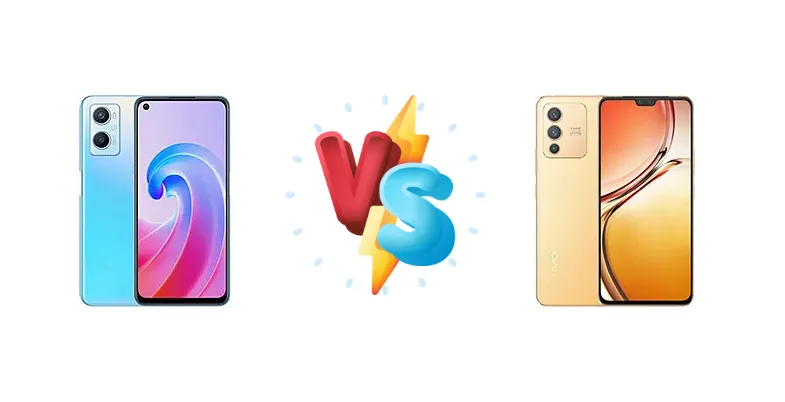
The Oppo A96 and vivo V23 5G represent distinct approaches to the mid-range smartphone market. The A96 prioritizes affordability with a Snapdragon 680 chipset, while the V23 5G aims for a more premium experience with the Mediatek Dimensity 920. This comparison dissects their key differences to help you choose the right device.
🏆 Quick Verdict
For the average user prioritizing consistent performance and 5G connectivity, the vivo V23 5G is the stronger choice. Its Dimensity 920 chipset offers a significant performance uplift over the Snapdragon 680 in the A96, justifying the potential price difference. However, the A96 remains a viable option for those on a tighter budget.
| Network |
|---|
| 2G bands | GSM 850 / 900 / 1800 / 1900 | GSM 850 / 900 / 1800 / 1900 |
| 3G bands | HSDPA 850 / 900 / 2100 | HSDPA 850 / 900 / 1700(AWS) / 1900 / 2100 |
| 4G bands | 1, 3, 5, 7, 8, 20, 28, 34, 38, 40, 41 | 1, 2, 3, 4, 5, 8, 18, 19, 26, 38, 39, 40, 41 |
| 5G bands | - | 1, 3, 38, 40, 41, 77, 78 SA/NSA |
| Speed | HSPA, LTE | HSPA, LTE, 5G |
| Technology | GSM / HSPA / LTE | GSM / HSPA / LTE / 5G |
| | IP5X (dust), IPX4 (water) resistance | 1, 3, 5, 8, 7, 20, 28, 38, 40, 41, 77, 78 SA/NSA |
| Launch |
|---|
| Announced | 2022, March 16 | 2022, January 05 |
| Status | Available. Released 2022, March 16 | Available. Released 2022, January 19 |
| Body |
|---|
| Build | Glass front, plastic frame, plastic back | Glass front (Schott Xensation Up), glass back |
| Dimensions | 164.4 x 75.7 x 8.4 mm (6.47 x 2.98 x 0.33 in) | 157.2 x 72.4 x 7.4 or 7.6 mm |
| SIM | Nano-SIM + Nano-SIM | Nano-SIM + Nano-SIM |
| Weight | 191 g (6.74 oz) | 179 g or 181 g (6.31 oz) |
| Display |
|---|
| Protection | - | Schott Xensation Up |
| Resolution | 1080 x 2412 pixels, 20:9 ratio (~401 ppi density) | 1080 x 2400 pixels, 20:9 ratio (~409 ppi density) |
| Size | 6.59 inches, 104.5 cm2 (~84.0% screen-to-body ratio) | 6.44 inches, 100.1 cm2 (~88.0% screen-to-body ratio) |
| Type | IPS LCD, 90Hz, 480 nits (typ), 600 nits (HBM) | AMOLED, 90Hz, HDR10+ |
| Platform |
|---|
| CPU | Octa-core (4x2.4 GHz Kryo 265 Gold & 4x1.9 GHz Kryo 265 Silver) | Octa-core (2x2.5 GHz Cortex-A78 & 6x2.0 GHz Cortex-A55) |
| Chipset | Qualcomm SM6225 Snapdragon 680 4G (6 nm) | Mediatek Dimensity 920 (6 nm) |
| GPU | Adreno 610 | Mali-G68 MC4 |
| OS | Android 11, ColorOS 11.1 | Android 12, upgradable to Android 14, Funtouch 14 |
| Memory |
|---|
| Card slot | microSDXC (dedicated slot) | No |
| Internal | 128GB 6GB RAM, 128GB 8GB RAM, 256GB 8GB RAM | 128GB 8GB RAM, 256GB 12GB RAM |
| | UFS 2.2 | - |
| Main Camera |
|---|
| Dual | 50 MP, f/1.8, 27mm (wide), PDAF
Auxiliary lens | 50 MP, f/2.0, (wide), AF
8 MP, f/2.3, 105˚ (ultrawide) |
| Features | LED flash, HDR, panorama | Dual-LED flash, HDR, panorama |
| Single | 16 MP, f/2.0, 26mm (wide) | - |
| Triple | - | 64 MP, f/1.9, 26mm (wide), PDAF
8 MP, f/2.2, 120˚, 16mm (ultrawide), 1/4.0", 1.12µm
2 MP (macro) |
| Video | 1080p@30fps | 4K@30fps, 1080p@30fps, gyro-EIS |
| Selfie camera |
|---|
| Dual | - | 50 MP, f/2.0, (wide), AF
8 MP, f/2.3, 105˚ (ultrawide) |
| Features | - | Dual-LED dual-tone flash, HDR |
| Single | 16 MP, f/2.0, 26mm (wide) | - |
| Video | 1080p@30fps | 4K@30fps, 1080p@30fps |
| Sound |
|---|
| 3.5mm jack | Yes | No |
| 35mm jack | Yes | No |
| Loudspeaker | Yes | Yes |
| | - | 24-bit/192kHz audio |
| Comms |
|---|
| Bluetooth | 5.0, A2DP, LE, aptX HD | 5.2, A2DP, LE, aptX HD |
| NFC | Yes (market/region dependent) | Yes (market/region dependent) |
| Positioning | GPS, GLONASS, BDS, GALILEO, QZSS | GPS, GLONASS, BDS, GALILEO, QZSS, NavIC |
| Radio | No | No |
| USB | USB Type-C 2.0, OTG | USB Type-C, OTG |
| WLAN | Wi-Fi 802.11 a/b/g/n/ac, dual-band, Wi-Fi Direct | Wi-Fi 802.11 a/b/g/n/ac, Wi-Fi 6 (market dependent), dual-band, Wi-Fi Direct |
| Features |
|---|
| Sensors | Fingerprint (side-mounted), accelerometer, proximity, compass | Fingerprint (under display, optical), accelerometer, gyro, proximity, compass |
| | - | Color changing back panel when exposed to sunlight |
| Battery |
|---|
| Charging | 33W wired, PD, 50% in 26 min
Reverse wired | 44W wired, 68% in 30 min |
| Type | Li-Po 5000 mAh | 4200 mAh |
| Misc |
|---|
| Colors | Starry Black, Sunset Blue | Sunshine Gold, Stardust Black |
| Models | CPH2333 | V2130, V2303 |
| Price | About 560 EUR | About 280 EUR |
| SAR | - | 1.08 W/kg (head) 0.72 W/kg (body) |
| Tests |
|---|
| Battery life | - |
Endurance rating 103h
|
| Camera | - |
Photo / Video |
| Display | - |
Contrast ratio: Infinite (nominal) |
| Loudspeaker | - |
-28.5 LUFS (Average)
|
| Performance | - |
AnTuTu: 406498 (v8), 476058 (v9)
GeekBench: 8421 (v4.4), 2140 (v5.1)
GFXBench: 22fps (ES 3.1 onscreen) |
Oppo A96
- More affordable price point
- Reverse wired charging capability
- Decent battery life for basic usage
- Significantly weaker processor performance
- Likely lacks 5G connectivity
- Potentially lower quality display
vivo V23 5G
- Faster and more powerful Dimensity 920 chipset
- Brighter and potentially higher quality display
- Faster 44W charging
- Higher price tag
- No reverse wired charging
- Battery life is similar to the A96 despite faster charging
Display Comparison
The vivo V23 5G boasts a brighter display, reaching a measured 629 nits, compared to an unspecified brightness for the Oppo A96. While both utilize 6nm chipsets, the V23’s brighter panel will offer superior visibility outdoors. The V23 5G’s ‘Infinite’ contrast ratio (nominal) suggests a typical AMOLED panel, providing deep blacks and vibrant colors, a feature likely absent in the A96, which is expected to use an LCD panel based on its price point. Bezels are not specified for either device, but the V23 5G’s marketing emphasizes a sleek design, hinting at narrower borders.
Camera Comparison
Both phones offer photo and video capabilities, but details are limited. The vivo V23 5G likely benefits from Mediatek’s Imagiq 760 ISP, offering advanced image processing features. Without sensor size information, it’s difficult to make a definitive judgment. However, vivo typically focuses on selfie cameras, and the V23 5G likely excels in this area. The Oppo A96’s camera system is expected to be more basic, prioritizing affordability over advanced features. We can assume the V23 5G will offer better low-light performance and more versatile shooting modes.
Performance
The core difference lies in the chipsets: the Oppo A96 features the Qualcomm Snapdragon 680, while the vivo V23 5G utilizes the Mediatek Dimensity 920. The Dimensity 920, with its 2x2.5 GHz Cortex-A78 cores and 6x2.0 GHz Cortex-A55 cores, significantly outperforms the Snapdragon 680’s 4x2.4 GHz Kryo 265 Gold and 4x1.9 GHz Kryo 265 Silver configuration in CPU-intensive tasks. This translates to faster app loading times, smoother multitasking, and a more enjoyable gaming experience on the V23 5G. Both are built on a 6nm process, but the Dimensity 920’s architecture provides a clear advantage. RAM specifications are not provided, but faster LPDDR5 RAM would further benefit the V23 5G.
Battery Life
Both devices share an endurance rating of 103 hours, suggesting similar real-world battery life despite differing charging speeds. The vivo V23 5G’s 44W charging is significantly faster than the Oppo A96’s 33W charging, achieving 68% charge in 30 minutes versus 50% in 26 minutes for the A96. While the A96 charges slightly faster initially, the V23 5G’s higher wattage will likely complete a full charge quicker overall. The A96 also offers reverse wired charging, a feature absent in the provided specs for the V23 5G.
Buying Guide
Buy the Oppo A96 if you need a reliable, affordable smartphone for everyday tasks like calling, texting, and social media, and 5G isn't a priority. Its 33W charging and decent battery life will keep you going. Buy the vivo V23 5G if you prefer a smoother, more responsive experience for gaming, multitasking, and content creation, and you want the benefits of 5G connectivity. The brighter display and potentially better camera system further enhance its appeal.
Frequently Asked Questions
❓ Does the Mediatek Dimensity 920 in the vivo V23 5G get noticeably hot during extended gaming sessions?
While the Dimensity 920 is a powerful chip, Mediatek has made strides in thermal efficiency with its 6nm process. The V23 5G’s thermal management system should prevent significant overheating during typical gaming sessions. However, prolonged, graphically demanding games may still cause some warmth, which is normal.
❓ Is the 33W charging on the Oppo A96 sufficient for overnight charging, or will I need to plug it in for extended periods?
33W charging is adequate for overnight charging. While not as fast as the V23 5G’s 44W, it will fully charge the A96 overnight, even with moderate usage during the day. The 50% charge in 26 minutes is useful for quick top-ups.
❓ How does the Snapdragon 680 handle multitasking compared to the Dimensity 920?
The Snapdragon 680 will struggle with heavy multitasking compared to the Dimensity 920. The Dimensity 920’s more powerful cores and architecture allow it to handle multiple apps and processes simultaneously without significant slowdowns. The A96 may exhibit lag or app reloading when switching between numerous applications.