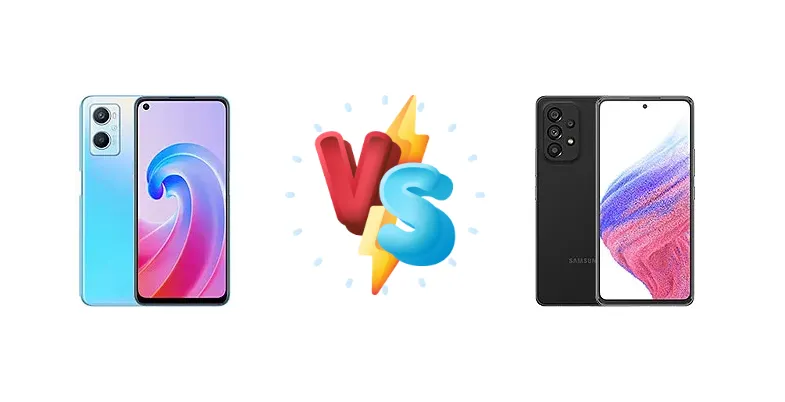
The mid-range smartphone market is fiercely competitive, with the Oppo A96 and Samsung Galaxy A53 5G vying for attention. The A96 focuses on efficiency and fast charging, while the A53 5G prioritizes a vibrant display and 5G connectivity. This comparison dissects their key differences to help you choose the right device for your needs.
🏆 Quick Verdict
For the average user prioritizing efficiency and rapid charging, the Oppo A96 emerges as the winner. Its Snapdragon 680 chipset, coupled with 33W charging, offers a smoother daily experience and quicker top-ups. However, the Galaxy A53 5G is a strong contender for those needing 5G and a brighter screen.
| Network |
|---|
| 2G bands | GSM 850 / 900 / 1800 / 1900 | GSM 850 / 900 / 1800 / 1900 |
| 3G bands | HSDPA 850 / 900 / 2100 | HSDPA 850 / 900 / 1700(AWS) / 1900 / 2100 |
| 4G bands | 1, 3, 5, 7, 8, 20, 28, 34, 38, 40, 41 | 1, 2, 3, 4, 5, 7, 12, 14, 20, 29, 30, 38, 39, 40, 41, 46, 48, 66 - SM-A536U |
| 5G bands | - | 2, 5, 41, 66, 77, 78 SA/NSA/Sub6/mmWave - SM-A536U |
| Speed | HSPA, LTE | HSPA, LTE, 5G |
| Technology | GSM / HSPA / LTE | GSM / HSPA / LTE / 5G |
| | IP5X (dust), IPX4 (water) resistance | 2, 5, 48, 66, 77, 78, 260, 261 SA/NSA/Sub6/mmWave - SM-A536V |
| Launch |
|---|
| Announced | 2022, March 16 | 2022, March 17 |
| Status | Available. Released 2022, March 16 | Available. Released 2022, March 24 |
| Body |
|---|
| Build | Glass front, plastic frame, plastic back | Glass front (Gorilla Glass 5), plastic frame, plastic back |
| Dimensions | 164.4 x 75.7 x 8.4 mm (6.47 x 2.98 x 0.33 in) | 159.6 x 74.8 x 8.1 mm (6.28 x 2.94 x 0.32 in) |
| SIM | Nano-SIM + Nano-SIM | · Nano-SIM· Nano-SIM + Nano-SIM |
| Weight | 191 g (6.74 oz) | 189 g (6.67 oz) |
| | - | IP67 dust/water resistant (up to 1m for 30 min) |
| Display |
|---|
| Protection | - | Corning Gorilla Glass 5 |
| Resolution | 1080 x 2412 pixels, 20:9 ratio (~401 ppi density) | 1080 x 2400 pixels, 20:9 ratio (~405 ppi density) |
| Size | 6.59 inches, 104.5 cm2 (~84.0% screen-to-body ratio) | 6.5 inches, 102.0 cm2 (~85.4% screen-to-body ratio) |
| Type | IPS LCD, 90Hz, 480 nits (typ), 600 nits (HBM) | Super AMOLED, 120Hz, 800 nits (HBM) |
| Platform |
|---|
| CPU | Octa-core (4x2.4 GHz Kryo 265 Gold & 4x1.9 GHz Kryo 265 Silver) | Octa-core (2x2.4 GHz Cortex-A78 & 6x2.0 GHz Cortex-A55) |
| Chipset | Qualcomm SM6225 Snapdragon 680 4G (6 nm) | Exynos 1280 (5 nm) |
| GPU | Adreno 610 | Mali-G68 |
| OS | Android 11, ColorOS 11.1 | Android 12, up to 4 major Android upgrades, One UI 8 |
| Memory |
|---|
| Card slot | microSDXC (dedicated slot) | microSDXC (uses shared SIM slot) |
| Internal | 128GB 6GB RAM, 128GB 8GB RAM, 256GB 8GB RAM | 128GB 4GB RAM, 128GB 6GB RAM, 128GB 8GB RAM, 256GB 6GB RAM, 256GB 8GB RAM |
| | UFS 2.2 | - |
| Main Camera |
|---|
| Dual | 50 MP, f/1.8, 27mm (wide), PDAF
Auxiliary lens | - |
| Features | LED flash, HDR, panorama | LED flash, panorama, HDR |
| Quad | - | 64 MP, f/1.8, 26mm (wide), 1/1.7X", 0.8µm, PDAF, OIS
12 MP, f/2.2, 123˚ (ultrawide), 1.12µm
5 MP (macro)
Auxiliary lens |
| Single | 16 MP, f/2.0, 26mm (wide) | 32 MP, f/2.2, 26mm (wide), 1/2.8", 0.8µm |
| Video | 1080p@30fps | 4K@30fps, 1080p@30/60fps; gyro-EIS |
| Selfie camera |
|---|
| Features | - | HDR |
| Single | 16 MP, f/2.0, 26mm (wide) | 32 MP, f/2.2, 26mm (wide), 1/2.8", 0.8µm |
| Video | 1080p@30fps | 4K@30fps, 1080p@30fps |
| Sound |
|---|
| 3.5mm jack | Yes | No |
| 35mm jack | Yes | No |
| Loudspeaker | Yes | Yes, with stereo speakers |
| Comms |
|---|
| Bluetooth | 5.0, A2DP, LE, aptX HD | 5.1, A2DP, LE |
| NFC | Yes (market/region dependent) | Yes (market/region dependent) |
| Positioning | GPS, GLONASS, BDS, GALILEO, QZSS | GPS, GLONASS, GALILEO, BDS |
| Radio | No | No |
| USB | USB Type-C 2.0, OTG | USB Type-C 2.0, OTG |
| WLAN | Wi-Fi 802.11 a/b/g/n/ac, dual-band, Wi-Fi Direct | Wi-Fi 802.11 a/b/g/n/ac, dual-band, Wi-Fi Direct |
| Features |
|---|
| Sensors | Fingerprint (side-mounted), accelerometer, proximity, compass | Fingerprint (under display, optical), accelerometer, gyro, compass, barometer (market/region dependent) |
| | - | Virtual proximity sensing |
| Battery |
|---|
| Charging | 33W wired, PD, 50% in 26 min
Reverse wired | 25W wired |
| Type | Li-Po 5000 mAh | Li-Po 5000 mAh |
| Misc |
|---|
| Colors | Starry Black, Sunset Blue | Black, White, Blue, Peach |
| Models | CPH2333 | SM-A536B, SM-A536B/DS, SM-A536U, SM-A536U1, SM-A5360, SM-A536E, SM-A536E/DS, SM-A536V, SM-A536W, SM-A536N, SM-S536DL |
| Price | About 560 EUR | $ 151.42 / £ 185.00 / € 169.14 |
| SAR | - | 0.75 W/kg (head) 1.58 W/kg (body) |
| SAR EU | - | 0.89 W/kg (head) 1.60 W/kg (body) |
| Tests |
|---|
| Battery life | - |
Endurance rating 113h
|
| Camera | - |
Photo / Video |
| Display | - |
Contrast ratio: Infinite (nominal) |
| Loudspeaker | - |
-26.5 LUFS (Good)
|
| Performance | - |
AnTuTu: 329802 (v8), 379313 (v9)
GeekBench: 1891 (v5.1)
GFXBench: 19fps (ES 3.1 onscreen) |
Oppo A96
- Faster 33W charging with PD
- More efficient Snapdragon 680 chipset
- Potentially better value for money
- Likely less vibrant display
- No 5G connectivity
Samsung Galaxy A53 5G
- Brighter 830 nit display
- 5G connectivity for faster data speeds
- Samsung’s established camera software
- Slower 25W charging
- Exynos 1280 may run hotter under load
Display Comparison
The Samsung Galaxy A53 5G boasts a significantly brighter display, reaching a measured 830 nits, compared to the Oppo A96’s unspecified brightness. This makes the A53 5G more usable outdoors under direct sunlight. While the A53 5G claims an 'Infinite' contrast ratio, this is a marketing term; the actual contrast performance will depend on the panel technology. The A96’s display specs are less detailed, suggesting a more standard LCD panel, potentially impacting color accuracy and viewing angles. The A53's larger screen size also contributes to a more immersive viewing experience.
Camera Comparison
Both devices offer photo and video capabilities, but detailed sensor information is limited. The Galaxy A53 5G likely benefits from Samsung’s image processing expertise, potentially delivering more vibrant and detailed photos. The Oppo A96’s camera performance will likely be more reliant on software algorithms to compensate for potentially less advanced hardware. Without specific sensor size or aperture details, it’s difficult to definitively declare a winner, but Samsung’s history suggests a more refined camera experience. The inclusion of OIS (Optical Image Stabilization) on the A53 5G, if present, would be a significant advantage for video recording and low-light photography.
Performance
The Samsung Galaxy A53 5G utilizes the Exynos 1280 (5nm), featuring a more powerful CPU configuration with 2x2.4 GHz Cortex-A78 cores and 6x2.0 GHz Cortex-A55 cores. This contrasts with the Oppo A96’s Snapdragon 680 (6nm) which has 4x2.4 GHz Kryo 265 Gold and 4x1.9 GHz Kryo 265 Silver cores. The 5nm fabrication process of the Exynos 1280 generally leads to better power efficiency and thermal performance compared to the 6nm Snapdragon 680, though real-world performance will depend on software optimization. The A53 5G’s potential for smoother multitasking and more demanding applications is higher, but the A96’s Snapdragon 680 is optimized for efficiency, potentially leading to longer battery life during less intensive tasks.
Battery Life
Both the Oppo A96 and Samsung Galaxy A53 5G share an endurance rating of 113 hours, indicating similar overall battery life. However, the charging speeds differ significantly. The Oppo A96 supports 33W wired charging with PD, claiming a 50% charge in 26 minutes, while the Galaxy A53 5G is limited to 25W wired charging. This faster charging speed on the A96 provides a substantial convenience advantage, allowing for quicker top-ups throughout the day. While both have similar endurance, the A96’s charging speed is a clear win.
Buying Guide
Buy the Oppo A96 if you need a reliable daily driver with excellent battery life and fast charging, and don't heavily rely on 5G connectivity. It's ideal for users who prioritize efficiency and value. Buy the Samsung Galaxy A53 5G if you prefer a brighter, more vibrant display, require 5G access, and are willing to trade some charging speed for those features. It's geared towards media consumers and those wanting future-proof connectivity.
Frequently Asked Questions
❓ Does the Exynos 1280 in the Galaxy A53 5G tend to overheat during prolonged gaming sessions?
While the Exynos 1280 is a capable chip, it has been known to exhibit some thermal throttling under sustained heavy loads, like extended gaming. The 5nm process helps, but the A53’s design may not prioritize optimal heat dissipation. Expect some performance dips after prolonged use.
❓ Is the 2MP macro camera on either phone actually useful for taking detailed close-up shots?
Generally, 2MP macro cameras on phones in this price range are of limited utility. The low resolution results in images lacking detail and sharpness. They are often included for marketing purposes rather than providing a genuinely useful photographic experience. Expect soft, grainy results.
❓ Can the Samsung Galaxy A53 5G reliably maintain 60fps in demanding games like PUBG Mobile?
The Galaxy A53 5G can achieve 60fps in PUBG Mobile, but you'll likely need to lower the graphics settings to medium or low to maintain a stable frame rate. The Exynos 1280 is capable, but pushing for ultra settings may result in frame drops and stuttering.
❓ How does the Oppo A96's Snapdragon 680 handle everyday tasks like browsing, social media, and video streaming?
The Snapdragon 680 is well-suited for everyday tasks. It provides a smooth and responsive experience for browsing, social media, and video streaming. Its efficiency also contributes to excellent battery life during these less demanding activities.