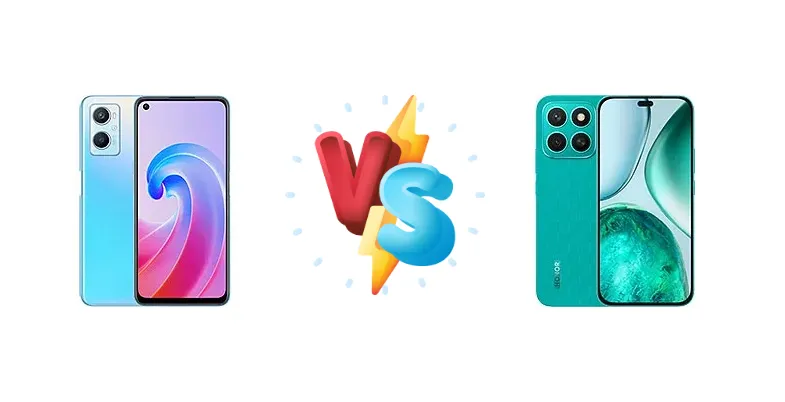
The Oppo A96 and Honor X8c represent a competitive segment of the smartphone market – affordable 4G devices aimed at everyday users. Both leverage Qualcomm's Snapdragon 6-series, but subtle differences in chipset and charging capabilities could sway your decision. This comparison dives deep into the specs to determine which phone delivers the best value.
🏆 Quick Verdict
For most users, the Honor X8c emerges as the slightly better choice. While both phones share a similar price point, the Snapdragon 685 offers a noticeable performance boost over the A96’s Snapdragon 680, making it more responsive for daily tasks and light gaming. The 35W charging is also a plus.
| Network |
|---|
| 2G bands | GSM 850 / 900 / 1800 / 1900 | GSM 850 / 900 / 1800 / 1900 |
| 3G bands | HSDPA 850 / 900 / 2100 | HSDPA 850 / 900 / 1900 / 2100 |
| 4G bands | 1, 3, 5, 7, 8, 20, 28, 34, 38, 40, 41 | LTE |
| Speed | HSPA, LTE | HSPA, LTE |
| Technology | GSM / HSPA / LTE | GSM / HSPA / LTE |
| | IP5X (dust), IPX4 (water) resistance | - |
| Launch |
|---|
| Announced | 2022, March 16 | 2025, January 14 |
| Status | Available. Released 2022, March 16 | Available. Released 2025, January 20 |
| Body |
|---|
| Build | Glass front, plastic frame, plastic back | Glass front, plastic frame, plastic back or silicone polymer back (eco leather) |
| Dimensions | 164.4 x 75.7 x 8.4 mm (6.47 x 2.98 x 0.33 in) | 161.1 x 74.6 x 7.1 mm (6.34 x 2.94 x 0.28 in) |
| SIM | Nano-SIM + Nano-SIM | Nano-SIM + Nano-SIM |
| Weight | 191 g (6.74 oz) | 174 g (6.14 oz) |
| Display |
|---|
| Resolution | 1080 x 2412 pixels, 20:9 ratio (~401 ppi density) | 1080 x 2412 pixels, 20:9 ratio (~394 ppi density) |
| Size | 6.59 inches, 104.5 cm2 (~84.0% screen-to-body ratio) | 6.7 inches, 108.0 cm2 (~89.9% screen-to-body ratio) |
| Type | IPS LCD, 90Hz, 480 nits (typ), 600 nits (HBM) | AMOLED, 120Hz, 1200 nits (HBM), 2800 nits (peak) |
| Platform |
|---|
| CPU | Octa-core (4x2.4 GHz Kryo 265 Gold & 4x1.9 GHz Kryo 265 Silver) | Octa-core (4x2.8 GHz Cortex-A73 & 4x1.9 GHz Cortex-A53) |
| Chipset | Qualcomm SM6225 Snapdragon 680 4G (6 nm) | Qualcomm SM6225 Snapdragon 685 (6 nm) |
| GPU | Adreno 610 | Adreno 610 |
| OS | Android 11, ColorOS 11.1 | Android 15, MagicOS 9 |
| Memory |
|---|
| Card slot | microSDXC (dedicated slot) | No |
| Internal | 128GB 6GB RAM, 128GB 8GB RAM, 256GB 8GB RAM | 128GB 6GB RAM, 128GB 8GB RAM, 256GB 8GB RAM, 512GB 8GB RAM |
| | UFS 2.2 | - |
| Main Camera |
|---|
| Dual | 50 MP, f/1.8, 27mm (wide), PDAF
Auxiliary lens | 108 MP, f/1.8, 24mm (wide), 1/1.67", PDAF, OIS
5 MP, f/2.2, (ultrawide) |
| Features | LED flash, HDR, panorama | LED flash, HDR, panorama |
| Single | 16 MP, f/2.0, 26mm (wide) | - |
| Video | 1080p@30fps | 1080p@30fps, gyro-EIS |
| Selfie camera |
|---|
| Single | 16 MP, f/2.0, 26mm (wide) | 50 MP, f/2.1, (wide) |
| Video | 1080p@30fps | 1080p@30fps |
| Sound |
|---|
| 3.5mm jack | Yes | - |
| 35mm jack | Yes | No |
| Loudspeaker | Yes | Yes |
| Comms |
|---|
| Bluetooth | 5.0, A2DP, LE, aptX HD | 5.0/5.1, A2DP, LE |
| NFC | Yes (market/region dependent) | Yes (market/region dependent) |
| Positioning | GPS, GLONASS, BDS, GALILEO, QZSS | GPS, GLONASS, GALILEO, BDS |
| Radio | No | No |
| USB | USB Type-C 2.0, OTG | USB Type-C 2.0, OTG |
| WLAN | Wi-Fi 802.11 a/b/g/n/ac, dual-band, Wi-Fi Direct | Wi-Fi 802.11 a/b/g/n/ac, dual-band, Wi-Fi Direct |
| Features |
|---|
| Sensors | Fingerprint (side-mounted), accelerometer, proximity, compass | Fingerprint (under display, optical), accelerometer, gyro, compass, proximity (ultrasonic) |
| Battery |
|---|
| Charging | 33W wired, PD, 50% in 26 min
Reverse wired | 35W wired |
| Type | Li-Po 5000 mAh | Li-Po 5000 mAh |
| Misc |
|---|
| Colors | Starry Black, Sunset Blue | Marrs Green, Midnight Black, Moonlight White, Cloud Purple |
| Models | CPH2333 | ABR-LX1, ABR-LX2, ABR-LX3 |
| Price | About 560 EUR | € 190.78 / $ 213.42 / £ 159.00 |
Oppo A96
- PD charging compatibility offers wider charger options.
- Established brand with a history of software support.
- Potentially more refined software experience (depending on ColorOS version).
- Slower CPU performance compared to the Snapdragon 685.
- Slightly slower charging speed (33W vs 35W).
Honor X8c
- Faster Snapdragon 685 processor for improved performance.
- Faster 35W wired charging for quicker top-ups.
- Potentially better value for money due to performance advantage.
- Honor's software update track record is less established than Oppo's.
- May lack PD charging compatibility.
Display Comparison
Neither Oppo nor Honor provide detailed display specifications beyond the basic panel type. Assuming both utilize IPS LCDs, the user experience will be similar in terms of color accuracy and viewing angles. The absence of high refresh rates (90Hz or 120Hz) is typical for this price bracket. Bezels are likely comparable, and peak brightness will be a key differentiator, though data is unavailable. Without specific nit ratings, it's difficult to declare a clear winner.
Camera Comparison
Detailed camera specs are missing, but both phones likely feature a primary camera and depth/macro sensors. Without knowing sensor sizes or apertures, a direct comparison is challenging. Image processing algorithms will play a crucial role, and Honor and Oppo typically employ different styles. The absence of Optical Image Stabilization (OIS) on either device suggests image quality will be heavily reliant on software processing, particularly in low-light conditions. The 2MP macro cameras found on many phones in this segment are unlikely to deliver significant detail.
Performance
The core difference lies in the chipsets. The Honor X8c’s Snapdragon 685, with its 4x2.8 GHz Cortex-A73 cores, offers a significant CPU performance advantage over the Oppo A96’s Snapdragon 680 (4x2.4 GHz Kryo 265 Gold). While both are 6nm chips, the Cortex-A73 architecture is more efficient and powerful than the Kryo 265 Gold. This translates to snappier app launches, smoother multitasking, and better performance in demanding applications. Both phones likely share similar RAM configurations, but the chipset difference is the defining factor. The GPU performance will also be slightly better on the X8c.
Battery Life
Battery capacity is not specified, but both phones likely house batteries in the 5000mAh range, typical for this price point. The Honor X8c’s 35W wired charging is faster than the Oppo A96’s 33W charging, allowing for a quicker top-up. The Oppo A96 supports PD (Power Delivery), offering wider compatibility with chargers, while the X8c also offers fast charging. The 35W charging on the X8c can achieve a 50% charge in a shorter timeframe (estimated around 30-40 minutes) compared to the A96’s 26 minutes to 50%.
Buying Guide
Buy the Oppo A96 if you prioritize a brand with a longer track record in software updates and a slightly more established ecosystem. Buy the Honor X8c if you value raw performance for the price and faster charging speeds, making it ideal for users who frequently consume media or play mobile games.
Frequently Asked Questions
❓ Will the Snapdragon 685 in the Honor X8c handle demanding games like PUBG Mobile?
The Snapdragon 685 is capable of running PUBG Mobile, but you'll likely need to lower the graphics settings to medium or low to achieve a consistently smooth frame rate. It's not a gaming powerhouse, but it's a step up from the Snapdragon 680 in the Oppo A96 for gaming performance.
❓ Does the Oppo A96 or Honor X8c support 5G connectivity?
No, both the Oppo A96 and Honor X8c are 4G-only devices. They utilize the Snapdragon 680 and 685 chipsets, respectively, which do not include 5G modems. If 5G connectivity is a priority, you'll need to consider other smartphones.
❓ How does the software experience differ between Oppo's ColorOS and Honor's Magic UI?
ColorOS (Oppo) is generally known for its feature-rich interface and customization options, while Magic UI (Honor) aims for a cleaner, more streamlined experience. Both are based on Android, but they offer distinct visual styles and pre-installed apps. Oppo has a longer track record of software updates, which may be a consideration.
❓ Is the 35W charging on the Honor X8c significantly faster in real-world use?
Yes, the 35W charging on the Honor X8c will noticeably reduce charging times compared to the Oppo A96's 33W charging. While both offer fast charging, the X8c will likely reach a full charge faster, especially from a low battery percentage.