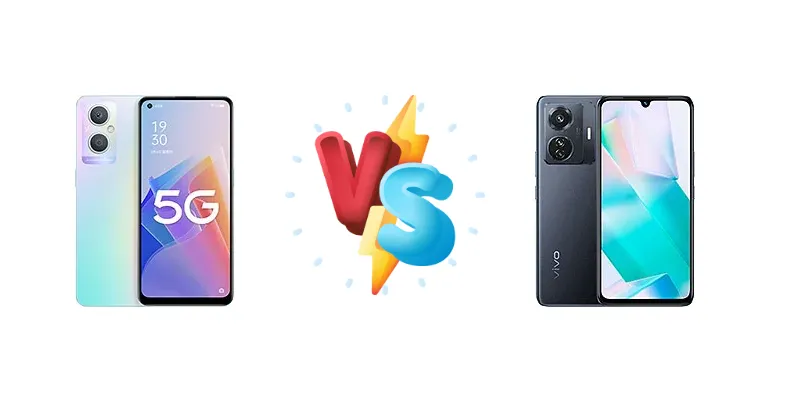
Both the Oppo A96 (China variant) and the vivo T1 Pro target the competitive mid-range smartphone market, but they take different approaches. The A96 focuses on a balance of features at a potentially lower price point, while the T1 Pro prioritizes performance with a more powerful chipset and faster charging. This comparison dissects the key differences to determine which phone delivers the best value.
🏆 Quick Verdict
For most users, the vivo T1 Pro is the superior choice. Its Snapdragon 778G 5G chipset provides a noticeable performance uplift over the A96’s Snapdragon 695, translating to smoother multitasking and better gaming. While the A96 offers reverse wired charging, the T1 Pro’s significantly faster 66W charging outweighs this benefit.
| Network |
|---|
| 2G bands | GSM 850 / 900 / 1800 / 1900 | GSM 850 / 900 / 1800 / 1900 |
| 3G bands | HSDPA 800 / 850 / 900 / 1700(AWS) / 1900 / 2100 | HSDPA 850 / 900 / 2100 |
| 4G bands | 1, 3, 5, 7, 8, 28, 34, 38, 39, 40, 41 | 1, 3, 5, 8, 38, 40, 41 |
| 5G bands | 1, 8, 28, 41, 77, 78 SA/NSA | 1, 3, 5, 8, 41, 77, 78 SA/NSA |
| Speed | HSPA, LTE, 5G | HSPA, LTE, 5G |
| Technology | GSM / CDMA / HSPA / EVDO / LTE / 5G | GSM / HSPA / LTE / 5G |
| | CDMA2000 1xEV-DO | - |
| Launch |
|---|
| Announced | 2022, January 12 | 2022, May 04 |
| Status | Available. Released 2022, January 12 | Available. Released 2022, May 07 |
| Body |
|---|
| Build | - | Glass front, plastic frame, plastic back |
| Dimensions | 159.9 x 73.2 x 7.5 mm (6.30 x 2.88 x 0.30 in) | 159.7 x 73.6 x 8.5 mm (6.29 x 2.90 x 0.33 in) |
| SIM | Nano-SIM + Nano-SIM | Nano-SIM + Nano-SIM |
| Weight | 171 g (6.03 oz) | 180.3 g (6.35 oz) |
| Display |
|---|
| Resolution | 1080 x 2400 pixels, 20:9 ratio (~409 ppi density) | 1080 x 2404 pixels, 20:9 ratio (~409 ppi density) |
| Size | 6.43 inches, 99.8 cm2 (~85.3% screen-to-body ratio) | 6.44 inches, 100.0 cm2 (~85.1% screen-to-body ratio) |
| Type | OLED, 430 nits (typ), 600 nits (HDR) | AMOLED, HDR10+, 1300 nits (peak) |
| Platform |
|---|
| CPU | Octa-core (2x2.2 GHz Kryo 660 Gold & 6x1.7 GHz Kryo 660 Silver) | Octa-core (1x2.4 GHz Cortex-A78 & 3x2.2 GHz Cortex-A78 & 4x1.9 GHz Cortex-A55) |
| Chipset | Qualcomm SM6375 Snapdragon 695 5G (6 nm) | Qualcomm SM7325 Snapdragon 778G 5G (6 nm) |
| GPU | Adreno 619 | Adreno 642L |
| OS | Android 11, ColorOS 12 | Android 12, Funtouch 12 |
| Memory |
|---|
| Card slot | microSDXC | No |
| Internal | 128GB 8GB RAM, 256GB 8GB RAM, 256GB 12GB RAM | 128GB 6GB RAM, 128GB 8GB RAM |
| | UFS 2.2 | - |
| Main Camera |
|---|
| Dual | 48 MP, f/1.7, 26mm (wide), PDAF
Auxiliary lens | - |
| Features | LED flash, HDR, panorama | Dual-LED dual-tone flash, HDR, panorama |
| Single | 16 MP, f/2.4, 27mm (wide), 1.0µm | 16 MP, f/2.0, (wide) |
| Triple | - | 64 MP, f/1.8, 26mm (wide), PDAF
8 MP, f/2.2, 117˚ (ultrawide)
2 MP (macro) |
| Video | 1080p@30fps, gyro-EIS | 1080p@30fps, gyro-EIS |
| Selfie camera |
|---|
| Features | HDR | - |
| Single | 16 MP, f/2.4, 27mm (wide), 1.0µm | 16 MP, f/2.0, (wide) |
| Video | 1080p@30fps | 1080p@30fps |
| Sound |
|---|
| 3.5mm jack | Yes | No |
| 35mm jack | Yes | No |
| Loudspeaker | Yes | Yes |
| | - | 24-bit/192kHz audio |
| Comms |
|---|
| Bluetooth | 5.1, A2DP, LE, aptX HD | 5.2, A2DP, LE |
| NFC | No | No |
| Positioning | GPS, GLONASS, BDS, GALILEO, QZSS | GPS, GLONASS, GALILEO, BDS |
| Radio | No | No |
| USB | USB Type-C 2.0, OTG | USB Type-C 2.0, OTG |
| WLAN | Wi-Fi 802.11 a/b/g/n/ac, dual-band, Wi-Fi Direct | Wi-Fi 802.11 a/b/g/n/ac, dual-band, Wi-Fi Direct |
| Features |
|---|
| Sensors | Fingerprint (under display, optical), accelerometer, gyro, proximity, compass | Fingerprint (under display, optical), accelerometer, gyro, proximity, compass |
| Battery |
|---|
| Charging | 33W wired, PD, 100% in 63 min
Reverse wired | 66W wired, 50% in 18 min |
| Type | Li-Po 4500 mAh | 4700 mAh |
| Misc |
|---|
| Colors | Black, Blue, Pink | Turbo Black, Turbo Cyan |
| Models | PFUM10 | V2151 |
| Price | About 280 EUR | About 300 EUR |
Oppo A96 (China)
- Potentially lower price point
- Reverse wired charging for accessories
- Efficient Snapdragon 695 5G chipset
- Significantly slower charging speed
- Less powerful CPU and GPU
- Likely less refined camera processing
vivo T1 Pro
- Faster Snapdragon 778G 5G chipset
- Significantly faster 66W charging
- Improved image processing capabilities
- Likely higher price
- No reverse wireless charging
- Potentially higher power consumption
Display Comparison
Neither device's display specifications are provided, so we must infer. Given the price bracket, both likely feature LCD panels with FHD+ resolution. However, the T1 Pro, being positioned slightly higher, may benefit from a higher peak brightness and potentially a more refined color calibration. The absence of details like refresh rate or PWM dimming frequency makes a direct comparison impossible, but users sensitive to flicker should investigate PWM rates if available.
Camera Comparison
Without specific camera sensor details, a direct comparison is limited. However, the T1 Pro’s higher overall processing power suggests better image processing capabilities. The Snapdragon 778G’s ISP (Image Signal Processor) is more advanced than the 695’s, potentially leading to improved dynamic range, noise reduction, and overall image quality. It’s reasonable to assume the T1 Pro will offer a more versatile and capable camera system, even if the megapixel counts are similar. The absence of OIS information is a key omission; its presence on either device would be a significant advantage.
Performance
The core difference lies in the chipsets. The vivo T1 Pro’s Snapdragon 778G 5G (6nm) is a substantial upgrade over the Oppo A96’s Snapdragon 695 5G (6nm). The 778G features a prime Cortex-A78 core clocked at 2.4 GHz, alongside three additional A78 cores at 2.2 GHz, and four efficiency cores. This contrasts with the A96’s dual 2.2 GHz Kryo 660 Gold cores and six 1.7 GHz Kryo 660 Silver cores. The 778G’s more powerful CPU architecture and higher clock speeds will result in significantly faster app loading times, smoother multitasking, and improved gaming performance. The GPU within the 778G also offers a considerable advantage. While both use 6nm fabrication, the 778G’s architecture is more efficient and powerful.
Battery Life
The Oppo A96 offers 33W wired charging, claiming a full charge in 63 minutes, and includes reverse wired charging. The vivo T1 Pro, however, boasts a significantly faster 66W wired charging, reaching 50% charge in just 18 minutes. While battery capacity isn’t specified for either device, the T1 Pro’s charging speed is a major advantage for users who prioritize quick top-ups. The A96’s reverse charging is a niche feature, useful for charging accessories, but unlikely to be a deciding factor for most buyers. The faster charging of the T1 Pro effectively mitigates any potential disadvantage from a slightly smaller battery capacity.
Buying Guide
Buy the Oppo A96 (China) if you prioritize a potentially lower entry price and value reverse wireless charging for topping up accessories. Buy the vivo T1 Pro if you demand a more responsive user experience, enjoy mobile gaming, and appreciate significantly faster charging speeds – even if it means spending a bit more.
Frequently Asked Questions
❓ Will the Snapdragon 695 in the Oppo A96 struggle with demanding games like Genshin Impact?
Yes, the Snapdragon 695 is a mid-range chipset and will likely require significant graphics settings reductions to achieve playable frame rates in demanding titles like Genshin Impact. The vivo T1 Pro’s Snapdragon 778G offers a much smoother gaming experience with higher graphical fidelity.
❓ How much faster is the 66W charging on the vivo T1 Pro compared to the Oppo A96 in real-world use?
The 66W charging on the T1 Pro is substantially faster. While the A96 takes over an hour for a full charge, the T1 Pro can reach 50% in just 18 minutes. This translates to significantly less time tethered to a charger, especially beneficial for users who frequently need to top up their battery.
❓ Does the Oppo A96's reverse wired charging work with all devices, including laptops?
The Oppo A96's reverse wired charging is primarily intended for smaller accessories like earbuds or smartwatches. While it *may* provide a trickle charge to some laptops, it's unlikely to significantly impact their battery level and is not a recommended charging method.