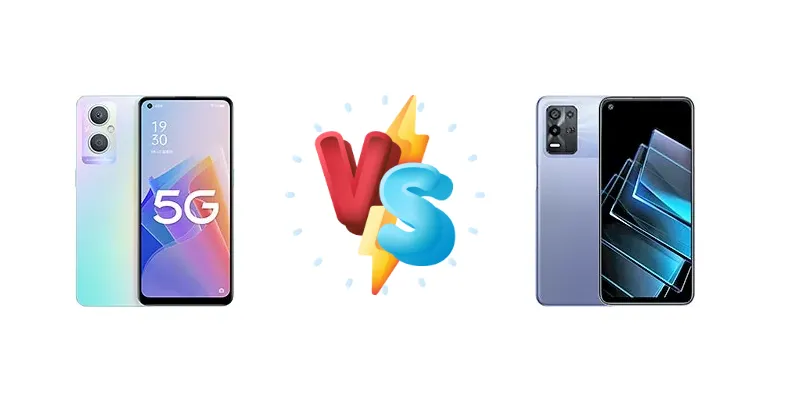
Oppo's A96 (China) and K9x represent compelling options in the increasingly crowded mid-range 5G smartphone market. While both aim for affordability, they diverge in their core processing power, relying on Qualcomm's Snapdragon 695 and MediaTek's Dimensity 810 respectively. This comparison dissects these key differences, alongside battery performance and charging capabilities, to determine which device delivers the best value.
🏆 Quick Verdict
For the average user prioritizing consistent performance and potentially better long-term software support, the Oppo K9x emerges as the stronger choice. Its Dimensity 810 chipset offers a noticeable CPU performance advantage, making it more responsive for everyday tasks and gaming, despite similar charging speeds.
| Network |
|---|
| 2G bands | GSM 850 / 900 / 1800 / 1900 | GSM 850 / 900 / 1800 / 1900 |
| 3G bands | HSDPA 800 / 850 / 900 / 1700(AWS) / 1900 / 2100 | HSDPA 800 / 850 / 900 / 1700(AWS) / 1900 / 2100 |
| 4G bands | 1, 3, 5, 7, 8, 28, 34, 38, 39, 40, 41 | 1, 2, 3, 5, 7, 8, 28, 34, 38, 39, 40, 41 |
| 5G bands | 1, 8, 28, 41, 77, 78 SA/NSA | 1, 28, 41, 77, 78 SA/NSA |
| Speed | HSPA, LTE, 5G | HSPA, LTE, 5G |
| Technology | GSM / CDMA / HSPA / EVDO / LTE / 5G | GSM / CDMA / HSPA / CDMA2000 / LTE / 5G |
| | CDMA2000 1xEV-DO | CDMA2000 1x |
| Launch |
|---|
| Announced | 2022, January 12 | 2021, December 23 |
| Status | Available. Released 2022, January 12 | Available. Released 2021, December 27 |
| Body |
|---|
| Dimensions | 159.9 x 73.2 x 7.5 mm (6.30 x 2.88 x 0.30 in) | 162.2 x 74.8 x 8.8 mm (6.39 x 2.94 x 0.35 in) |
| SIM | Nano-SIM + Nano-SIM | Nano-SIM + Nano-SIM |
| Weight | 171 g (6.03 oz) | 194 g (6.84 oz) |
| Display |
|---|
| Protection | - | Aluminosilicate glass |
| Resolution | 1080 x 2400 pixels, 20:9 ratio (~409 ppi density) | 1080 x 2400 pixels, 20:9 ratio (~405 ppi density) |
| Size | 6.43 inches, 99.8 cm2 (~85.3% screen-to-body ratio) | 6.49 inches, 102.2 cm2 (~84.2% screen-to-body ratio) |
| Type | OLED, 430 nits (typ), 600 nits (HDR) | IPS LCD, 90Hz, 480 nits (typ), 600 nits (HBM) |
| Platform |
|---|
| CPU | Octa-core (2x2.2 GHz Kryo 660 Gold & 6x1.7 GHz Kryo 660 Silver) | Octa-core (2x2.4 GHz Cortex-A76 & 6x2.0 GHz Cortex-A55) |
| Chipset | Qualcomm SM6375 Snapdragon 695 5G (6 nm) | Mediatek Dimensity 810 (6 nm) |
| GPU | Adreno 619 | Mali-G57 MC2 |
| OS | Android 11, ColorOS 12 | Android 11, ColorOS 11.1 |
| Memory |
|---|
| Card slot | microSDXC | microSDXC |
| Internal | 128GB 8GB RAM, 256GB 8GB RAM, 256GB 12GB RAM | 128GB 6GB RAM, 128GB 8GB RAM, 256GB 8GB RAM, 256GB 12GB RAM, 512GB 12GB RAM |
| | UFS 2.2 | UFS 2.2 |
| Main Camera |
|---|
| Dual | 48 MP, f/1.7, 26mm (wide), PDAF
Auxiliary lens | - |
| Features | LED flash, HDR, panorama | LED flash, HDR, panorama |
| Single | 16 MP, f/2.4, 27mm (wide), 1.0µm | 16 MP, f/2.0, 26mm (wide), 1/3.0”, 1.0µm |
| Triple | - | 64 MP, f/1.7, 26mm (wide), 1/1.97”, 0.7µm, PDAF
2 MP (macro)
Auxiliary lens |
| Video | 1080p@30fps, gyro-EIS | 1080p@30fps, gyro-EIS |
| Selfie camera |
|---|
| Features | HDR | - |
| Single | 16 MP, f/2.4, 27mm (wide), 1.0µm | 16 MP, f/2.0, 26mm (wide), 1/3.0”, 1.0µm |
| Video | 1080p@30fps | 1080p@30fps |
| Sound |
|---|
| 3.5mm jack | Yes | Yes |
| 35mm jack | Yes | Yes |
| Loudspeaker | Yes | Yes |
| Comms |
|---|
| Bluetooth | 5.1, A2DP, LE, aptX HD | 5.1, A2DP, LE, aptX |
| NFC | No | No |
| Positioning | GPS, GLONASS, BDS, GALILEO, QZSS | GPS, GLONASS, GALILEO, BDS |
| Radio | No | No |
| USB | USB Type-C 2.0, OTG | USB Type-C 2.0, OTG |
| WLAN | Wi-Fi 802.11 a/b/g/n/ac, dual-band, Wi-Fi Direct | Wi-Fi 802.11 a/b/g/n/ac, dual-band, Wi-Fi Direct |
| Features |
|---|
| Sensors | Fingerprint (under display, optical), accelerometer, gyro, proximity, compass | Fingerprint (side-mounted), accelerometer, gyro, proximity, compass |
| Battery |
|---|
| Charging | 33W wired, PD, 100% in 63 min
Reverse wired | 33W wired, 50% in 27 min
Reverse wired |
| Type | Li-Po 4500 mAh | Li-Po 5000 mAh |
| Misc |
|---|
| Colors | Black, Blue, Pink | Black, Blue |
| Models | PFUM10 | PGCM10 |
| Price | About 280 EUR | About 190 EUR |
Oppo A96 (China)
- Qualcomm’s 5G modem integration for potentially wider network compatibility.
- Established brand reputation for software support (potentially).
- 33W charging with full charge time specified.
- Less powerful Snapdragon 695 chipset compared to Dimensity 810.
- Potentially slower CPU performance for demanding tasks.
- Limited display information suggests a basic LCD experience.
Oppo K9x
- More powerful MediaTek Dimensity 810 chipset for smoother performance.
- Faster initial charging speed (50% in 27 minutes).
- Potentially better value for performance-focused users.
- MediaTek chipsets sometimes receive less frequent software updates.
- Limited display information suggests a basic LCD experience.
- Thermal throttling potential under sustained load.
Display Comparison
Both devices lack detailed display specifications in the provided data. However, given their market positioning, we can infer both likely utilize LCD panels. The absence of information regarding refresh rates suggests a standard 60Hz experience on both. The real-world impact will be similar, with neither offering the visual fidelity of higher-end AMOLED displays.
Camera Comparison
Without detailed camera specifications, a direct comparison is limited. Both phones likely feature a multi-camera setup geared towards social media sharing. The absence of information regarding sensor size or optical image stabilization (OIS) suggests both rely on software processing for image enhancement. The inclusion of a 2MP macro camera on either device is likely a marketing feature with limited practical benefit due to the small sensor size and lack of detail capture. Image quality will likely be comparable, with differences stemming from Oppo’s image processing algorithms.
Performance
The core difference lies in the chipsets. The Oppo K9x’s MediaTek Dimensity 810, with its 2x2.4 GHz Cortex-A76 cores, boasts a higher peak CPU clock speed compared to the Oppo A96’s Qualcomm Snapdragon 695 (2x2.2 GHz Kryo 660 Gold). This translates to faster application loading times and smoother multitasking. While both are 6nm chips, the Dimensity 810’s Cortex-A76 cores represent a more modern and efficient architecture than the Kryo 660 Gold. The K9x will likely exhibit better sustained performance under load, though thermal throttling remains a potential concern for both. The Snapdragon 695 benefits from Qualcomm’s 5G modem integration, but the performance gap is more pronounced in CPU-intensive tasks.
Battery Life
Both the Oppo A96 (China) and K9x feature 33W wired charging, with the A96 claiming a full charge in 63 minutes and the K9x reaching 50% in 27 minutes. This suggests the K9x may charge slightly faster overall, despite the same wattage. The actual battery capacity is not specified, but given the similar price points and features, they likely house batteries of comparable size (around 5000mAh). The faster initial charge of the K9x is beneficial for users needing a quick power boost, while the A96’s full charge time is adequate for overnight charging.
Buying Guide
Buy the Oppo A96 (China) if you prioritize a brand known for consistent software updates and are comfortable with a slightly less powerful processor for basic usage. Buy the Oppo K9x if you prefer a more capable chipset for smoother multitasking, gaming, and a generally snappier user experience, even if it means potentially less frequent software updates.
Frequently Asked Questions
❓ Will the Dimensity 810 in the Oppo K9x overheat during prolonged gaming sessions?
While the Dimensity 810 is a capable chipset, it's not immune to thermal throttling. The extent of throttling will depend on Oppo’s thermal management solution within the K9x. Expect some performance reduction after extended gaming, but it should still provide a playable experience. The Snapdragon 695 in the A96 may throttle similarly, potentially offering a more consistent, albeit lower, frame rate.
❓ Does the Oppo A96 (China) support carrier aggregation for improved 5G speeds?
The Snapdragon 695 typically supports carrier aggregation, which combines multiple frequency bands for faster data speeds. However, the specific bands supported will vary depending on the region and carrier. Check with your local carrier to confirm compatibility and supported bands for optimal 5G performance with the Oppo A96.
❓ Is the 33W charging on both phones compatible with Power Delivery (PD) chargers?
The Oppo A96 (China) explicitly states support for PD charging. The K9x also supports 33W wired charging, and while not explicitly stated, Oppo often implements PD compatibility across its devices. Using a PD charger should result in faster and more efficient charging for both phones.