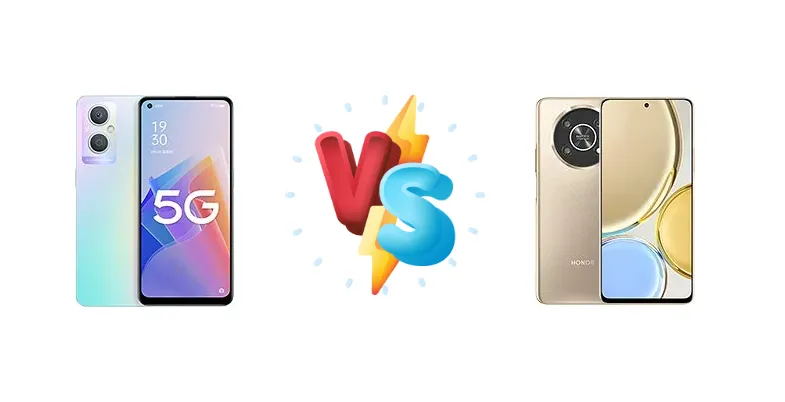
Both the Oppo A96 (China variant) and the Honor X30 target the competitive mid-range 5G market, relying on the Qualcomm Snapdragon 695 5G chipset. However, they diverge significantly in charging speed, a crucial factor for users prioritizing convenience. This comparison dissects the nuances beyond the shared processor to determine which device delivers the best overall experience.
🏆 Quick Verdict
For the average user, the Honor X30 emerges as the stronger choice. While both phones share the same Snapdragon 695 5G, the X30’s 66W charging – capable of reaching 80% in just 30 minutes – provides a substantial usability advantage over the Oppo A96’s 33W charging, which takes 63 minutes for a full charge.
| Network |
|---|
| 2G bands | GSM 850 / 900 / 1800 / 1900 | GSM 850 / 900 / 1800 / 1900 |
| 3G bands | HSDPA 800 / 850 / 900 / 1700(AWS) / 1900 / 2100 | HSDPA 850 / 900 / 1700(AWS) / 1900 / 2100 |
| 4G bands | 1, 3, 5, 7, 8, 28, 34, 38, 39, 40, 41 | LTE |
| 5G bands | 1, 8, 28, 41, 77, 78 SA/NSA | SA/NSA |
| Speed | HSPA, LTE, 5G | HSPA, LTE, 5G |
| Technology | GSM / CDMA / HSPA / EVDO / LTE / 5G | GSM / CDMA / HSPA / CDMA2000 / LTE / 5G |
| | CDMA2000 1xEV-DO | CDMA2000 1x |
| Launch |
|---|
| Announced | 2022, January 12 | 2021, December 16 |
| Status | Available. Released 2022, January 12 | Available. Released 2021, December 25 |
| Body |
|---|
| Dimensions | 159.9 x 73.2 x 7.5 mm (6.30 x 2.88 x 0.30 in) | 166.1 x 75.8 x 8.1 mm (6.54 x 2.98 x 0.32 in) |
| SIM | Nano-SIM + Nano-SIM | Nano-SIM + Nano-SIM |
| Weight | 171 g (6.03 oz) | 189 g (6.67 oz) |
| Display |
|---|
| Resolution | 1080 x 2400 pixels, 20:9 ratio (~409 ppi density) | 1080 x 2388 pixels (~385 ppi density) |
| Size | 6.43 inches, 99.8 cm2 (~85.3% screen-to-body ratio) | 6.81 inches, 112.3 cm2 (~89.2% screen-to-body ratio) |
| Type | OLED, 430 nits (typ), 600 nits (HDR) | IPS LCD, 120Hz |
| Platform |
|---|
| CPU | Octa-core (2x2.2 GHz Kryo 660 Gold & 6x1.7 GHz Kryo 660 Silver) | Octa-core (2x2.2 GHz Kryo 660 Gold & 6x1.7 GHz Kryo 660 Silver) |
| Chipset | Qualcomm SM6375 Snapdragon 695 5G (6 nm) | Qualcomm SM6375 Snapdragon 695 5G (6 nm) |
| GPU | Adreno 619 | Adreno 619 |
| OS | Android 11, ColorOS 12 | Android 11, Magic UI 5.0 |
| Memory |
|---|
| Card slot | microSDXC | No |
| Internal | 128GB 8GB RAM, 256GB 8GB RAM, 256GB 12GB RAM | 128GB 6GB RAM, 128GB 8GB RAM, 256GB 8GB RAM, 256GB 12GB RAM |
| | UFS 2.2 | - |
| Main Camera |
|---|
| Dual | 48 MP, f/1.7, 26mm (wide), PDAF
Auxiliary lens | - |
| Features | LED flash, HDR, panorama | LED flash, panorama, HDR |
| Single | 16 MP, f/2.4, 27mm (wide), 1.0µm | 16 MP, f/2.5 |
| Triple | - | 48 MP, f/1.8, 26mm (wide), PDAF
2 MP (macro)
Auxiliary lens |
| Video | 1080p@30fps, gyro-EIS | 1080p@30fps |
| Selfie camera |
|---|
| Features | HDR | - |
| Single | 16 MP, f/2.4, 27mm (wide), 1.0µm | 16 MP, f/2.5 |
| Video | 1080p@30fps | 1080p@30fps |
| Sound |
|---|
| 3.5mm jack | Yes | No |
| 35mm jack | Yes | No |
| Loudspeaker | Yes | Yes |
| Comms |
|---|
| Bluetooth | 5.1, A2DP, LE, aptX HD | 5.1, A2DP, LE |
| NFC | No | No |
| Positioning | GPS, GLONASS, BDS, GALILEO, QZSS | GPS, GLONASS, BDS |
| Radio | No | No |
| USB | USB Type-C 2.0, OTG | USB Type-C 2.0, OTG |
| WLAN | Wi-Fi 802.11 a/b/g/n/ac, dual-band, Wi-Fi Direct | Wi-Fi 802.11 a/b/g/n/ac, dual-band, Wi-Fi Direct |
| Features |
|---|
| Sensors | Fingerprint (under display, optical), accelerometer, gyro, proximity, compass | Fingerprint (side-mounted), accelerometer, gyro, proximity, compass |
| Battery |
|---|
| Charging | 33W wired, PD, 100% in 63 min
Reverse wired | 66W wired, 80% in 30 min |
| Type | Li-Po 4500 mAh | Li-Po 4800 mAh |
| Misc |
|---|
| Colors | Black, Blue, Pink | Black, Blue, Silver, Gold |
| Models | PFUM10 | ANY-AN00 |
| Price | About 280 EUR | About 210 EUR |
Oppo A96 (China)
- Potentially lower price point
- Qualcomm Snapdragon 695 5G provides 5G connectivity
- Reverse wired charging offers added convenience
- Slower 33W charging
- Missing detailed display and camera specifications
- Potential for thermal throttling under sustained load
Honor X30
- Significantly faster 66W charging
- Qualcomm Snapdragon 695 5G provides 5G connectivity
- Likely optimized software for efficient power management
- Potentially higher price compared to Oppo A96
- Missing detailed display and camera specifications
- Potential for thermal throttling under sustained load
Display Comparison
Neither Oppo nor Honor provide display specifications beyond resolution in their marketing materials. Given the price point, both likely utilize LCD panels. The absence of high refresh rates (90Hz or 120Hz) is expected. The real-world impact will be similar viewing experiences, with color accuracy and peak brightness being the differentiating factors, but without data, we can only speculate. Bezels are likely comparable, aiming for maximizing screen real estate within the budget constraints.
Camera Comparison
Detailed camera specifications are lacking for both devices. The focus should be on the main sensor's megapixel count and aperture. Without this information, it’s difficult to assess image quality. The inclusion of 2MP macro or depth sensors is common in this segment but offers limited practical benefit. Image processing algorithms will play a significant role in differentiating the final image output, but without sample photos, it’s impossible to compare.
Performance
Both the Oppo A96 and Honor X30 are powered by the Qualcomm Snapdragon 695 5G (6nm). This chipset features an octa-core configuration with 2x 2.2 GHz Kryo 660 Gold and 6x 1.7 GHz Kryo 660 Silver cores. Performance will be virtually identical for everyday tasks and moderate gaming. The 6nm process node offers reasonable power efficiency, but sustained workloads could lead to thermal throttling. RAM configuration (LPDDR4X or LPDDR5) is unknown, but impacts multitasking performance; LPDDR5 would provide a noticeable advantage.
Battery Life
The battery capacity is not specified for either device. However, the charging speed is a clear differentiator. The Honor X30’s 66W wired charging is significantly faster than the Oppo A96’s 33W charging. The X30 can reach 80% charge in 30 minutes, while the A96 requires 63 minutes for a full charge. This difference is substantial for users who frequently need to quickly replenish their battery. Even with a slightly smaller battery capacity, the Honor X30’s faster charging mitigates range anxiety.
Buying Guide
Buy the Oppo A96 (China) if you prioritize a potentially lower initial cost and are comfortable with slower charging speeds. It’s a solid option for users who primarily charge overnight or don’t frequently deplete their battery. Buy the Honor X30 if you value rapid charging and convenience. The 66W charging is a game-changer for those who need quick top-ups throughout the day, making it ideal for busy individuals and travelers.
Frequently Asked Questions
❓ Will the Snapdragon 695 5G in the Honor X30 struggle with demanding games like PUBG Mobile?
The Snapdragon 695 5G is a capable chipset for mid-range gaming, but it's not a powerhouse. PUBG Mobile will be playable at medium settings with reasonable frame rates. However, expect some frame drops during intense action sequences, especially after prolonged gaming sessions due to potential thermal throttling. Lowering graphics settings will improve stability.
❓ How much faster is the 66W charging on the Honor X30 compared to the 33W charging on the Oppo A96 in real-world use?
The difference is substantial. The Honor X30 can reach 80% charge in approximately 30 minutes, while the Oppo A96 takes over an hour to fully charge. This means you can add a significant amount of battery life to the X30 during a quick coffee break, whereas the A96 requires a much longer charging period.
❓ Does the Honor X30 support VoLTE and VoWiFi for improved call quality?
While not explicitly stated, Honor devices generally support VoLTE and VoWiFi in regions where these technologies are deployed by carriers. It's advisable to check compatibility with your specific carrier before purchasing.