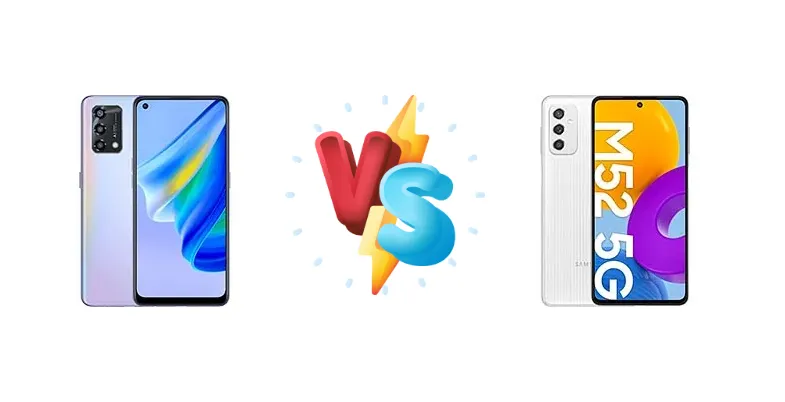
The mid-range 5G smartphone market is fiercely competitive, and the Oppo A95 and Samsung Galaxy M52 5G represent compelling options for budget-conscious buyers. While both aim to deliver 5G connectivity and a modern smartphone experience, they diverge significantly in their core hardware, particularly in chipset choice. This comparison dissects these differences to determine which device offers the best value and performance.
🏆 Quick Verdict
For most users, the Samsung Galaxy M52 5G is the superior choice. Its Snapdragon 778G chipset provides a substantial performance uplift over the Oppo A95’s Snapdragon 662, translating to smoother multitasking, faster app loading, and a more enjoyable gaming experience. While the Oppo A95 offers faster wired charging, the M52 5G’s brighter display and more powerful processor make it the better all-rounder.
| Network |
|---|
| 2G bands | GSM 850 / 900 / 1800 / 1900 | GSM 850 / 900 / 1800 / 1900 |
| 3G bands | HSDPA 850 / 900 / 2100 | HSDPA 850 / 900 / 1700(AWS) / 1900 / 2100 |
| 4G bands | 1, 3, 5, 7, 8, 20, 28, 38, 40, 41 | 1, 2, 3, 4, 5, 7, 8, 12, 17, 20, 26, 28, 38, 40, 41, 66 |
| 5G bands | - | SA/NSA/Sub6 |
| Speed | HSPA, LTE | HSPA, LTE, 5G |
| Technology | GSM / HSPA / LTE | GSM / HSPA / LTE / 5G |
| Launch |
|---|
| Announced | 2021, November 16 | 2021, September 24 |
| Status | Available. Released 2021, November 16 | Available. Released 2021, October 03 |
| Body |
|---|
| Build | - | Glass front (Gorilla Glass 5), plastic frame, plastic back |
| Dimensions | 160.3 x 73.8 x 8 mm (6.31 x 2.91 x 0.31 in) | 164.2 x 76.4 x 7.4 mm (6.46 x 3.01 x 0.29 in) |
| SIM | Nano-SIM + Nano-SIM | Nano-SIM + Nano-SIM |
| Weight | 175 g (6.17 oz) | 173 g (6.10 oz) |
| Display |
|---|
| Protection | - | Corning Gorilla Glass 5 |
| Resolution | 1080 x 2400 pixels, 20:9 ratio (~409 ppi density) | 1080 x 2400 pixels, 20:9 ratio (~393 ppi density) |
| Size | 6.43 inches, 99.8 cm2 (~84.4% screen-to-body ratio) | 6.7 inches, 108.4 cm2 (~86.4% screen-to-body ratio) |
| Type | AMOLED, 430 nits (typ), 800 nits (peak) | Super AMOLED Plus, 120Hz |
| Platform |
|---|
| CPU | Octa-core (4x2.0 GHz Kryo 260 Gold & 4x1.8 GHz Kryo 260 Silver) | Octa-core (1x2.4 GHz Cortex-A78 & 3x2.2 GHz Cortex-A78 & 4x1.9 GHz Cortex-A55) |
| Chipset | Qualcomm SM6115 Snapdragon 662 (11 nm) | Qualcomm SM7325 Snapdragon 778G 5G (6 nm) |
| GPU | Adreno 610 | Adreno 642L |
| OS | Android 11, ColorOS 11.1 | Android 11, upgradable to Android 13, One UI 5.1 |
| Memory |
|---|
| Card slot | microSDXC | microSDXC (uses shared SIM slot) |
| Internal | 128GB 8GB RAM, 256GB 8GB RAM | 128GB 6GB RAM, 128GB 8GB RAM |
| Main Camera |
|---|
| Features | LED flash, HDR, panorama | LED flash, panorama, HDR |
| Single | 16 MP, f/2.4, 27mm (wide), 1/3.06", 1.0µm | 32 MP, f/2.2, 26mm (wide) |
| Triple | 48 MP, f/1.7, 26mm (wide), 1/2.0", 0.8µm, PDAF
2 MP (macro)
Auxiliary lens | 64 MP, f/1.8, 26mm (wide), 1/1.97", 0.7um, PDAF
12 MP, f/2.2, 123˚, (ultrawide), 1/3.06", 1.12µm
5 MP (macro) |
| Video | 1080p@30fps | 4K@30fps, 1080p@30/60fps |
| Selfie camera |
|---|
| Single | 16 MP, f/2.4, 27mm (wide), 1/3.06", 1.0µm | 32 MP, f/2.2, 26mm (wide) |
| Video | 1080p@30fps | 4K@30fps, 1080p@30fps |
| Sound |
|---|
| 3.5mm jack | Yes | No |
| 35mm jack | Yes | No |
| Loudspeaker | Yes | Yes |
| Comms |
|---|
| Bluetooth | 5.0, A2DP, LE, aptX | 5.0, A2DP, LE |
| NFC | No | Yes |
| Positioning | GPS, GLONASS, GALILEO, BDS | GPS, GLONASS, GALILEO, BDS, QZSS |
| Radio | Unspecified | Unspecified |
| USB | USB Type-C 2.0, OTG | USB Type-C 2.0, OTG |
| WLAN | Wi-Fi 802.11 a/b/g/n/ac, dual-band, Wi-Fi Direct | Wi-Fi 802.11 a/b/g/n/ac/6, dual-band, Wi-Fi Direct |
| Features |
|---|
| Sensors | Fingerprint (under display, optical), accelerometer, gyro, proximity, compass | Fingerprint (side-mounted), accelerometer, gyro, proximity, compass |
| Battery |
|---|
| Charging | 33W wired, 54% in 30 min | 25W wired |
| Type | Li-Po 5000 mAh | Li-Ion 5000 mAh |
| Misc |
|---|
| Colors | Glowing Starry Black, Glowing Rainbow Silver | Icy Blue, Blazing Black, White |
| Models | CHP2365, CPH2365 | SM-M526BR, SM-M526BR/DS, SM-M526B, SM-M526B/DS |
| Price | About 230 EUR | About 300 EUR |
| SAR EU | - | 0.79 W/kg (head) 1.40 W/kg (body) |
| Tests |
|---|
| Battery life | - |
Endurance rating 123h
|
| Camera | - |
Photo / Video |
| Display | - |
Contrast ratio: Infinite (nominal) |
| Loudspeaker | - |
-30.0 LUFS (Average)
|
| Performance | - |
AnTuTu: 504424 (v9)
GeekBench: 2796 (v5.1)
GFXBench: 28fps (ES 3.1 onscreen) |
Oppo A95
- Faster 33W wired charging
- Potentially more affordable price point
- Sufficient for basic smartphone tasks
- Significantly weaker Snapdragon 662 processor
- Likely lower display quality (LCD vs AMOLED)
- Less capable camera system
Samsung Galaxy M52 5G
- Powerful Snapdragon 778G 5G processor
- Brighter and likely higher-quality display
- More advanced ISP for better image processing
- Slower 25W wired charging
- Potentially higher price
- Similar battery endurance to the A95
Display Comparison
The Samsung Galaxy M52 5G boasts a significantly brighter display, reaching a measured peak brightness of 777 nits, compared to an unspecified brightness for the Oppo A95. This higher brightness ensures excellent visibility outdoors, even in direct sunlight. While both displays are described as having an 'infinite' contrast ratio (typical for AMOLED panels), the M52 5G’s superior brightness is a clear advantage. Details regarding the A95’s panel technology (LCD vs AMOLED) are missing, but given the price point, it’s likely an LCD, which would further widen the gap in visual quality.
Camera Comparison
Both devices feature photo and video capabilities, but specific details regarding sensor size, aperture, and image processing are lacking for both. However, the Snapdragon 778G in the M52 5G includes a more advanced Image Signal Processor (ISP), enabling better image processing, noise reduction, and dynamic range. Without detailed camera specs, it’s difficult to definitively declare a winner, but the M52 5G’s superior chipset suggests a more capable camera system overall. The presence of a 2MP macro camera on either device is unlikely to significantly impact image quality.
Performance
The core difference between these two phones lies in their chipsets. The Samsung Galaxy M52 5G is powered by the Qualcomm Snapdragon 778G 5G (6nm), featuring a 1x2.4 GHz Cortex-A78 prime core and 3x2.2 GHz Cortex-A78 performance cores, alongside 4x1.9 GHz Cortex-A55 efficiency cores. This architecture, built on a more efficient 6nm process, delivers significantly higher performance than the Oppo A95’s Snapdragon 662 (11nm). The 662’s octa-core configuration (4x2.0 GHz Kryo 260 Gold & 4x1.8 GHz Kryo 260 Silver) is geared towards efficiency rather than raw power. The 778G’s superior CPU and GPU will result in noticeably faster app loading times, smoother multitasking, and a more enjoyable gaming experience on the M52 5G.
Battery Life
Both the Oppo A95 and Samsung Galaxy M52 5G achieve an endurance rating of 123 hours, suggesting comparable battery life in typical usage scenarios. However, the Oppo A95 compensates with significantly faster 33W wired charging, achieving 54% charge in 30 minutes, while the M52 5G is limited to 25W. This means the A95 can top up its battery more quickly, but the overall endurance is similar. The 6nm process of the Snapdragon 778G in the M52 5G may also contribute to slightly better power efficiency under heavy load.
Buying Guide
Buy the Oppo A95 if you prioritize fast charging and are primarily focused on basic smartphone tasks like calling, texting, and light social media use. Its Snapdragon 662 is sufficient for these everyday activities. Buy the Samsung Galaxy M52 5G if you demand a smoother, more responsive experience, enjoy mobile gaming, or frequently consume multimedia content. The Snapdragon 778G delivers a significant performance advantage, justifying the slightly slower charging speed.
Frequently Asked Questions
❓ Does the Snapdragon 778G in the Samsung M52 5G get noticeably hot during extended gaming sessions?
The Snapdragon 778G is known for its efficiency, and while it will generate heat during prolonged gaming, its 6nm process and optimized architecture help to mitigate thermal throttling. The M52 5G’s thermal design should be adequate for most gaming scenarios, offering a sustained level of performance that the Snapdragon 662 in the A95 simply cannot match.
❓ Is the 25W charging on the Samsung M52 5G slow compared to other phones in this price range?
While 33W charging is becoming increasingly common, 25W is still a respectable charging speed. The M52 5G’s large battery (size unspecified, but endurance rating suggests substantial capacity) will still charge reasonably quickly, and the difference in charging time compared to 33W is unlikely to be significant for most users. The performance benefits of the 778G outweigh the slightly slower charging.
❓ How does the Oppo A95 perform with multitasking and running multiple apps simultaneously?
The Oppo A95’s Snapdragon 662 is a capable processor for basic multitasking, but it will struggle with demanding applications or a large number of apps running concurrently. Users who frequently switch between apps or use resource-intensive software will likely experience lag and slowdowns. The M52 5G’s Snapdragon 778G offers a much smoother multitasking experience.