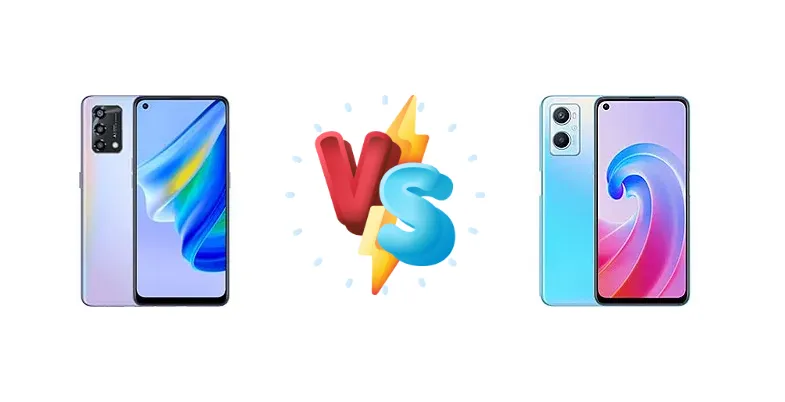
Oppo's A-series consistently delivers impressive value in the budget smartphone market. The A95 and A96 are two strong contenders, offering a blend of features and affordability. But which one is the better choice for your needs? Let's dive into a detailed comparison.
🏆 Quick Verdict
The Oppo A96 edges out the A95 thanks to its more efficient 6nm Snapdragon 680 chipset, slightly faster charging, and reverse wired charging. While both offer solid value, the A96 provides a noticeable performance and efficiency boost, making it the preferred pick for most users.
| Network |
|---|
| 2G bands | GSM 850 / 900 / 1800 / 1900 | GSM 850 / 900 / 1800 / 1900 |
| 3G bands | HSDPA 850 / 900 / 2100 | HSDPA 850 / 900 / 2100 |
| 4G bands | 1, 3, 5, 7, 8, 20, 28, 38, 40, 41 | 1, 3, 5, 7, 8, 20, 28, 34, 38, 40, 41 |
| Speed | HSPA, LTE | HSPA, LTE |
| Technology | GSM / HSPA / LTE | GSM / HSPA / LTE |
| | - | IP5X (dust), IPX4 (water) resistance |
| Launch |
|---|
| Announced | 2021, November 16 | 2022, March 16 |
| Status | Available. Released 2021, November 16 | Available. Released 2022, March 16 |
| Body |
|---|
| Build | - | Glass front, plastic frame, plastic back |
| Dimensions | 160.3 x 73.8 x 8 mm (6.31 x 2.91 x 0.31 in) | 164.4 x 75.7 x 8.4 mm (6.47 x 2.98 x 0.33 in) |
| SIM | Nano-SIM + Nano-SIM | Nano-SIM + Nano-SIM |
| Weight | 175 g (6.17 oz) | 191 g (6.74 oz) |
| Display |
|---|
| Resolution | 1080 x 2400 pixels, 20:9 ratio (~409 ppi density) | 1080 x 2412 pixels, 20:9 ratio (~401 ppi density) |
| Size | 6.43 inches, 99.8 cm2 (~84.4% screen-to-body ratio) | 6.59 inches, 104.5 cm2 (~84.0% screen-to-body ratio) |
| Type | AMOLED, 430 nits (typ), 800 nits (peak) | IPS LCD, 90Hz, 480 nits (typ), 600 nits (HBM) |
| Platform |
|---|
| CPU | Octa-core (4x2.0 GHz Kryo 260 Gold & 4x1.8 GHz Kryo 260 Silver) | Octa-core (4x2.4 GHz Kryo 265 Gold & 4x1.9 GHz Kryo 265 Silver) |
| Chipset | Qualcomm SM6115 Snapdragon 662 (11 nm) | Qualcomm SM6225 Snapdragon 680 4G (6 nm) |
| GPU | Adreno 610 | Adreno 610 |
| OS | Android 11, ColorOS 11.1 | Android 11, ColorOS 11.1 |
| Memory |
|---|
| Card slot | microSDXC | microSDXC (dedicated slot) |
| Internal | 128GB 8GB RAM, 256GB 8GB RAM | 128GB 6GB RAM, 128GB 8GB RAM, 256GB 8GB RAM |
| | - | UFS 2.2 |
| Main Camera |
|---|
| Dual | - | 50 MP, f/1.8, 27mm (wide), PDAF
Auxiliary lens |
| Features | LED flash, HDR, panorama | LED flash, HDR, panorama |
| Single | 16 MP, f/2.4, 27mm (wide), 1/3.06", 1.0µm | 16 MP, f/2.0, 26mm (wide) |
| Triple | 48 MP, f/1.7, 26mm (wide), 1/2.0", 0.8µm, PDAF
2 MP (macro)
Auxiliary lens | - |
| Video | 1080p@30fps | 1080p@30fps |
| Selfie camera |
|---|
| Single | 16 MP, f/2.4, 27mm (wide), 1/3.06", 1.0µm | 16 MP, f/2.0, 26mm (wide) |
| Video | 1080p@30fps | 1080p@30fps |
| Sound |
|---|
| 3.5mm jack | Yes | Yes |
| 35mm jack | Yes | Yes |
| Loudspeaker | Yes | Yes |
| Comms |
|---|
| Bluetooth | 5.0, A2DP, LE, aptX | 5.0, A2DP, LE, aptX HD |
| NFC | No | Yes (market/region dependent) |
| Positioning | GPS, GLONASS, GALILEO, BDS | GPS, GLONASS, BDS, GALILEO, QZSS |
| Radio | Unspecified | No |
| USB | USB Type-C 2.0, OTG | USB Type-C 2.0, OTG |
| WLAN | Wi-Fi 802.11 a/b/g/n/ac, dual-band, Wi-Fi Direct | Wi-Fi 802.11 a/b/g/n/ac, dual-band, Wi-Fi Direct |
| Features |
|---|
| Sensors | Fingerprint (under display, optical), accelerometer, gyro, proximity, compass | Fingerprint (side-mounted), accelerometer, proximity, compass |
| Battery |
|---|
| Charging | 33W wired, 54% in 30 min | 33W wired, PD, 50% in 26 min
Reverse wired |
| Type | Li-Po 5000 mAh | Li-Po 5000 mAh |
| Misc |
|---|
| Colors | Glowing Starry Black, Glowing Rainbow Silver | Starry Black, Sunset Blue |
| Models | CHP2365, CPH2365 | CPH2333 |
| Price | About 230 EUR | About 560 EUR |
Oppo A95
- Lower price
- Decent performance for everyday tasks
- Large 5000mAh battery
- Older chipset (Snapdragon 662)
- Slower charging
- No reverse wired charging
Oppo A96
- More efficient chipset (Snapdragon 680)
- Faster charging
- Reverse wired charging
- Improved camera performance
- Slightly higher price
- Still a budget phone with limitations
Display Comparison
Both phones feature a 6.5-inch FHD+ (1080 x 2400) display with a 90Hz refresh rate, offering smooth scrolling and visuals. The A96 might have slightly improved color accuracy due to its newer panel, but the difference is minimal and unlikely to be noticeable for most users. Both utilize LCD technology.
Camera Comparison
The A95 typically features a 48MP main camera, 2MP depth sensor, and 2MP macro lens. The A96 boasts a 50MP main camera, 2MP depth sensor, and 2MP macro lens. While megapixels aren't everything, the A96's larger sensor and improved image processing algorithms generally result in better image quality, especially in low-light conditions. Both offer decent selfie cameras, likely around 16MP.
Performance
The Oppo A96's Snapdragon 680 (6nm) is a significant upgrade over the A95's Snapdragon 662 (11nm). The 680 offers better CPU and GPU performance, resulting in smoother multitasking, faster app loading times, and improved gaming performance. The A95 is still capable for everyday tasks, but the A96 provides a more responsive experience.
Battery Life
Both phones pack a 5000mAh battery, providing all-day battery life. However, the A96's more efficient Snapdragon 680 chipset contributes to slightly better battery endurance. The A96 also charges slightly faster (50% in 26 minutes vs 54% in 30 minutes for the A95) and includes reverse wired charging, allowing you to use it to charge other devices.
Buying Guide
Who should buy the Oppo A95? Users prioritizing a slightly lower price point and are comfortable with slightly older hardware. Who should buy the Oppo A96? Those seeking better performance, improved efficiency, and the added convenience of reverse wired charging, even at a slightly higher cost.
Frequently Asked Questions
❓ Is the Oppo A96 worth the extra money compared to the A95?
Yes, the A96's improved performance and efficiency make it a worthwhile upgrade, especially if you value a smoother user experience and faster charging.
❓ What is reverse wired charging?
Reverse wired charging allows you to use your phone's battery to charge other devices, like earbuds or smartwatches, using a USB cable.