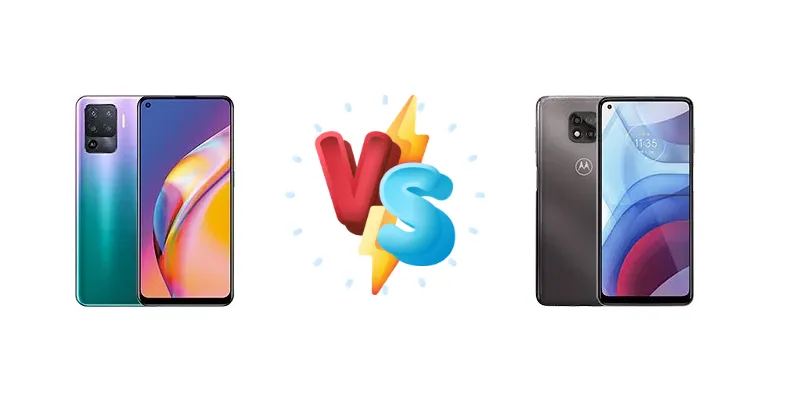
The Oppo A94 and Motorola Moto G Power (2021) represent two distinct approaches to the budget and mid-range smartphone market. The A94 aims for a balance of style and performance, while the Moto G Power prioritizes exceptional battery life. This comparison dives deep into their core specifications to determine which device delivers the best value for your money.
🏆 Quick Verdict
For users prioritizing faster charging and a slightly more powerful processor for everyday tasks, the Oppo A94 is the better choice. However, the Motorola Moto G Power (2021) remains a compelling option for those who value long-lasting battery life above all else, offering a dependable experience without frequent top-ups.
| Network |
|---|
| 2G bands | GSM 850 / 900 / 1800 / 1900 | GSM 850 / 900 / 1800 / 1900 |
| 3G bands | HSDPA 850 / 900 / 2100 | HSDPA 850 / 900 / 1700(AWS) / 1900 / 2100 |
| 4G bands | 1, 3, 5, 7, 8, 20, 28, 38, 40, 41 | 1, 2, 3, 4, 5, 7, 8, 12, 13, 14, 17, 25, 26, 29, 30, 38, 41, 66, 71 |
| Speed | HSPA, LTE | HSPA, LTE |
| Technology | GSM / HSPA / LTE | GSM / CDMA / HSPA / EVDO / LTE |
| | - | CDMA2000 1xEV-DO |
| Launch |
|---|
| Announced | 2021, March 05 | 2021, January 08 |
| Status | Available. Released 2021, March 11 | Available. Released 2021, January 14 |
| Body |
|---|
| Build | - | Glass front, plastic back, plastic frame |
| Dimensions | 160.1 x 73.2 x 7.8 mm (6.30 x 2.88 x 0.31 in) | 165.3 x 75.9 x 9.5 mm (6.51 x 2.99 x 0.37 in) |
| SIM | Nano-SIM + Nano-SIM | Nano-SIM |
| Weight | 172 g (6.07 oz) | 206.5 g (7.30 oz) |
| | - | Water-repellent coating |
| Display |
|---|
| Resolution | 1080 x 2400 pixels, 20:9 ratio (~409 ppi density) | 720 x 1600 pixels, 20:9 ratio (~266 ppi density) |
| Size | 6.43 inches, 99.8 cm2 (~85.2% screen-to-body ratio) | 6.6 inches, 105.2 cm2 (~83.8% screen-to-body ratio) |
| Type | AMOLED, 430 nits (typ), 800 nits (peak) | IPS LCD |
| Platform |
|---|
| CPU | Octa-core (2x2.2 GHz Cortex-A75 & 6x2.0 GHz Cortex-A55) | Octa-core (4x2.0 GHz Kryo 260 Gold & 4x1.8 GHz Kryo 260 Silver) |
| Chipset | Mediatek MT6779V Helio P95 (12 nm) | Qualcomm SM6115 Snapdragon 662 (11 nm) |
| GPU | PowerVR GM9446 | Adreno 610 |
| OS | Android 11, ColorOS 11.1 | Android 10 |
| Memory |
|---|
| Card slot | microSDXC | microSDXC (dedicated slot) |
| Internal | 128GB 8GB RAM | 32GB 3GB RAM, 64GB 4GB RAM |
| | - | eMMC 5.1 |
| Main Camera |
|---|
| Features | LED flash, HDR, panorama | LED flash, HDR, panorama |
| Quad | 48 MP, f/1.7, 26mm (wide), 1/2.0", 0.8µm, PDAF
8 MP, f/2.2, 16mm, 119˚ (ultrawide), 1/4.0", 1.12µm
2 MP (macro)
Auxiliary lens | - |
| Single | 32 MP, f/2.4, 24mm (wide) | - |
| Triple | - | 48 MP, f/1.7, (wide), 1/2.0", 0.8µm, PDAF
2 MP (macro)
Auxiliary lens |
| Video | 4K@30fps, 1080p@30/120fps; gyro-EIS | 1080p@30/60fps, gyro-EIS |
| Selfie camera |
|---|
| Features | HDR | HDR |
| Single | 32 MP, f/2.4, 24mm (wide) | 8 MP, f/2.0, 1.12µm |
| Video | 1080p@30fps | 1080p@30fps, gyro-EIS |
| Sound |
|---|
| 3.5mm jack | Yes | Yes |
| 35mm jack | Yes | Yes |
| Loudspeaker | Yes | Yes |
| Comms |
|---|
| Bluetooth | 5.1, A2DP, LE, aptX HD | 5.0, A2DP, LE |
| NFC | No | No |
| Positioning | GPS, GLONASS, GALILEO, BDS, QZSS | GPS, GLONASS, GALILEO |
| Radio | Unspecified | FM radio |
| USB | USB Type-C 2.0, OTG | USB Type-C 2.0 |
| WLAN | Wi-Fi 802.11 a/b/g/n/ac, dual-band, Wi-Fi Direct | Wi-Fi 802.11 a/b/g/n/ac, dual-band, Wi-Fi Direct |
| Features |
|---|
| Sensors | Fingerprint (under display, optical), accelerometer, gyro, proximity, compass | Fingerprint (side-mounted), accelerometer, gyro, proximity, compass, barometer |
| Battery |
|---|
| Charging | 30W wired | 15W wired |
| Type | Li-Po 4310 mAh | Li-Po 5000 mAh |
| Misc |
|---|
| Colors | Fluid Black, Fantastic Purple | Flash Gray, Polar Silver |
| Models | CPH2203 | - |
| Price | About 160 EUR | About 60 EUR |
Oppo A94
- Faster 30W charging for quicker top-ups
- More powerful CPU for smoother multitasking
- Potentially better burst performance with Cortex-A75 cores
- Less efficient 12nm process may lead to slightly higher power consumption
- Potentially less refined image processing compared to Snapdragon
Motorola Moto G Power (2021)
- Exceptional battery life for multi-day use
- More efficient 11nm process for improved power management
- Qualcomm ISP generally delivers strong image processing
- Slower 15W charging takes significantly longer
- Less powerful CPU may struggle with demanding tasks
Display Comparison
Neither device boasts a particularly standout display. While specific display specs (resolution, panel type) are missing, the focus here is on performance. The difference in processing power will likely have a more noticeable impact on UI responsiveness than any minor display variations. Both likely utilize IPS LCD panels, common in this price bracket.
Camera Comparison
Without detailed camera specifications, a direct comparison is difficult. However, the chipset’s image signal processor (ISP) plays a crucial role. Qualcomm’s Snapdragon ISPs are generally known for their strong image processing capabilities, particularly in low-light conditions. The A94’s Helio P95 ISP is competent, but likely won’t match the Snapdragon 662 in dynamic range and noise reduction. The presence of a larger main sensor (if present on either device) would be a significant advantage, but this information is unavailable. It's safe to assume both phones will offer acceptable image quality for social media sharing, but won't compete with flagship camera performance.
Performance
The core difference lies in the chipsets. The Oppo A94’s MediaTek Helio P95 (12nm) features a more powerful CPU configuration – a pair of Cortex-A75 cores clocked at 2.2GHz alongside six Cortex-A55 cores. This contrasts with the Motorola Moto G Power (2021)’s Qualcomm Snapdragon 662 (11nm) which uses four Kryo 260 Gold cores at 2.0GHz and four Kryo 260 Silver cores. The 12nm process of the Helio P95 is less efficient than the 11nm process of the Snapdragon 662, potentially leading to slightly higher power consumption under sustained load. However, the A75 cores in the Helio P95 offer a performance advantage in single-core tasks and burst performance, making the A94 feel snappier for everyday use. The Snapdragon 662 prioritizes efficiency, contributing to the Moto G Power’s excellent battery life.
Battery Life
The Motorola Moto G Power (2021) is designed for longevity. While the exact battery capacity isn't provided, Motorola’s ‘Power’ branding consistently delivers exceptional battery life. The Oppo A94 compensates for potentially lower battery capacity with 30W wired charging, significantly faster than the Moto G Power’s 15W charging. This means the A94 can replenish its battery much quicker, reducing downtime. A full charge on the A94 will likely take under 70 minutes, while the Moto G Power could require over two hours.
Buying Guide
Buy the Oppo A94 if you need quicker app loading times, smoother multitasking, and the convenience of 30W fast charging. This phone suits users who frequently use social media, browse the web, and occasionally play casual games. Buy the Motorola Moto G Power (2021) if you prefer a phone that can reliably last through two full days of moderate use, and if minimizing charging frequency is your top priority. It’s ideal for travelers, outdoor workers, or anyone who dislikes battery anxiety.
Frequently Asked Questions
❓ Will the Oppo A94’s Helio P95 struggle with graphically intensive games like PUBG Mobile?
While the Helio P95 can run PUBG Mobile, you may need to lower graphics settings to maintain a stable frame rate. The Snapdragon 662 in the Moto G Power will likely offer a similar gaming experience, but neither phone is designed for high-end gaming.
❓ How much faster is the 30W charging on the Oppo A94 compared to the 15W charging on the Moto G Power?
The 30W charging on the Oppo A94 can significantly reduce charging times. Expect a full charge in under 70 minutes, whereas the Moto G Power could take over two hours with its 15W charger. This difference is particularly noticeable for quick top-ups.
❓ Does the Snapdragon 662 in the Moto G Power support any form of fast charging?
Yes, the Snapdragon 662 supports Quick Charge 3.0, but Motorola only implements 15W charging in the Moto G Power (2021). While it's not the fastest, it's still faster than standard 5W charging.
❓ Which phone is better for streaming videos and browsing the web?
The Oppo A94’s more powerful CPU will likely provide a smoother experience for streaming videos and browsing the web, especially with multiple tabs open. The Helio P95’s Cortex-A75 cores offer a performance advantage in these scenarios.