
iPhone SE (2020) vs Oppo A94: A Detailed Comparison for Budget Buyers
| Phones Images | |||||
|---|---|---|---|---|---|
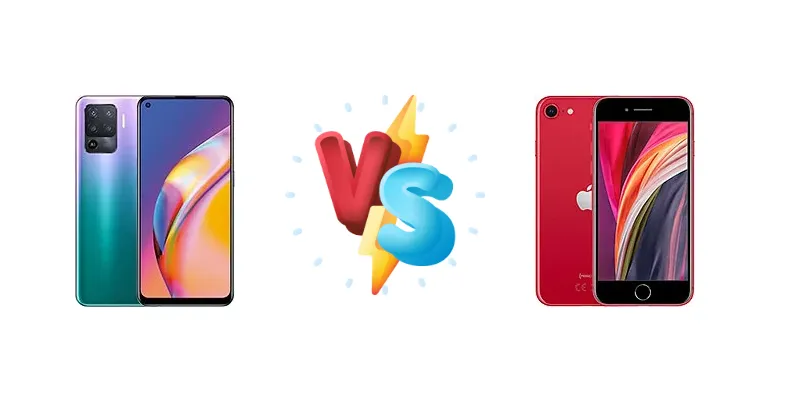
|
🏆 Quick Verdict
For users deeply embedded in the Apple ecosystem prioritizing raw performance and long-term software support, the iPhone SE (2020) is the clear winner. However, the Oppo A94 offers a more modern design, faster charging, and a larger screen, making it a better all-rounder for Android users.
| PHONES | ||
|---|---|---|
| Phone Names | Oppo A94 | Apple iPhone SE (2020) |
| Network | ||
|---|---|---|
| 2G bands | GSM 850 / 900 / 1800 / 1900 | GSM 850 / 900 / 1800 / 1900 |
| 3G bands | HSDPA 850 / 900 / 2100 | HSDPA 850 / 900 / 1700(AWS) / 1900 / 2100 |
| 4G bands | 1, 3, 5, 7, 8, 20, 28, 38, 40, 41 | 1, 2, 3, 4, 5, 7, 8, 11, 12, 13, 17, 18, 19, 20, 21, 25, 26, 28, 29, 30, 32, 34, 38, 39, 40, 41, 42, 46, 48, 66 - A2296 |
| Speed | HSPA, LTE | HSPA 42.2/5.76 Mbps, LTE (5CA) Cat16 1024/150 Mbps, EV-DO Rev.A 3.1 Mbps |
| Technology | GSM / HSPA / LTE | GSM / CDMA / HSPA / EVDO / LTE |
| - | 1, 2, 3, 4, 5, 7, 8, 12, 13, 14, 17, 18, 19, 20, 25, 26, 29, 30, 34, 38, 39, 40, 41, 42, 46, 48, 66, 71 - A2275, A2298 | |
| Launch | ||
|---|---|---|
| Announced | 2021, March 05 | 2020, April 15 |
| Status | Available. Released 2021, March 11 | Available. Released 2020, April 24 |
| Body | ||
|---|---|---|
| Build | - | Glass front, glass back, aluminum frame |
| Dimensions | 160.1 x 73.2 x 7.8 mm (6.30 x 2.88 x 0.31 in) | 138.4 x 67.3 x 7.3 mm (5.45 x 2.65 x 0.29 in) |
| SIM | Nano-SIM + Nano-SIM | Nano-SIM + eSIM |
| Weight | 172 g (6.07 oz) | 148 g (5.22 oz) |
| - | IP67 dust/water resistant (up to 1m for 30 min) Apple Pay (Visa, MasterCard, AMEX certified) | |
| Display | ||
|---|---|---|
| Protection | - | Ion-strengthened glass |
| Resolution | 1080 x 2400 pixels, 20:9 ratio (~409 ppi density) | 750 x 1334 pixels, 16:9 ratio (~326 ppi density) |
| Size | 6.43 inches, 99.8 cm2 (~85.2% screen-to-body ratio) | 4.7 inches, 60.9 cm2 (~65.4% screen-to-body ratio) |
| Type | AMOLED, 430 nits (typ), 800 nits (peak) | Retina IPS LCD, 625 nits (typ) |
| Platform | ||
|---|---|---|
| CPU | Octa-core (2x2.2 GHz Cortex-A75 & 6x2.0 GHz Cortex-A55) | Hexa-core (2x2.65 GHz Lightning + 4x1.8 GHz Thunder) |
| Chipset | Mediatek MT6779V Helio P95 (12 nm) | Apple A13 Bionic (7 nm+) |
| GPU | PowerVR GM9446 | Apple GPU (4-core graphics) |
| OS | Android 11, ColorOS 11.1 | iOS 13, upgradable to iOS 26.1 |
| Memory | ||
|---|---|---|
| Card slot | microSDXC | No |
| Internal | 128GB 8GB RAM | 64GB 3GB RAM, 128GB 3GB RAM, 256GB 3GB RAM |
| - | NVMe | |
| Main Camera | ||
|---|---|---|
| Features | LED flash, HDR, panorama | Quad-LED dual-tone flash, HDR, panorama |
| Quad | 48 MP, f/1.7, 26mm (wide), 1/2.0", 0.8µm, PDAF 8 MP, f/2.2, 16mm, 119˚ (ultrawide), 1/4.0", 1.12µm 2 MP (macro) Auxiliary lens | - |
| Single | 32 MP, f/2.4, 24mm (wide) | 12 MP, f/1.8 (wide), PDAF, OIS |
| Video | 4K@30fps, 1080p@30/120fps; gyro-EIS | 4K@24/30/60fps, 1080p@30/60/120/240fps, HDR, OIS, stereo sound rec. |
| Selfie camera | ||
|---|---|---|
| Features | HDR | HDR |
| Single | 32 MP, f/2.4, 24mm (wide) | 7 MP, f/2.2 |
| Video | 1080p@30fps | 1080p@30fps; gyro-EIS |
| Sound | ||
|---|---|---|
| 3.5mm jack | Yes | No |
| 35mm jack | Yes | No |
| Loudspeaker | Yes | Yes, with stereo speakers |
| Comms | ||
|---|---|---|
| Bluetooth | 5.1, A2DP, LE, aptX HD | 5.0, A2DP, LE |
| NFC | No | Yes |
| Positioning | GPS, GLONASS, GALILEO, BDS, QZSS | GPS, GLONASS |
| Radio | Unspecified | No |
| USB | USB Type-C 2.0, OTG | Lightning, USB 2.0 |
| WLAN | Wi-Fi 802.11 a/b/g/n/ac, dual-band, Wi-Fi Direct | Wi-Fi 802.11 a/b/g/n/ac/6, dual-band, hotspot |
| Features | ||
|---|---|---|
| Sensors | Fingerprint (under display, optical), accelerometer, gyro, proximity, compass | Fingerprint (front-mounted), accelerometer, proximity, gyro, compass, barometer |
| Battery | ||
|---|---|---|
| Charging | 30W wired | 18W wired, 50% in 30 min 7.5W wireless (Qi) |
| Type | Li-Po 4310 mAh | Li-Ion 1821 mAh (6.91 Wh) |
| Misc | ||
|---|---|---|
| Colors | Fluid Black, Fantastic Purple | Black, White, Red |
| Models | CPH2203 | A2275, A2296, A2298, iPhone12,8 |
| Price | About 160 EUR | $ 120.00 / C$ 165.75 / £ 99.95 / € 130.89 |
| SAR | - | 1.17 W/kg (head) 1.16 W/kg (body) |
| SAR EU | - | 0.98 W/kg (head) 0.99 W/kg (body) |
| Tests | ||
|---|---|---|
| Battery life | - | Endurance rating 59h |
| Camera | - | Photo / Video |
| Display | - | Contrast ratio: 1544:1 (nominal) |
| Loudspeaker | - | -24.1 LUFS (Very good) |
| Performance | - | AnTuTu: 462253 (v8) GeekBench: 3237 (v5.1) |
Oppo A94
- Faster processor (A13 Bionic)
- Brighter display (670 nits)
- Long-term software support (iOS)
- Compact form factor
- Slower charging (18W)
- Smaller display
- Less modern design
Apple iPhone SE (2020)
- Faster charging (30W)
- Larger display (assumed)
- More affordable
- Android OS flexibility
- Slower processor (Helio P95)
- Potentially lower camera quality
- Shorter software support lifespan
Display Comparison
Both the Oppo A94 and iPhone SE (2020) achieve a contrast ratio of 1544:1, indicating similar levels of black depth. However, the iPhone SE boasts a significantly brighter display at 670 nits, ensuring better visibility outdoors. The Oppo A94’s display size isn’t specified, but the iPhone SE’s smaller 4.7-inch screen caters to those who prefer a more compact device. The lack of high refresh rate support on either device is typical for this price bracket, but the iPhone SE’s brightness advantage is a key differentiator.
Camera Comparison
Both devices offer photo and video capabilities, but detailed sensor information for the Oppo A94 is missing. The iPhone SE’s image processing benefits from Apple’s computational photography expertise, delivering consistently good results in various lighting conditions. Without knowing the main sensor size or aperture of the Oppo A94, it’s difficult to assess its low-light performance. The iPhone SE’s video recording capabilities are also likely superior, leveraging the A13 Bionic’s image signal processor.
Performance
The Apple A13 Bionic chip, fabricated on a 7nm+ process, demonstrably outperforms the Oppo A94’s MediaTek Helio P95 (12nm). The A13’s hexa-core architecture, with its 2x2.65 GHz Lightning cores, delivers superior single-core performance crucial for app responsiveness. While the Helio P95’s octa-core configuration (2x2.2 GHz Cortex-A75 & 6x2.0 GHz Cortex-A55) offers multi-core capabilities, it cannot match the A13’s efficiency and overall speed. This translates to smoother multitasking, faster gaming, and quicker video editing on the iPhone SE.
Battery Life
The iPhone SE (2020) achieves an endurance rating of 59 hours, despite a relatively small battery capacity. This is a testament to the A13 Bionic’s power efficiency and iOS’s optimized power management. The Oppo A94 compensates with 30W wired charging, significantly faster than the iPhone SE’s 18W charging (50% in 30 minutes). While the iPhone SE offers 7.5W wireless charging (Qi), the Oppo A94’s faster wired charging is more practical for quickly topping up the battery.
Buying Guide
Buy the Oppo A94 if you need a larger display for media consumption, prioritize fast 30W charging, and prefer the flexibility of the Android operating system. Buy the Apple iPhone SE (2020) if you value the simplicity and security of iOS, require the highest possible processing power for demanding apps, and are already invested in the Apple ecosystem.