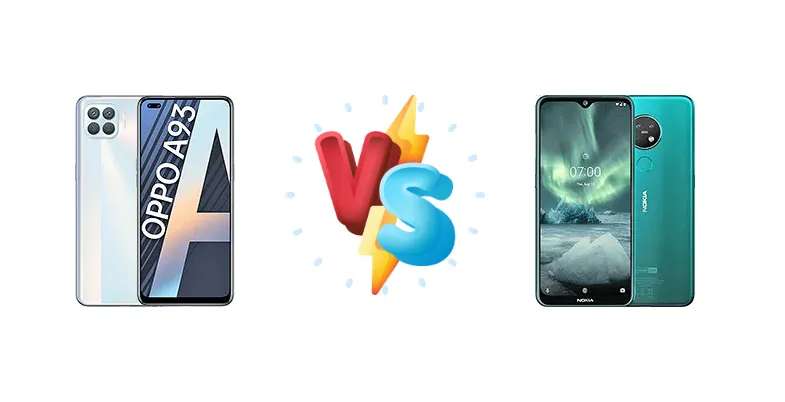
The Oppo A93 and Nokia 7.2 represent different approaches to the mid-range smartphone market. The A93 prioritizes processing power with a newer chipset, while the Nokia 7.2 focuses on a clean software experience and a well-regarded display. This comparison dives deep into their specifications to determine which device offers the best value for your money.
🏆 Quick Verdict
For the average user prioritizing responsiveness and future-proofing, the Oppo A93 is the better choice. Its Mediatek Helio P95 chipset offers a noticeable performance advantage over the Nokia 7.2’s Snapdragon 660. While both phones offer similar battery endurance, the A93’s faster charging is a welcome addition.
| Network |
|---|
| 2G bands | GSM 850 / 900 / 1800 / 1900 | GSM 850 / 900 / 1800 / 1900 |
| 3G bands | HSDPA 850 / 900 / 2100 | HSDPA 850 / 900 / 2100 - ROW |
| 4G bands | 1, 3, 5, 7, 8, 38, 40, 41 | 1, 3, 5, 7, 8, 20, 28, 38, 40, 41 - ROW |
| Speed | HSPA, LTE | HSPA 42.2/5.76 Mbps, LTE (2CA) Cat6 300/50 Mbps or LTE Cat4 150/50 Mbps |
| Technology | GSM / HSPA / LTE | GSM / HSPA / LTE |
| | - | 1, 3, 5, 8, 40, 41 - IN |
| Launch |
|---|
| Announced | 2020, October 01. Released 2020, October 01 | 2019, September 05. Released 2019, September 23 |
| Status | Discontinued | Discontinued |
| Body |
|---|
| Build | Glass front, plastic back | Glass front (Gorilla Glass 3), glass back (Gorilla Glass 3), plastic frame |
| Dimensions | 160.1 x 73.8 x 7.5 mm (6.30 x 2.91 x 0.30 in) | 159.9 x 75.2 x 8.3 mm (6.30 x 2.96 x 0.33 in) |
| SIM | Nano-SIM + Nano-SIM | · Nano-SIM· Nano-SIM + Nano-SIM |
| Weight | 164 g (5.78 oz) | 180 g (6.35 oz) |
| Display |
|---|
| Protection | - | Corning Gorilla Glass 3 |
| Resolution | 1080 x 2400 pixels, 20:9 ratio (~409 ppi density) | 1080 x 2280 pixels, 19:9 ratio (~400 ppi density) |
| Size | 6.43 inches, 99.8 cm2 (~84.5% screen-to-body ratio) | 6.3 inches, 99.1 cm2 (~82.4% screen-to-body ratio) |
| Type | Super AMOLED, 430 nits (typ), 800 nits (peak) | IPS LCD, HDR10 |
| Platform |
|---|
| CPU | Octa-core (2x2.2 GHz Cortex-A75 & 6x2.0 GHz Cortex-A55) | Octa-core (4x2.2 GHz Kryo 260 Gold & 4x1.8 GHz Kryo 260 Silver) |
| Chipset | Mediatek MT6779V Helio P95 (12 nm) | Qualcomm SDM660 Snapdragon 660 (14 nm) |
| GPU | PowerVR GM9446 | Adreno 512 |
| OS | Android 10, ColorOS 7.2 | Android 9.0 (Pie), upgradable to Android 11, Android One |
| Memory |
|---|
| Card slot | microSDXC (dedicated slot) | microSDXC (dedicated slot) |
| Internal | 128GB 8GB RAM | 64GB 4GB RAM, 64GB 6GB RAM, 128GB 4GB RAM, 128GB 6GB RAM |
| | UFS 2.1 | eMMC 5.1 |
| Main Camera |
|---|
| Features | LED flash, HDR, panorama | Zeiss optics, LED flash, panorama, HDR |
| Quad | 48 MP, f/1.7, 26mm (wide), 1/2.0", 0.8µm, PDAF
8 MP, f/2.2, 119˚, 16mm (ultrawide), 1/4.0", 1.12µm
Auxiliary lens | - |
| Triple | - | 48 MP, f/1.8, (wide), 1/2.0", 0.8µm, PDAF
8 MP, f/2.2, 13mm (ultrawide), 1/4.0", 1.12µm
Auxiliary lens |
| Video | 4K@30fps, 1080p@30/120fps, gyro-EIS | 4K@30fps, 1080p@30fps (gyro-EIS) |
| Selfie camera |
|---|
| Dual | 16 MP, f/2.4, (wide), 1/3.09", 1.0µm
2 MP, f/2.4, (depth) | - |
| Features | HDR | Zeiss optics, HDR |
| Single | - | 20 MP, f/2.0, (wide), 1/3", 0.9µm |
| Video | 1080p@30fps | 1080p@30fps |
| Sound |
|---|
| 3.5mm jack | Yes | Yes |
| 35mm jack | Yes | Yes |
| Loudspeaker | Yes | Yes |
| Comms |
|---|
| Bluetooth | 5.1, A2DP, LE, aptX HD | 5.0, A2DP, EDR, LE, aptX |
| NFC | No | Yes (excl. India) |
| Positioning | GPS, GLONASS, GALILEO, BDS, QZSS | GPS, GLONASS, GALILEO, BDS |
| Radio | FM radio | FM radio |
| USB | USB Type-C 2.0, OTG | USB Type-C 2.0, OTG |
| WLAN | Wi-Fi 802.11 a/b/g/n/ac, dual-band, Wi-Fi Direct | Wi-Fi 802.11 b/g/n/ac, dual-band, Wi-Fi Direct |
| Features |
|---|
| Sensors | Fingerprint (under display, optical), accelerometer, gyro, proximity, compass | Fingerprint (rear-mounted), accelerometer, gyro, proximity, compass |
| Battery |
|---|
| Charging | 18W wired | 10W wired |
| Type | Li-Po 4000 mAh | Li-Po 3500 mAh, non-removable |
| Misc |
|---|
| Colors | Matte Black, Metallic White | Cyan Green, Charcoal, Ice |
| Models | CPH2121, CPH2123 | TA-1193, TA-1178, TA-1196, TA-1181 |
| Price | About 280 EUR | About 240 EUR |
| SAR | - | 1.15 W/kg (head) 0.90 W/kg (body) |
| SAR EU | - | 0.99 W/kg (head) 1.44 W/kg (body) |
| Tests |
|---|
| Audio quality | - |
Noise -93.0dB / Crosstalk -93.4dB |
| Battery life | - |
Endurance rating 69h
|
| Camera | - |
Photo / Video |
| Display | - |
Contrast ratio: 1342:1 (nominal) |
| Loudspeaker | - |
-29.6 LUFS (Average)
|
| Performance | - |
AnTuTu: 139495 (v7), 164484 (v8)
GeekBench: 5440 (v4.4), 1398 (v5.1)
GFXBench: 8.1fps (ES 3.1 onscreen) |
Oppo A93
- Faster processor for smoother performance
- Faster 18W charging
- Potentially better image processing
- Display specifications are unknown
- Software experience may not be as clean as Nokia
Nokia 7.2
- Excellent display brightness and contrast
- Clean Android software experience
- Good battery endurance
- Older, less powerful chipset
- Slower 10W charging
- Potentially slower app loading times
Display Comparison
The Nokia 7.2 boasts a strong display showing 585 nits of peak brightness and a 1342:1 contrast ratio, providing a vivid viewing experience. While the Oppo A93’s display specifications aren’t provided, the Nokia 7.2’s measured brightness is a key advantage for outdoor visibility. The identical contrast ratios suggest similar black levels and color depth, but the Nokia 7.2’s measured performance gives it a clear edge in real-world usage. The Nokia 7.2’s display is a strong point for media consumers.
Camera Comparison
Both devices are listed as having Photo/Video capabilities, but detailed camera specifications are lacking. Without sensor size, aperture, or image processing details, a direct comparison is difficult. However, given the A93’s focus on overall performance, it’s reasonable to assume it benefits from a more advanced image signal processor (ISP) within the Helio P95 chipset, potentially leading to better image quality and faster processing times. The Nokia 7.2’s camera likely relies on the Snapdragon 660’s ISP, which is adequate but less capable. The absence of specific details makes a definitive judgment impossible, but the A93 likely has a slight advantage.
Performance
The Oppo A93’s Mediatek Helio P95 (12nm) chipset, with its octa-core configuration (2x2.2 GHz Cortex-A75 & 6x2.0 GHz Cortex-A55), represents a significant architectural leap over the Nokia 7.2’s Qualcomm Snapdragon 660 (14nm). The P95 utilizes more modern Cortex-A75 cores, offering superior single-core performance crucial for app launch speeds and general responsiveness. The Snapdragon 660’s Kryo 260 cores, while efficient, are older generation. The 12nm process node of the Helio P95 is also more efficient than the 14nm node of the Snapdragon 660, potentially leading to better thermal management under sustained load. This translates to a smoother user experience on the Oppo A93, particularly for gaming and demanding applications.
Battery Life
Both the Oppo A93 and Nokia 7.2 achieve an endurance rating of 69 hours, indicating comparable battery life under similar usage patterns. However, the Oppo A93 features 18W wired charging, significantly faster than the Nokia 7.2’s 10W charging. This means the A93 can replenish its battery much quicker, reducing downtime. While both phones last roughly the same on a single charge, the A93’s faster charging provides a more convenient user experience, especially for those who frequently need to top up their battery.
Buying Guide
Buy the Oppo A93 if you need a phone capable of handling demanding apps and occasional gaming without significant lag. It’s ideal for users who frequently multitask or enjoy mobile entertainment. Buy the Nokia 7.2 if you prefer a clean Android experience, a vibrant display for media consumption, and prioritize a more established brand reputation for software updates, even if it means sacrificing some raw processing power.
Frequently Asked Questions
❓ Will the Oppo A93 struggle with graphically intensive games like PUBG or Call of Duty?
While the Helio P95 isn't a flagship chipset, it's capable of running PUBG and Call of Duty at medium settings. Expect some frame drops during intense scenes, but the experience should be playable. The Snapdragon 660 in the Nokia 7.2 will likely require lower settings and may exhibit more noticeable lag.
❓ How does the software experience differ between the Oppo A93 and Nokia 7.2?
The Nokia 7.2 runs a near-stock version of Android, offering a clean and bloatware-free experience with guaranteed software updates. Oppo’s ColorOS, found on the A93, is more heavily customized and includes additional features, but also comes with pre-installed apps and a different user interface. Preference here is subjective.
❓ Is the 18W charging on the Oppo A93 a significant improvement over the Nokia 7.2’s 10W charging?
Yes, it is. 18W charging will significantly reduce the time it takes to fully charge the Oppo A93. Expect a 0-100% charge in approximately 1.5-2 hours, compared to 2.5-3 hours with the Nokia 7.2’s 10W charging. This is a noticeable convenience factor.