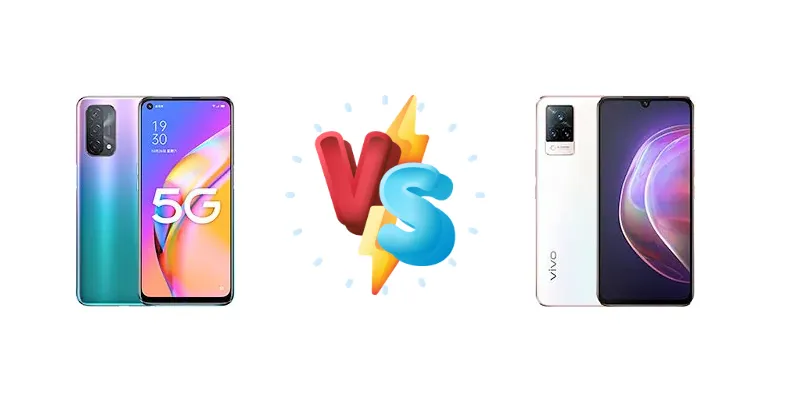
The Oppo A93 5G and vivo V21 5G represent compelling options in the increasingly crowded mid-range 5G smartphone market. While both aim to deliver 5G connectivity at an accessible price point, they diverge significantly in their core hardware choices, impacting performance, battery life, and overall user experience. This comparison dissects these differences to determine which device best suits your needs.
🏆 Quick Verdict
For the average user prioritizing a brighter display and faster charging, the vivo V21 5G emerges as the stronger contender. Its Mediatek Dimensity 800U chipset provides a noticeable performance edge, and the 33W charging significantly reduces downtime. However, the Oppo A93 5G remains a viable option for those on a tighter budget.
| Network |
|---|
| 2G bands | GSM 850 / 900 / 1800 / 1900 | GSM 850 / 900 / 1800 / 1900 |
| 3G bands | HSDPA 850 / 900 / 1900 / 2100 | HSDPA 850 / 900 / 1700(AWS) / 1900 / 2100 |
| 4G bands | 1, 3, 5, 8, 34, 38, 39, 40, 41 | 1, 2, 3, 4, 5, 8, 34, 38, 40, 41 - India |
| 5G bands | 1, 28, 41, 77, 78 SA/NSA | 78 Sub6 - India |
| Speed | HSPA, LTE, 5G | HSPA, LTE, 5G |
| Technology | GSM / CDMA / HSPA / EVDO / LTE / 5G | GSM / HSPA / LTE / 5G |
| | CDMA2000 1xEV-DO | - |
| Launch |
|---|
| Announced | 2021, January 14 | 2021, April 27 |
| Status | Available. Released 2021, January 20 | Available. Released 2021, May 06 |
| Body |
|---|
| Build | - | Glass front, plastic frame, plastic back |
| Dimensions | 162.9 x 74.7 x 8.4 mm (6.41 x 2.94 x 0.33 in) | 159.7 x 73.9 x 7.3 mm (6.29 x 2.91 x 0.29 in) |
| SIM | Nano-SIM + Nano-SIM | Nano-SIM + Nano-SIM |
| Weight | 188 g (6.63 oz) | 176 g (6.21 oz) |
| Display |
|---|
| Resolution | 1080 x 2400 pixels, 20:9 ratio (~405 ppi density) | 1080 x 2400 pixels, 20:9 ratio (~409 ppi density) |
| Size | 6.5 inches, 102.0 cm2 (~83.8% screen-to-body ratio) | 6.44 inches, 100.1 cm2 (~84.8% screen-to-body ratio) |
| Type | IPS LCD, 90Hz, 480 nits (typ) | AMOLED, 90Hz, HDR10+, 500 nits (typ) |
| Platform |
|---|
| CPU | Octa-core (2x2.0 GHz Kryo 460 & 6x1.8 GHz Kryo 460) | Octa-core (2x2.4 GHz Cortex-A76 & 6x2.0 GHz Cortex-A55) |
| Chipset | Qualcomm SM4350 Snapdragon 480 5G (8 nm) | Mediatek Dimensity 800U (7 nm) |
| GPU | Adreno 619 | Mali-G57 MC3 |
| OS | Android 11, ColorOS 11.1 | Android 11, Funtouch 11.1 |
| Memory |
|---|
| Card slot | microSDXC | microSDXC (uses shared SIM slot) |
| Internal | 128GB 8GB RAM, 256GB 8GB RAM | 128GB 6GB RAM, 128GB 8GB RAM, 256GB 8GB RAM |
| | UFS | UFS 2.2 |
| Main Camera |
|---|
| Features | LED flash, HDR, panorama | LED flash, HDR, panorama |
| Single | - | 44 MP, f/2.0, (wide), AF, OIS |
| Triple | 48 MP, f/1.8, 26mm (wide), 1/2.0", 0.8µm, PDAF
Auxiliary lens | 64 MP, f/1.8, 26mm (wide), 1/1.72", 0.8µm, PDAF, OIS
8 MP, f/2.2, 120˚, 16mm (ultrawide), 1/4.0", 1.12µm
2 MP (macro) |
| Video | 1080p@30fps, gyro-EIS | 4K@30fps (no OIS), 1080p@30/60fps |
| Selfie camera |
|---|
| Features | HDR | Dual-LED flash, HDR |
| Single | 8 MP, f/2.0, (wide) | 44 MP, f/2.0, (wide), AF, OIS |
| Video | 1080p@30fps | 4K@30fps (no OIS), 1080p@30fps |
| Sound |
|---|
| 3.5mm jack | Yes | No |
| 35mm jack | Yes | No |
| Loudspeaker | Yes | Yes |
| Comms |
|---|
| Bluetooth | 5.1, A2DP, LE, aptX HD | 5.1, A2DP, LE |
| NFC | Yes | Yes (market/region dependent) |
| Positioning | GPS, GLONASS, GALILEO, BDS, QZSS | GPS, GLONASS, GALILEO, BDS |
| Radio | No | No |
| USB | USB Type-C 2.0, OTG | USB Type-C 2.0, OTG |
| WLAN | Wi-Fi 802.11 a/b/g/n/ac, dual-band, Wi-Fi Direct | Wi-Fi 802.11 a/b/g/n/ac, dual-band, Wi-Fi Direct |
| Features |
|---|
| Sensors | Fingerprint (side-mounted), accelerometer, proximity, compass | Fingerprint (under display, optical), accelerometer, gyro, proximity, compass |
| Battery |
|---|
| Charging | 18W wired | 33W wired, 63% in 30 min |
| Type | Li-Po 5000 mAh | 4000 mAh |
| Misc |
|---|
| Colors | Black, White, Aurora | Dusk Blue, Sunset Dazzle, Arctic White |
| Models | PCGM00, PEHM00, PEHT00 | V2050 |
| Price | About 260 EUR | About 190 EUR |
| SAR | - | 1.05 W/kg (head) 0.87 W/kg (body) |
| Tests |
|---|
| Battery life | - |
Endurance rating 123h
|
| Camera | - |
Photo / Video |
| Display | - |
Contrast ratio: Infinite (nominal) |
| Loudspeaker | - |
-28.2 LUFS (Average)
|
| Performance | - |
AnTuTu: 336699 (v8), 365055 (v9)
GeekBench: 6516 (v4.4), 1600 (v5.1)
GFXBench: 17fps (ES 3.1 onscreen) |
Oppo A93 5G
- More affordable price point
- Acceptable performance for basic tasks
- 5G connectivity
- Slower charging speed (18W)
- Less powerful chipset (Snapdragon 480)
- Likely a less vibrant display
vivo V21 5G
- Faster charging (33W, 63% in 30min)
- More powerful chipset (Dimensity 800U)
- Brighter display (761 nits)
- Potentially better camera performance
- Higher price compared to Oppo A93 5G
- Battery life is similar to A93 5G despite faster charging
Display Comparison
The vivo V21 5G boasts a significantly brighter display, reaching a measured 761 nits, compared to an unspecified brightness for the Oppo A93 5G. This higher peak brightness translates to better visibility outdoors under direct sunlight. While both displays are described as having an 'infinite' contrast ratio (typical for OLED/AMOLED panels), the V21 5G’s superior brightness is a tangible advantage. The lack of detailed display specifications for the A93 5G, such as refresh rate or panel type, suggests a more basic display experience.
Camera Comparison
Both devices feature photo and video capabilities, but detailed camera specifications are lacking for both. Without information on sensor sizes, aperture values, or image stabilization (OIS), a direct comparison is difficult. However, the market positioning of the V21 5G suggests a potentially more refined camera system, possibly with larger sensors and more advanced image processing algorithms. The inclusion of a 2MP macro camera on either device is unlikely to significantly impact image quality, serving primarily as a marketing feature.
Performance
The core performance difference lies in the chipsets. The vivo V21 5G’s Mediatek Dimensity 800U, fabricated on a 7nm process, offers a clear advantage over the Oppo A93 5G’s Qualcomm Snapdragon 480 5G (8nm). The Dimensity 800U’s octa-core configuration, featuring 2x2.4 GHz Cortex-A76 cores, provides a more powerful CPU for demanding tasks and gaming compared to the Snapdragon 480’s 2x2.0 GHz Kryo 460 cores. While both are 5G capable, the Dimensity 800U generally exhibits superior modem performance and efficiency. The 7nm process node of the Dimensity 800U also contributes to better thermal management, potentially reducing throttling during sustained workloads.
Battery Life
Both the Oppo A93 5G and vivo V21 5G achieve an endurance rating of 123 hours, suggesting similar overall battery life under typical usage. However, the V21 5G’s 33W wired charging capability is a significant advantage, allowing it to reach 63% charge in just 30 minutes. The A93 5G’s 18W charging is considerably slower, requiring more time to fully replenish the battery. This faster charging speed on the V21 5G minimizes downtime and provides greater convenience for users who frequently need to top up their battery.
Buying Guide
Buy the Oppo A93 5G if you need a functional 5G phone with acceptable performance for everyday tasks and prioritize cost savings above all else. Buy the vivo V21 5G if you prefer a smoother user experience, faster charging speeds, and a brighter, more vibrant display, even if it means spending a bit more.
Frequently Asked Questions
❓ Is the Mediatek Dimensity 800U in the vivo V21 5G prone to overheating during extended gaming sessions?
The Dimensity 800U, built on a 7nm process, generally exhibits good thermal efficiency. While some heat generation is inevitable during demanding tasks like gaming, it's less likely to throttle performance compared to the 8nm Snapdragon 480 in the Oppo A93 5G. However, sustained gaming will still generate heat, and performance may be slightly reduced over very long periods.
❓ Does the Oppo A93 5G's 18W charging feel significantly slower in real-world use compared to the vivo V21 5G's 33W?
Yes, the difference in charging speed is noticeable. While both phones have similar battery endurance, the V21 5G's 33W charging can add a substantial percentage of battery life in a short amount of time (63% in 30 minutes). The A93 5G's 18W charging will take considerably longer to achieve a full charge, making it less convenient for users who need a quick power boost.
❓ How does the Snapdragon 480 5G handle multitasking compared to the Dimensity 800U?
The Dimensity 800U, with its more powerful Cortex-A76 cores, handles multitasking more efficiently than the Snapdragon 480. You'll likely experience smoother app switching and less lag when running multiple applications simultaneously on the vivo V21 5G.