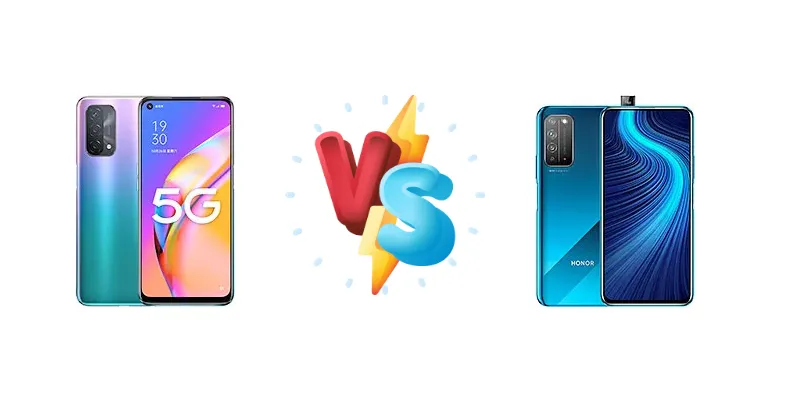
The Oppo A93 5G and Honor X10 5G represent compelling options in the increasingly crowded mid-range 5G smartphone market. While both aim to deliver 5G connectivity at an accessible price point, they diverge significantly in their core hardware. This comparison dissects those differences, focusing on the impact of the Snapdragon 480 versus the Kirin 820 on real-world performance and user experience.
🏆 Quick Verdict
For the average user prioritizing overall performance and future-proofing, the Honor X10 5G is the clear winner. Its Kirin 820 chipset, built on a 7nm process, provides a substantial performance advantage over the Oppo A93 5G’s Snapdragon 480. While the Oppo offers slightly faster charging, the Honor’s superior processing power outweighs this benefit.
| Network |
|---|
| 2G bands | GSM 850 / 900 / 1800 / 1900 | GSM 850 / 900 / 1800 / 1900 |
| 3G bands | HSDPA 850 / 900 / 1900 / 2100 | HSDPA 800 / 850 / 900 / 1700(AWS) / 1900 / 2100 |
| 4G bands | 1, 3, 5, 8, 34, 38, 39, 40, 41 | 1, 2, 3, 4, 5, 8, 18, 19, 26, 34, 38, 39, 40, 41 |
| 5G bands | 1, 28, 41, 77, 78 SA/NSA | 1, 3, 38, 41, 77, 78, 79, 80, 84 SA/NSA |
| Speed | HSPA, LTE, 5G | HSPA 42.2/5.76 Mbps, LTE (4CA) Cat12 600/50 Mbps, 5G 2.3 Gbps DL |
| Technology | GSM / CDMA / HSPA / EVDO / LTE / 5G | GSM / CDMA / HSPA / EVDO / LTE / 5G |
| | CDMA2000 1xEV-DO | CDMA2000 1xEV-DO |
| Launch |
|---|
| Announced | 2021, January 14 | 2020, May 20. Released 2020, May 26 |
| Status | Available. Released 2021, January 20 | Discontinued |
| Body |
|---|
| Build | - | Glass front (Aluminosilicate glass) |
| Dimensions | 162.9 x 74.7 x 8.4 mm (6.41 x 2.94 x 0.33 in) | 163.7 x 76.5 x 8.8 mm (6.44 x 3.01 x 0.35 in) |
| SIM | Nano-SIM + Nano-SIM | Nano-SIM + Nano-SIM |
| Weight | 188 g (6.63 oz) | 203 g (7.16 oz) |
| Display |
|---|
| Protection | - | Aluminosilicate glass |
| Resolution | 1080 x 2400 pixels, 20:9 ratio (~405 ppi density) | 1080 x 2400 pixels, 20:9 ratio (~397 ppi density) |
| Size | 6.5 inches, 102.0 cm2 (~83.8% screen-to-body ratio) | 6.63 inches, 106.1 cm2 (~84.7% screen-to-body ratio) |
| Type | IPS LCD, 90Hz, 480 nits (typ) | IPS LCD, 90Hz |
| Platform |
|---|
| CPU | Octa-core (2x2.0 GHz Kryo 460 & 6x1.8 GHz Kryo 460) | Octa-core (1x2.36 GHz Cortex-A76 & 3x2.22 GHz Cortex-A76 & 4x1.84 GHz Cortex-A55) |
| Chipset | Qualcomm SM4350 Snapdragon 480 5G (8 nm) | Kirin 820 5G (7 nm) |
| GPU | Adreno 619 | Mali-G57 (6-core) |
| OS | Android 11, ColorOS 11.1 | Android 10, Magic UI 3.1, no Google Play Services |
| Memory |
|---|
| Card slot | microSDXC | Nano Memory (uses shared SIM slot) |
| Internal | 128GB 8GB RAM, 256GB 8GB RAM | 64GB 6GB RAM, 128GB 6GB RAM, 128GB 8GB RAM |
| | UFS | - |
| Main Camera |
|---|
| Features | LED flash, HDR, panorama | LED flash, panorama, HDR |
| Triple | 48 MP, f/1.8, 26mm (wide), 1/2.0", 0.8µm, PDAF
Auxiliary lens | 40 MP, f/1.8, 26mm (wide), 1/1.7", PDAF
8 MP, f/2.4, 17mm, 120˚ (ultrawide)
Auxiliary lens |
| Video | 1080p@30fps, gyro-EIS | 4K@30fps, 1080p@30fps, 720p@960fps, gyro-EIS |
| Selfie camera |
|---|
| Features | HDR | HDR |
| Single | 8 MP, f/2.0, (wide) | Motorized pop-up 16 MP, f/2.2, 24mm (wide), 1/3.06", 1.0µm |
| Video | 1080p@30fps | 1080p@30fps |
| Sound |
|---|
| 3.5mm jack | Yes | Yes |
| 35mm jack | Yes | Yes |
| Loudspeaker | Yes | Yes |
| Comms |
|---|
| Bluetooth | 5.1, A2DP, LE, aptX HD | 5.1, A2DP, LE |
| NFC | Yes | No |
| Positioning | GPS, GLONASS, GALILEO, BDS, QZSS | GPS, GLONASS, BDS |
| Radio | No | No |
| USB | USB Type-C 2.0, OTG | USB Type-C 2.0, OTG |
| WLAN | Wi-Fi 802.11 a/b/g/n/ac, dual-band, Wi-Fi Direct | Wi-Fi 802.11 a/b/g/n/ac, dual-band, Wi-Fi Direct |
| Features |
|---|
| Sensors | Fingerprint (side-mounted), accelerometer, proximity, compass | Fingerprint (side-mounted), accelerometer, gyro, proximity, compass |
| Battery |
|---|
| Charging | 18W wired | 22.5W wired
5W reverse wired |
| Type | Li-Po 5000 mAh | Li-Po 4300 mAh |
| Misc |
|---|
| Colors | Black, White, Aurora | Blue, Orange, Black, Silver |
| Models | PCGM00, PEHM00, PEHT00 | TEL-AN00, TEL-TN00, TEL-AN00a, TEL-AN10 |
| Price | About 260 EUR | About 250 EUR |
Oppo A93 5G
- Slightly faster wired charging (18W)
- Potentially more affordable price point
- Qualcomm chipset benefits from widespread software optimization
- Significantly weaker processor performance
- Less efficient chipset (Snapdragon 480)
- Lacks reverse wireless charging
Honor X10 5G
- Superior processor performance (Kirin 820)
- Faster wired charging (22.5W) with reverse charging
- More efficient chipset (7nm process)
- Potential software support concerns (Honor)
- May be slightly more expensive
- Kirin chipsets have historically had less widespread software optimization compared to Qualcomm
Display Comparison
Neither device boasts a particularly standout display. Specifics regarding panel type (IPS vs AMOLED) and resolution are missing, but the focus here is on processing power. Bezels are likely comparable given the market segment. The absence of high refresh rate information suggests both are likely 60Hz panels. Display quality will likely be a minor differentiator.
Camera Comparison
Without detailed camera sensor information, a direct comparison is limited. However, the chipset plays a role in image processing. The Kirin 820’s more powerful ISP (Image Signal Processor) will likely result in better image quality, particularly in low-light conditions, and faster processing of HDR photos. The Oppo A93 5G will likely rely more heavily on software processing to compensate for a less capable ISP. The presence of a 2MP macro camera on either device is unlikely to significantly impact the overall camera experience.
Performance
The core difference lies in the chipsets. The Honor X10 5G’s Kirin 820 5G, fabricated on a 7nm process, features a more sophisticated CPU configuration – a 1x2.36 GHz Cortex-A76, 3x2.22 GHz Cortex-A76, and 4x1.84 GHz Cortex-A55 – compared to the Oppo A93 5G’s Qualcomm SM4350 Snapdragon 480 5G (8nm) with its 2x2.0 GHz Kryo 460 & 6x1.8 GHz Kryo 460. This translates to significantly better multi-core performance for the Honor device. The Kirin 820’s architecture, with more powerful Cortex-A76 cores, will handle demanding tasks and multitasking with greater ease. The Snapdragon 480, while capable, is geared towards efficiency and basic functionality. Users who intend to play graphically intensive games or frequently edit photos/videos will see a substantial benefit from the Honor X10 5G.
Battery Life
The Honor X10 5G offers 22.5W wired charging, exceeding the Oppo A93 5G’s 18W charging. This means faster top-ups, reducing downtime. The Honor X10 5G also includes 5W reverse wired charging, a feature absent on the Oppo. While battery capacity isn’t specified, the more efficient Kirin 820 chipset in the Honor X10 5G may offset a potentially smaller battery size, resulting in comparable real-world battery life. The faster charging speed of the Honor is a tangible benefit for users who frequently need to quickly replenish their battery.
Buying Guide
Buy the Oppo A93 5G if you need a basic 5G phone for everyday tasks like browsing, social media, and light communication, and prioritize a slightly faster charging experience. Buy the Honor X10 5G if you prefer a smoother, more responsive experience for multitasking, gaming, and demanding applications, and value a more powerful processor for long-term usability.
Frequently Asked Questions
❓ Is the Kirin 820 known to overheat under sustained load, like during gaming?
While the Kirin 820 isn't as renowned for thermal efficiency as flagship chipsets, it generally manages heat well within the context of a mid-range device. The 7nm process helps, and the Honor X10 5G likely incorporates adequate cooling solutions. Expect some throttling during extended, demanding gaming sessions, but it shouldn't be severe enough to render the phone unusable.
❓ How much of a real-world performance difference will I notice between the Snapdragon 480 and the Kirin 820 in everyday tasks?
For basic tasks like browsing, social media, and messaging, the difference will be minimal. However, when multitasking, opening numerous apps, or playing graphically intensive games, the Kirin 820 will provide a noticeably smoother and more responsive experience. The Honor X10 5G will feel significantly faster and more capable in these scenarios.
❓ Does the Oppo A93 5G support VoLTE and 5G on all carriers?
Compatibility with VoLTE and 5G bands varies by carrier and region. It's crucial to check with your specific carrier to ensure the Oppo A93 5G is fully compatible with their network before purchasing. The Snapdragon 480 generally offers broad carrier support, but regional variations exist.
❓ What is the long-term software support outlook for the Honor X10 5G, given Honor's separation from Huawei?
Honor has committed to providing regular software updates and security patches for its devices. While the initial transition period after separating from Huawei raised concerns, Honor has established its own software development team and is actively releasing updates. However, the long-term support duration may not be as extensive as some other brands.