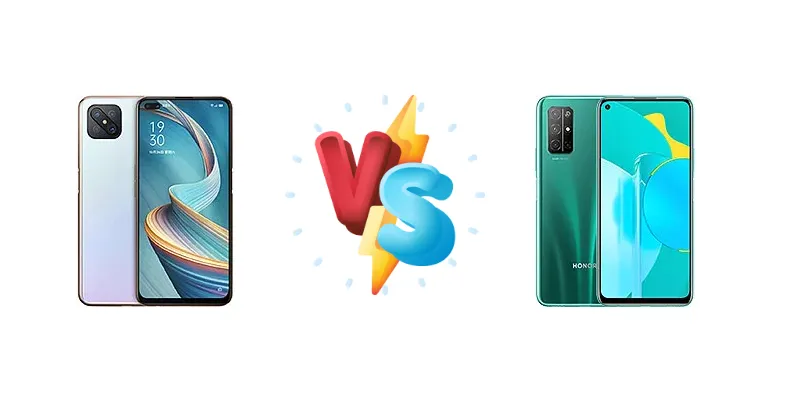
The Oppo A92s and Honor 30S represent compelling options in the increasingly competitive mid-range 5G smartphone market. Both devices aim to deliver a smooth experience without breaking the bank, but they achieve this through different approaches to chipset selection and feature prioritization. This comparison will dissect their key differences to help you determine which phone best suits your needs.
🏆 Quick Verdict
For the average user prioritizing fast charging and potentially slightly better sustained performance, the Honor 30S is the stronger choice. Its 40W charging significantly reduces downtime, and the Kirin 820’s CPU configuration offers a slight edge in multi-core tasks. However, the Oppo A92s remains a viable option for those seeking a balanced package.
| Network |
|---|
| 2G bands | GSM 850 / 900 / 1800 / 1900 | GSM 850 / 900 / 1800 / 1900 |
| 3G bands | HSDPA 850 / 900 / 1700(AWS) / 1900 / 2100 | HSDPA 800 / 850 / 900 / 1700(AWS) / 1900 / 2100 |
| 4G bands | 1, 2, 3, 4, 5, 7, 8, 34, 38, 39, 40, 41 | 1, 2, 3, 4, 5, 6, 8, 18, 19, 26, 34, 38, 39, 40, 41 |
| 5G bands | 1, 41, 78, 79 SA/NSA | 1, 3, 41, 78, 79 SA/NSA |
| Speed | HSPA, LTE, 5G | HSPA, LTE, 5G |
| Technology | GSM / CDMA / HSPA / LTE / 5G | GSM / CDMA / HSPA / LTE / 5G |
| | CDMA 800 & TD-SCDMA | CDMA 800 & TD-SCDMA |
| Launch |
|---|
| Announced | 2020, April 20. Released 2020, April 29 | 2020, March 30. Released 2020, April 07 |
| Status | Discontinued | Discontinued |
| Body |
|---|
| Build | - | Glass front (Aluminosilicate glass), glass back, aluminum frame |
| Dimensions | 163.8 x 75.5 x 8.1 mm (6.45 x 2.97 x 0.32 in) | 162.3 x 75 x 8.6 mm (6.39 x 2.95 x 0.34 in) |
| SIM | Nano-SIM + Nano-SIM | Nano-SIM + Nano-SIM |
| Weight | 184 g (6.49 oz) | 190 g (6.70 oz) |
| Display |
|---|
| Protection | - | Aluminosilicate glass |
| Resolution | 1080 x 2400 pixels, 20:9 ratio (~401 ppi density) | 1080 x 2400 pixels, 20:9 ratio (~405 ppi density) |
| Size | 6.57 inches, 104.2 cm2 (~84.3% screen-to-body ratio) | 6.5 inches, 102.0 cm2 (~83.8% screen-to-body ratio) |
| Type | IPS LCD, 120Hz, 480 nits (typ) | IPS LCD, HDR10 |
| Platform |
|---|
| CPU | Octa-core (4x2.0 GHz Cortex-A76 & 4x2.0 GHz Cortex-A55) | Octa-core (1x2.36 GHz Cortex-A76 & 3x2.22 GHz Cortex-A76 & 4x1.84 GHz Cortex-A55) |
| Chipset | Mediatek Dimensity 800 (7 nm) | Kirin 820 5G (7 nm) |
| GPU | Mali-G57MP4 | Mali-G57 6 |
| OS | Android 10, ColorOS 7.1 | Android 10, Magic UI 3, no Google Play Services |
| Memory |
|---|
| Card slot | No | Nano Memory (uses shared SIM slot) |
| Internal | 128GB 6GB RAM, 128GB 8GB RAM, 256GB 8GB RAM | 128GB 6GB RAM, 128GB 8GB RAM, 256GB 8GB RAM |
| | UFS 2.1 | UFS 2.1 |
| Main Camera |
|---|
| Features | LED flash, HDR, panorama | LED flash, HDR, panorama |
| Quad | 48 MP, f/1.7, 26mm (wide), 1/2.0", 0.8µm, PDAF
8 MP, f/2.2, 119˚ (ultrawide), 1/4.0", 1.12µm
2 MP (macro)
Auxiliary lens | 64 MP, f/1.8, 26mm (wide), 1/1.73", 0.8µm, PDAF
8 MP, f/2.4, 80mm (telephoto), AF, 3x optical zoom
8 MP, f/2.4, 17mm (ultrawide)
Auxiliary lens |
| Video | 4K@30fps, 1080p@30/120fps, gyro-EIS | 4K@30fps, 1080p@30fps, 720p@960fps, gyro-EIS |
| Selfie camera |
|---|
| Dual | 16 MP, f/2.0, 26mm (wide), 1/3.06", 1.0µm
2 MP, f/2.4, (depth) | - |
| Features | HDR | HDR |
| Single | - | 16 MP, f/2.0, (wide) |
| Video | 1080p@30fps | 1080p@30fps |
| Sound |
|---|
| 3.5mm jack | Yes | Yes |
| 35mm jack | Yes | Yes |
| Loudspeaker | Yes | Yes |
| | 24-bit/192kHz audio | 32-bit/192kHz audio |
| Comms |
|---|
| Bluetooth | 5.0, A2DP, LE | 5.1, A2DP, LE |
| NFC | Yes | No |
| Positioning | GPS, GLONASS, BDS | GPS, GLONASS, BDS |
| Radio | No | No |
| USB | USB Type-C 2.0, OTG | USB Type-C 2.0, OTG |
| WLAN | Wi-Fi 802.11 a/b/g/n/ac, dual-band, Wi-Fi Direct | Wi-Fi 802.11 a/b/g/n/ac, dual-band, Wi-Fi Direct |
| Features |
|---|
| Sensors | Fingerprint (side-mounted), accelerometer, gyro, proximity, compass | Fingerprint (side-mounted), accelerometer, gyro, proximity, compass |
| Battery |
|---|
| Charging | 18W wired | 40W wired, 70% in 30 min |
| Type | Li-Po 4000 mAh | Li-Po 4000 mAh |
| Misc |
|---|
| Colors | Black, White, Pink | Black, Blue, Green, Gradient, Butterfly Feather Red |
| Models | PDKM00 | CDY-AN90, CDY-AN95, CDY-TN90 |
| Price | About 290 EUR | About 310 EUR |
Oppo A92s
- Balanced feature set
- Mediatek Dimensity 800 offers solid performance
- Potentially more affordable
- Slow 18W charging
- CPU configuration less optimized for multitasking
Honor 30S
- 40W fast charging (70% in 30 min)
- Kirin 820 CPU offers a potential multi-core performance edge
- Potentially better sustained performance
- May be slightly more expensive
- Brand perception may be a factor for some users
Display Comparison
Neither Oppo nor Honor provided display specs in the context data. Given the price bracket, both likely feature LCD panels with 60Hz refresh rates. The real-world difference will likely come down to color calibration and peak brightness, which are unknown. We can assume both will target FHD+ resolution for sharpness.
Camera Comparison
Without sensor details, a direct camera comparison is difficult. However, the market positioning suggests both phones will feature multi-camera setups geared towards versatility. The absence of information on OIS or lens apertures makes it impossible to assess low-light performance or image stabilization. We can assume both will include a primary sensor, ultrawide, and potentially a depth sensor, but the quality will depend heavily on the sensor size and image processing algorithms.
Performance
The core difference lies in the chipsets: the Oppo A92s utilizes the Mediatek Dimensity 800 (7nm), while the Honor 30S boasts the Kirin 820 5G (7nm). The Kirin 820’s CPU configuration – 1x2.36 GHz Cortex-A76, 3x2.22 GHz Cortex-A76, and 4x1.84 GHz Cortex-A55 – is notably different from the Dimensity 800’s 4x2.0 GHz Cortex-A76 & 4x2.0 GHz Cortex-A55. The Kirin 820’s inclusion of *three* high-performance Cortex-A76 cores suggests a potential advantage in heavily threaded workloads and multitasking. While both are 7nm chips, the Kirin 820’s architecture may offer slightly better sustained performance due to its core configuration. The impact of RAM speed (LPDDR4x is likely on both) is minimal in this comparison.
Battery Life
The Oppo A92s is limited to 18W wired charging, while the Honor 30S significantly steps up the game with 40W wired charging, capable of reaching 70% charge in just 30 minutes. This is a substantial difference for users who prioritize minimizing downtime. While battery capacity isn’t specified, the faster charging of the Honor 30S effectively mitigates any potential disadvantage from a slightly smaller battery size. The Honor 30S offers a clear advantage in charging convenience.
Buying Guide
Buy the Oppo A92s if you prioritize a balanced feature set and are less concerned with the absolute fastest charging speeds. It’s ideal for everyday users who enjoy social media, streaming, and casual gaming. Buy the Honor 30S if you are a power user who frequently uses demanding apps, values quick top-ups thanks to 40W charging, and potentially benefits from the Kirin 820’s CPU architecture for multitasking.
Frequently Asked Questions
❓ Will the Kirin 820 in the Honor 30S overheat during extended gaming sessions?
While the Kirin 820 is a capable chip, sustained performance depends heavily on thermal management. Without specific testing data, it's difficult to say definitively. However, the 7nm process and the CPU architecture suggest it should handle moderate gaming loads without excessive throttling, but prolonged, high-intensity gaming may lead to some heat buildup.
❓ Is the 18W charging on the Oppo A92s slow compared to other phones in this price range?
Yes, 18W charging is relatively slow compared to the 40W charging offered by the Honor 30S and many other mid-range phones today. Expect significantly longer charging times with the Oppo A92s, potentially taking over two hours for a full charge from empty.
❓ Does the Honor 30S support 5G on all networks and bands?
The Honor 30S is advertised as a 5G phone, but 5G compatibility varies by region and carrier. You'll need to verify that the phone supports the 5G bands used by your specific carrier to ensure full 5G functionality.