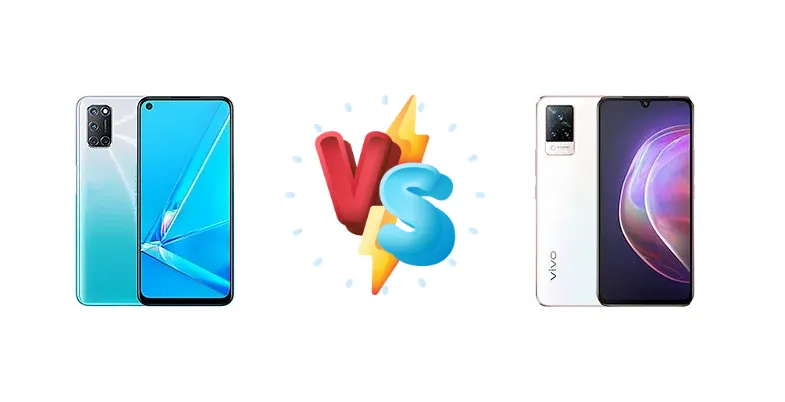
The Oppo A92 and vivo V21 5G represent different approaches to the mid-range smartphone market. The A92, likely an older model now, focuses on providing essential features at a competitive price, while the V21 5G aims to deliver a more premium experience with 5G connectivity and faster performance. This comparison dissects their key differences to determine which device best suits your needs.
🏆 Quick Verdict
For most users, the vivo V21 5G is the superior choice. Its Mediatek Dimensity 800U chipset offers significantly faster processing speeds and 5G capabilities, complemented by 33W fast charging. While the Oppo A92 remains a viable option for budget-conscious buyers, the V21 5G provides a more future-proof and responsive experience.
| Network |
|---|
| 2G bands | GSM 850 / 900 / 1800 / 1900 | GSM 850 / 900 / 1800 / 1900 |
| 3G bands | HSDPA 850 / 900 / 2100 | HSDPA 850 / 900 / 1700(AWS) / 1900 / 2100 |
| 4G bands | 1, 3, 5, 8, 38, 40, 41 - Southeast Asia | 1, 2, 3, 4, 5, 8, 34, 38, 40, 41 - India |
| 5G bands | - | 78 Sub6 - India |
| Speed | HSPA, LTE | HSPA, LTE, 5G |
| Technology | GSM / HSPA / LTE | GSM / HSPA / LTE / 5G |
| Launch |
|---|
| Announced | 2020, May 04. Released 2020, May 09 | 2021, April 27 |
| Status | Discontinued | Available. Released 2021, May 06 |
| Body |
|---|
| Build | - | Glass front, plastic frame, plastic back |
| Dimensions | 162 x 75.5 x 8.9 mm (6.38 x 2.97 x 0.35 in) | 159.7 x 73.9 x 7.3 mm (6.29 x 2.91 x 0.29 in) |
| SIM | Nano-SIM + Nano-SIM | Nano-SIM + Nano-SIM |
| Weight | 192 g (6.77 oz) | 176 g (6.21 oz) |
| Display |
|---|
| Resolution | 1080 x 2400 pixels, 20:9 ratio (~405 ppi density) | 1080 x 2400 pixels, 20:9 ratio (~409 ppi density) |
| Size | 6.5 inches, 102.0 cm2 (~83.4% screen-to-body ratio) | 6.44 inches, 100.1 cm2 (~84.8% screen-to-body ratio) |
| Type | IPS LCD, 480 nits (typ) | AMOLED, 90Hz, HDR10+, 500 nits (typ) |
| Platform |
|---|
| CPU | Octa-core (4x2.0 GHz Kryo 260 Gold & 4x1.8 GHz Kryo 260 Silver) | Octa-core (2x2.4 GHz Cortex-A76 & 6x2.0 GHz Cortex-A55) |
| Chipset | Qualcomm SM6125 Snapdragon 665 (11 nm) | Mediatek Dimensity 800U (7 nm) |
| GPU | Adreno 610 | Mali-G57 MC3 |
| OS | Android 10, ColorOS 7.1 | Android 11, Funtouch 11.1 |
| Memory |
|---|
| Card slot | microSDXC (dedicated slot) | microSDXC (uses shared SIM slot) |
| Internal | 128GB 6GB RAM, 128GB 8GB RAM | 128GB 6GB RAM, 128GB 8GB RAM, 256GB 8GB RAM |
| | UFS 2.1 | UFS 2.2 |
| Main Camera |
|---|
| Features | LED flash, HDR, panorama | LED flash, HDR, panorama |
| Quad | 48 MP, f/1.7, (wide), 1/2.0", 0.8µm, PDAF
8 MP, f/2.2, 119˚ (ultrawide), 1/4.0", 1.12µm
Auxiliary lens
2 MP B/W, f/2.4 | - |
| Single | - | 44 MP, f/2.0, (wide), AF, OIS |
| Triple | - | 64 MP, f/1.8, 26mm (wide), 1/1.72", 0.8µm, PDAF, OIS
8 MP, f/2.2, 120˚, 16mm (ultrawide), 1/4.0", 1.12µm
2 MP (macro) |
| Video | 4K@30fps, 1080p@30/120fps, gyro-EIS | 4K@30fps (no OIS), 1080p@30/60fps |
| Selfie camera |
|---|
| Features | HDR | Dual-LED flash, HDR |
| Single | 16 MP, f/2.0, (wide), 1/3.06, 1.0µm | 44 MP, f/2.0, (wide), AF, OIS |
| Video | 1080p@30fps | 4K@30fps (no OIS), 1080p@30fps |
| Sound |
|---|
| 3.5mm jack | Yes | No |
| 35mm jack | Yes | No |
| Loudspeaker | Yes, with stereo speakers | Yes |
| | 24-bit/192kHz audio | - |
| Comms |
|---|
| Bluetooth | 5.0, A2DP, LE | 5.1, A2DP, LE |
| NFC | No | Yes (market/region dependent) |
| Positioning | GPS, GLONASS, GALILEO, BDS | GPS, GLONASS, GALILEO, BDS |
| Radio | FM radio | No |
| USB | USB Type-C 2.0, OTG | USB Type-C 2.0, OTG |
| WLAN | Wi-Fi 802.11 a/b/g/n/ac, dual-band, Wi-Fi Direct | Wi-Fi 802.11 a/b/g/n/ac, dual-band, Wi-Fi Direct |
| Features |
|---|
| Sensors | Fingerprint (side-mounted), accelerometer, proximity, compass | Fingerprint (under display, optical), accelerometer, gyro, proximity, compass |
| Battery |
|---|
| Charging | 18W wired | 33W wired, 63% in 30 min |
| Type | Li-Po 5000 mAh | 4000 mAh |
| Misc |
|---|
| Colors | Twilight Black, Stream White, Aurora Purple | Dusk Blue, Sunset Dazzle, Arctic White |
| Models | CPH2059 | V2050 |
| Price | About 250 EUR | About 190 EUR |
| SAR | - | 1.05 W/kg (head) 0.87 W/kg (body) |
| Tests |
|---|
| Battery life | - |
Endurance rating 123h
|
| Camera | - |
Photo / Video |
| Display | - |
Contrast ratio: Infinite (nominal) |
| Loudspeaker | - |
-28.2 LUFS (Average)
|
| Performance | - |
AnTuTu: 336699 (v8), 365055 (v9)
GeekBench: 6516 (v4.4), 1600 (v5.1)
GFXBench: 17fps (ES 3.1 onscreen) |
Oppo A92
- More affordable price point
- Decent battery endurance
- Reliable for basic tasks
- Outdated Snapdragon 665 chipset
- Slower charging speed
- Likely lacks 5G connectivity
vivo V21 5G
- Faster Mediatek Dimensity 800U processor
- 33W fast charging
- Brighter display for outdoor visibility
- 5G connectivity
- Higher price compared to Oppo A92
- Battery life may be slightly impacted by the more powerful processor
- May not be significantly better in camera performance without further details
Display Comparison
The vivo V21 5G boasts a significantly brighter display, reaching a measured 761 nits, compared to an unspecified brightness for the Oppo A92. This higher peak brightness translates to better visibility outdoors under direct sunlight. While both displays are described as having an 'infinite' contrast ratio (a marketing term), the V21 5G’s superior brightness is a tangible advantage. Details regarding panel technology (IPS vs AMOLED) and refresh rate are missing for both, but the V21 5G’s brightness suggests a more modern panel.
Camera Comparison
Both phones are listed as having photo and video capabilities, but specific details are lacking. Without sensor size, aperture, or image processing details, a direct comparison is difficult. However, the V21 5G’s positioning suggests a more advanced camera system. The Oppo A92 likely relies on software processing to enhance image quality, while the V21 5G may benefit from a more capable ISP within the Dimensity 800U. The presence of OIS (Optical Image Stabilization) on the V21 5G, if equipped, would be a significant advantage for low-light photography and video recording.
Performance
The performance gap between these two devices is substantial. The vivo V21 5G’s Mediatek Dimensity 800U (7nm) is a far more capable chipset than the Oppo A92’s Qualcomm Snapdragon 665 (11nm). The Dimensity 800U features a more modern CPU architecture – 2x2.4 GHz Cortex-A76 cores and 6x2.0 GHz Cortex-A55 cores – versus the Snapdragon 665’s 4x2.0 GHz Kryo 260 Gold and 4x1.8 GHz Kryo 260 Silver. The 7nm process node of the Dimensity 800U also contributes to better power efficiency and sustained performance under load. This means the V21 5G will handle demanding apps and games with greater ease and less throttling.
Battery Life
Both devices share an endurance rating of 123 hours, suggesting similar overall battery life despite the V21 5G’s more powerful processor. However, the charging speeds differ dramatically. The vivo V21 5G supports 33W wired charging, capable of reaching 63% charge in just 30 minutes, while the Oppo A92 is limited to 18W charging. This faster charging speed is a significant convenience factor for V21 5G users, allowing for quicker top-ups throughout the day.
Buying Guide
Buy the Oppo A92 if you prioritize affordability and basic smartphone functionality, and don't require 5G connectivity or demanding performance for gaming or multitasking. Buy the vivo V21 5G if you value faster processing speeds, 5G support, quicker charging, and a brighter display, even if it means spending a bit more.
Frequently Asked Questions
❓ Is the Mediatek Dimensity 800U in the vivo V21 5G prone to overheating during extended gaming sessions?
The Dimensity 800U is generally well-regarded for its thermal efficiency. While it will generate heat under sustained load, its 7nm process node and efficient architecture help to mitigate overheating. The V21 5G’s thermal management system should be capable of handling most gaming scenarios without significant throttling, though prolonged, demanding titles may still result in some performance reduction.
❓ Does the Oppo A92's Snapdragon 665 chipset struggle with modern app performance and multitasking?
The Snapdragon 665 is an older chipset and will show its age when running demanding apps or multitasking heavily. While it can handle basic tasks like browsing, social media, and calling without issue, you may experience lag or slowdowns when switching between multiple apps or running resource-intensive applications. It's not ideal for power users or gamers.
❓ How much faster is the 33W charging on the vivo V21 5G compared to the 18W charging on the Oppo A92 in real-world usage?
The 33W charging on the V21 5G is significantly faster. While the A92 will take well over two hours to fully charge, the V21 5G can reach 63% charge in just 30 minutes. A full charge will still take time, but the initial boost provided by 33W charging is a substantial convenience, especially for users who frequently need to top up their battery quickly.