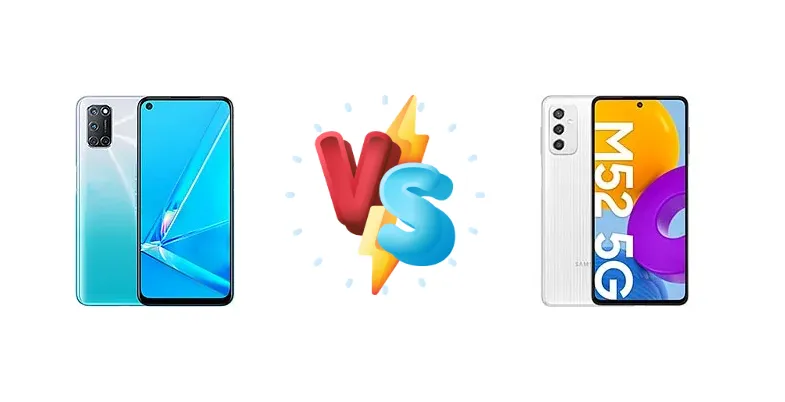
The Oppo A92 and Samsung Galaxy M52 5G represent different approaches to the mid-range smartphone market. The A92, powered by the Snapdragon 665, aims for affordability, while the M52 5G, with its Snapdragon 778G, prioritizes performance and 5G connectivity. This comparison dissects their key differences to determine which device delivers the best value.
🏆 Quick Verdict
For most users, the Samsung Galaxy M52 5G is the clear winner. Its Snapdragon 778G chipset provides a substantial performance advantage over the Oppo A92’s Snapdragon 665, making it better suited for demanding tasks and future-proofing. While both offer similar battery endurance, the M52 5G’s faster 25W charging is a significant convenience.
| Network |
|---|
| 2G bands | GSM 850 / 900 / 1800 / 1900 | GSM 850 / 900 / 1800 / 1900 |
| 3G bands | HSDPA 850 / 900 / 2100 | HSDPA 850 / 900 / 1700(AWS) / 1900 / 2100 |
| 4G bands | 1, 3, 5, 8, 38, 40, 41 - Southeast Asia | 1, 2, 3, 4, 5, 7, 8, 12, 17, 20, 26, 28, 38, 40, 41, 66 |
| 5G bands | - | SA/NSA/Sub6 |
| Speed | HSPA, LTE | HSPA, LTE, 5G |
| Technology | GSM / HSPA / LTE | GSM / HSPA / LTE / 5G |
| Launch |
|---|
| Announced | 2020, May 04. Released 2020, May 09 | 2021, September 24 |
| Status | Discontinued | Available. Released 2021, October 03 |
| Body |
|---|
| Build | - | Glass front (Gorilla Glass 5), plastic frame, plastic back |
| Dimensions | 162 x 75.5 x 8.9 mm (6.38 x 2.97 x 0.35 in) | 164.2 x 76.4 x 7.4 mm (6.46 x 3.01 x 0.29 in) |
| SIM | Nano-SIM + Nano-SIM | Nano-SIM + Nano-SIM |
| Weight | 192 g (6.77 oz) | 173 g (6.10 oz) |
| Display |
|---|
| Protection | - | Corning Gorilla Glass 5 |
| Resolution | 1080 x 2400 pixels, 20:9 ratio (~405 ppi density) | 1080 x 2400 pixels, 20:9 ratio (~393 ppi density) |
| Size | 6.5 inches, 102.0 cm2 (~83.4% screen-to-body ratio) | 6.7 inches, 108.4 cm2 (~86.4% screen-to-body ratio) |
| Type | IPS LCD, 480 nits (typ) | Super AMOLED Plus, 120Hz |
| Platform |
|---|
| CPU | Octa-core (4x2.0 GHz Kryo 260 Gold & 4x1.8 GHz Kryo 260 Silver) | Octa-core (1x2.4 GHz Cortex-A78 & 3x2.2 GHz Cortex-A78 & 4x1.9 GHz Cortex-A55) |
| Chipset | Qualcomm SM6125 Snapdragon 665 (11 nm) | Qualcomm SM7325 Snapdragon 778G 5G (6 nm) |
| GPU | Adreno 610 | Adreno 642L |
| OS | Android 10, ColorOS 7.1 | Android 11, upgradable to Android 13, One UI 5.1 |
| Memory |
|---|
| Card slot | microSDXC (dedicated slot) | microSDXC (uses shared SIM slot) |
| Internal | 128GB 6GB RAM, 128GB 8GB RAM | 128GB 6GB RAM, 128GB 8GB RAM |
| | UFS 2.1 | - |
| Main Camera |
|---|
| Features | LED flash, HDR, panorama | LED flash, panorama, HDR |
| Quad | 48 MP, f/1.7, (wide), 1/2.0", 0.8µm, PDAF
8 MP, f/2.2, 119˚ (ultrawide), 1/4.0", 1.12µm
Auxiliary lens
2 MP B/W, f/2.4 | - |
| Single | - | 32 MP, f/2.2, 26mm (wide) |
| Triple | - | 64 MP, f/1.8, 26mm (wide), 1/1.97", 0.7um, PDAF
12 MP, f/2.2, 123˚, (ultrawide), 1/3.06", 1.12µm
5 MP (macro) |
| Video | 4K@30fps, 1080p@30/120fps, gyro-EIS | 4K@30fps, 1080p@30/60fps |
| Selfie camera |
|---|
| Features | HDR | - |
| Single | 16 MP, f/2.0, (wide), 1/3.06, 1.0µm | 32 MP, f/2.2, 26mm (wide) |
| Video | 1080p@30fps | 4K@30fps, 1080p@30fps |
| Sound |
|---|
| 3.5mm jack | Yes | No |
| 35mm jack | Yes | No |
| Loudspeaker | Yes, with stereo speakers | Yes |
| | 24-bit/192kHz audio | - |
| Comms |
|---|
| Bluetooth | 5.0, A2DP, LE | 5.0, A2DP, LE |
| NFC | No | Yes |
| Positioning | GPS, GLONASS, GALILEO, BDS | GPS, GLONASS, GALILEO, BDS, QZSS |
| Radio | FM radio | Unspecified |
| USB | USB Type-C 2.0, OTG | USB Type-C 2.0, OTG |
| WLAN | Wi-Fi 802.11 a/b/g/n/ac, dual-band, Wi-Fi Direct | Wi-Fi 802.11 a/b/g/n/ac/6, dual-band, Wi-Fi Direct |
| Features |
|---|
| Sensors | Fingerprint (side-mounted), accelerometer, proximity, compass | Fingerprint (side-mounted), accelerometer, gyro, proximity, compass |
| Battery |
|---|
| Charging | 18W wired | 25W wired |
| Type | Li-Po 5000 mAh | Li-Ion 5000 mAh |
| Misc |
|---|
| Colors | Twilight Black, Stream White, Aurora Purple | Icy Blue, Blazing Black, White |
| Models | CPH2059 | SM-M526BR, SM-M526BR/DS, SM-M526B, SM-M526B/DS |
| Price | About 250 EUR | About 300 EUR |
| SAR EU | - | 0.79 W/kg (head) 1.40 W/kg (body) |
| Tests |
|---|
| Battery life | - |
Endurance rating 123h
|
| Camera | - |
Photo / Video |
| Display | - |
Contrast ratio: Infinite (nominal) |
| Loudspeaker | - |
-30.0 LUFS (Average)
|
| Performance | - |
AnTuTu: 504424 (v9)
GeekBench: 2796 (v5.1)
GFXBench: 28fps (ES 3.1 onscreen) |
Oppo A92
- More affordable price point
- Acceptable battery life for basic use
- Lightweight design (assumed based on market segment)
- Significantly weaker performance
- Slower charging speed
- Likely inferior camera quality
Samsung Galaxy M52 5G
- Superior performance with Snapdragon 778G
- Faster 25W charging
- Brighter and more vibrant display
- Higher price tag
- Potentially larger and heavier design
- May not be significantly better for extremely basic tasks
Display Comparison
The Samsung Galaxy M52 5G boasts a significantly brighter display, reaching a measured 777 nits, compared to the Oppo A92’s unspecified brightness. This higher peak brightness translates to better visibility outdoors under direct sunlight. While both displays have an 'infinite' contrast ratio (typical for LCD/AMOLED panels), the M52 5G’s superior brightness is a key advantage. Details regarding panel technology (LCD vs AMOLED) for the A92 are missing, but the M52 5G’s brightness alone makes it the superior option for media consumption and general usability.
Camera Comparison
Both phones feature photo and video capabilities, but detailed camera specifications are limited. Without sensor size or aperture information for either device, a direct comparison is difficult. However, the Snapdragon 778G’s image signal processor (ISP) in the M52 5G is considerably more advanced than the ISP in the Snapdragon 665, enabling better image processing, noise reduction, and dynamic range. The M52 5G is likely to deliver superior image quality, especially in challenging lighting conditions. The presence of a dedicated 2MP macro camera on the A92 is unlikely to provide a significant benefit due to its small sensor size.
Performance
The performance gap between these two devices is substantial. The Samsung Galaxy M52 5G’s Snapdragon 778G (6nm) is a far more capable chipset than the Oppo A92’s Snapdragon 665 (11nm). The 778G features a Cortex-A78 prime core clocked at 2.4 GHz, alongside three additional A78 cores, offering significantly improved CPU performance. The 665 relies on older Kryo 260 cores. Furthermore, the 6nm process node of the 778G results in better power efficiency and reduced thermal throttling during sustained workloads. Gamers and power users will overwhelmingly benefit from the M52 5G’s superior processing power.
Battery Life
Both the Oppo A92 and Samsung Galaxy M52 5G achieve an endurance rating of 123 hours, suggesting comparable battery life under similar usage patterns. However, the M52 5G’s 25W wired charging is significantly faster than the A92’s 18W charging. This means the M52 5G can replenish its battery much more quickly, reducing downtime. While both offer all-day battery life for moderate users, the M52 5G’s faster charging provides a more convenient user experience.
Buying Guide
Buy the Oppo A92 if you prioritize extreme budget-friendliness and only need a phone for basic tasks like calls, messaging, and light social media. Buy the Samsung Galaxy M52 5G if you value performance for gaming, multitasking, and 5G connectivity, and are willing to spend a bit more for a smoother, more responsive experience. The M52 5G is the better choice for users who plan to keep their phone for several years.
Frequently Asked Questions
❓ Is the Snapdragon 778G in the M52 5G capable of handling demanding games like Genshin Impact or Call of Duty Mobile?
Yes, the Snapdragon 778G is a very capable chipset for mobile gaming. It can comfortably run Genshin Impact and Call of Duty Mobile at medium to high settings with stable frame rates. The Adreno 642L GPU provides ample graphical power for a smooth gaming experience.
❓ Does the Samsung Galaxy M52 5G support carrier aggregation for faster 5G speeds?
While specific carrier aggregation support varies by region and carrier, the Snapdragon 778G generally supports a wide range of 5G bands and carrier aggregation technologies. This allows for faster and more reliable 5G connectivity when available from your mobile carrier.
❓ How long does it realistically take to fully charge the Samsung Galaxy M52 5G from 0% with the included 25W charger?
With the included 25W charger, the Samsung Galaxy M52 5G typically takes around 60-75 minutes to fully charge from 0% to 100%. This is significantly faster than the Oppo A92’s 18W charging, which would likely take over 2 hours.
❓ Is the Oppo A92 a good choice for someone who primarily uses their phone for calls, texts, and basic web browsing?
Yes, the Oppo A92 is a suitable option for users with very basic smartphone needs. Its Snapdragon 665 chipset is sufficient for these tasks, and its lower price point makes it an attractive choice for budget-conscious consumers. However, it will struggle with more demanding applications.