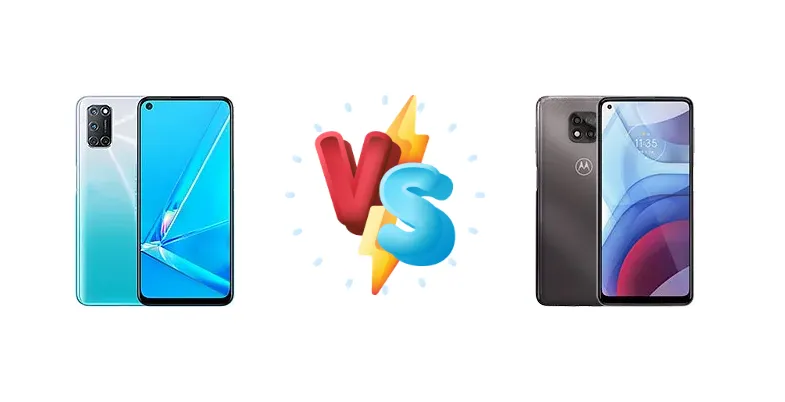
Both the Oppo A92 and the Motorola Moto G Power (2021) target the budget-conscious smartphone user, but they employ slightly different approaches. The A92, released earlier, features the Snapdragon 665, while the 2021 Moto G Power utilizes the Snapdragon 662. This comparison dissects the nuances between these two closely related chipsets and their impact on overall user experience, focusing on performance, battery, and charging.
🏆 Quick Verdict
For the average user prioritizing sustained performance and slightly faster charging, the Oppo A92 edges out the Motorola Moto G Power (2021). While the Snapdragon 662 offers incremental improvements, the 18W charging on the A92 provides a more noticeable benefit in daily use, offsetting the minor chipset differences.
| Network |
|---|
| 2G bands | GSM 850 / 900 / 1800 / 1900 | GSM 850 / 900 / 1800 / 1900 |
| 3G bands | HSDPA 850 / 900 / 2100 | HSDPA 850 / 900 / 1700(AWS) / 1900 / 2100 |
| 4G bands | 1, 3, 5, 8, 38, 40, 41 - Southeast Asia | 1, 2, 3, 4, 5, 7, 8, 12, 13, 14, 17, 25, 26, 29, 30, 38, 41, 66, 71 |
| Speed | HSPA, LTE | HSPA, LTE |
| Technology | GSM / HSPA / LTE | GSM / CDMA / HSPA / EVDO / LTE |
| | - | CDMA2000 1xEV-DO |
| Launch |
|---|
| Announced | 2020, May 04. Released 2020, May 09 | 2021, January 08 |
| Status | Discontinued | Available. Released 2021, January 14 |
| Body |
|---|
| Build | - | Glass front, plastic back, plastic frame |
| Dimensions | 162 x 75.5 x 8.9 mm (6.38 x 2.97 x 0.35 in) | 165.3 x 75.9 x 9.5 mm (6.51 x 2.99 x 0.37 in) |
| SIM | Nano-SIM + Nano-SIM | Nano-SIM |
| Weight | 192 g (6.77 oz) | 206.5 g (7.30 oz) |
| | - | Water-repellent coating |
| Display |
|---|
| Resolution | 1080 x 2400 pixels, 20:9 ratio (~405 ppi density) | 720 x 1600 pixels, 20:9 ratio (~266 ppi density) |
| Size | 6.5 inches, 102.0 cm2 (~83.4% screen-to-body ratio) | 6.6 inches, 105.2 cm2 (~83.8% screen-to-body ratio) |
| Type | IPS LCD, 480 nits (typ) | IPS LCD |
| Platform |
|---|
| CPU | Octa-core (4x2.0 GHz Kryo 260 Gold & 4x1.8 GHz Kryo 260 Silver) | Octa-core (4x2.0 GHz Kryo 260 Gold & 4x1.8 GHz Kryo 260 Silver) |
| Chipset | Qualcomm SM6125 Snapdragon 665 (11 nm) | Qualcomm SM6115 Snapdragon 662 (11 nm) |
| GPU | Adreno 610 | Adreno 610 |
| OS | Android 10, ColorOS 7.1 | Android 10 |
| Memory |
|---|
| Card slot | microSDXC (dedicated slot) | microSDXC (dedicated slot) |
| Internal | 128GB 6GB RAM, 128GB 8GB RAM | 32GB 3GB RAM, 64GB 4GB RAM |
| | UFS 2.1 | eMMC 5.1 |
| Main Camera |
|---|
| Features | LED flash, HDR, panorama | LED flash, HDR, panorama |
| Quad | 48 MP, f/1.7, (wide), 1/2.0", 0.8µm, PDAF
8 MP, f/2.2, 119˚ (ultrawide), 1/4.0", 1.12µm
Auxiliary lens
2 MP B/W, f/2.4 | - |
| Triple | - | 48 MP, f/1.7, (wide), 1/2.0", 0.8µm, PDAF
2 MP (macro)
Auxiliary lens |
| Video | 4K@30fps, 1080p@30/120fps, gyro-EIS | 1080p@30/60fps, gyro-EIS |
| Selfie camera |
|---|
| Features | HDR | HDR |
| Single | 16 MP, f/2.0, (wide), 1/3.06, 1.0µm | 8 MP, f/2.0, 1.12µm |
| Video | 1080p@30fps | 1080p@30fps, gyro-EIS |
| Sound |
|---|
| 3.5mm jack | Yes | Yes |
| 35mm jack | Yes | Yes |
| Loudspeaker | Yes, with stereo speakers | Yes |
| | 24-bit/192kHz audio | - |
| Comms |
|---|
| Bluetooth | 5.0, A2DP, LE | 5.0, A2DP, LE |
| NFC | No | No |
| Positioning | GPS, GLONASS, GALILEO, BDS | GPS, GLONASS, GALILEO |
| Radio | FM radio | FM radio |
| USB | USB Type-C 2.0, OTG | USB Type-C 2.0 |
| WLAN | Wi-Fi 802.11 a/b/g/n/ac, dual-band, Wi-Fi Direct | Wi-Fi 802.11 a/b/g/n/ac, dual-band, Wi-Fi Direct |
| Features |
|---|
| Sensors | Fingerprint (side-mounted), accelerometer, proximity, compass | Fingerprint (side-mounted), accelerometer, gyro, proximity, compass, barometer |
| Battery |
|---|
| Charging | 18W wired | 15W wired |
| Type | Li-Po 5000 mAh | Li-Po 5000 mAh |
| Misc |
|---|
| Colors | Twilight Black, Stream White, Aurora Purple | Flash Gray, Polar Silver |
| Models | CPH2059 | - |
| Price | About 250 EUR | About 60 EUR |
Oppo A92
- Faster 18W charging
- Potentially better sustained performance due to chipset
- May offer more vibrant image processing
- Likely smaller battery capacity
- Oppo’s ColorOS may not appeal to all users
Motorola Moto G Power (2021)
- Likely larger battery capacity for extended runtime
- Motorola’s near-stock Android experience
- Generally more affordable
- Slower 15W charging
- Slightly less powerful chipset
- May have less optimized thermal management
Display Comparison
Neither Oppo nor Motorola provide display specifications in the provided data. However, given the price point, both likely utilize LCD panels with 720p+ resolution. The absence of high refresh rates is expected. The real-world difference will likely come down to color calibration and peak brightness, which are unknown. Bezels are also likely comparable, typical of this segment.
Camera Comparison
The provided data doesn't detail camera specifications. Given the market segment, both phones likely feature a multi-camera setup with a primary sensor, an ultrawide, and potentially a macro or depth sensor. The image processing algorithms will be a significant differentiator, with Motorola generally favoring a more natural look while Oppo often boosts saturation. Without sensor size or aperture information, a definitive camera comparison is impossible. The inclusion of a 2MP macro lens on either device is likely more for marketing than practical use.
Performance
Both devices are equipped with octa-core CPUs featuring the same Kryo 260 Gold (2.0 GHz) and Kryo 260 Silver (1.8 GHz) core configuration. The key difference lies in the chipset: the Oppo A92 uses the Qualcomm SM6125 Snapdragon 665, while the Moto G Power (2021) uses the SM6115 Snapdragon 662. The 662 is a slightly refined version of the 665, offering minor improvements in CPU and GPU performance. However, these differences are unlikely to be noticeable in everyday tasks. Both phones will handle social media, web browsing, and light multitasking without issue. The Snapdragon 665 in the A92 *may* have a slight edge in sustained performance due to potentially better thermal management, though this is speculative without detailed thermal testing.
Battery Life
Battery capacity isn't specified, but the Moto G Power line is renowned for its large batteries. It's reasonable to assume the 2021 model has a larger capacity than the A92. However, the A92 compensates with 18W wired charging, while the Moto G Power (2021) is limited to 15W. This means the A92 will likely achieve a 0-100% charge faster, even if the Moto G Power’s larger battery provides longer overall runtime. The difference in charging speed will be more noticeable for users who frequently top up their phones throughout the day.
Buying Guide
Buy the Oppo A92 if you need a phone that charges a bit faster and potentially handles extended gaming sessions with slightly better thermal headroom. Buy the Motorola Moto G Power (2021) if you prioritize maximizing battery life and prefer Motorola’s clean Android software experience, accepting a slower charging rate as a trade-off.
Frequently Asked Questions
❓ Will I notice a difference in gaming performance between the Snapdragon 665 and 662?
The difference in gaming performance between the Snapdragon 665 and 662 is minimal. Both chipsets can handle less demanding mobile games, but you'll likely need to lower graphics settings for more intensive titles. The A92 *might* maintain slightly higher frame rates for longer periods due to potentially better thermal management, but this is not guaranteed.
❓ How long will it take to fully charge each phone?
With 18W charging, the Oppo A92 should reach a full charge in approximately 2-2.5 hours. The Motorola Moto G Power (2021), with its 15W charging, will likely take closer to 3-3.5 hours to fully charge, assuming similar battery capacities. This difference is significant for users who prefer quicker top-ups.
❓ Does the Motorola Moto G Power (2021) support fast charging standards like Quick Charge?
While the Moto G Power (2021) supports 15W charging, it doesn't fully utilize the Quick Charge standard. It's compatible with some Quick Charge chargers, but won't achieve the maximum charging speeds offered by those chargers. Using the included 15W charger is recommended.