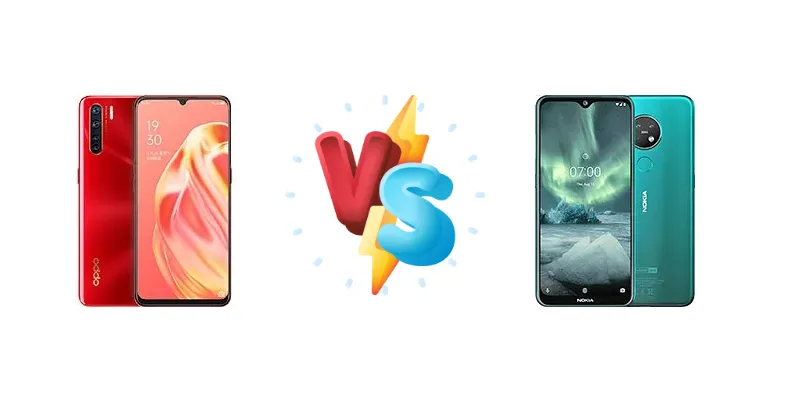
The Oppo A91 and Nokia 7.2 represent compelling options in the crowded budget smartphone market. While both aim to deliver a solid experience without breaking the bank, they take different approaches. The A91 prioritizes faster charging and a newer chipset, while the Nokia 7.2 focuses on display quality and a clean software experience. This comparison dives deep into the specifications to determine which device best suits your needs.
🏆 Quick Verdict
For the average user prioritizing responsiveness and quicker top-ups, the Oppo A91 emerges as the better choice. Its Helio P70 chipset, coupled with 20W fast charging, offers a noticeable advantage in daily tasks and convenience. However, the Nokia 7.2 remains a strong contender for those valuing display quality and a stock Android experience.
| Network |
|---|
| 2G bands | GSM 850 / 900 / 1800 / 1900 | GSM 850 / 900 / 1800 / 1900 |
| 3G bands | HSDPA 850 / 1700(AWS) / 1900 / 2100 - International | HSDPA 850 / 900 / 2100 - ROW |
| 4G bands | 1, 3, 5, 7, 8, 20, 28, 38, 40, 41 - International | 1, 3, 5, 7, 8, 20, 28, 38, 40, 41 - ROW |
| Speed | HSPA, LTE | HSPA 42.2/5.76 Mbps, LTE (2CA) Cat6 300/50 Mbps or LTE Cat4 150/50 Mbps |
| Technology | GSM / CDMA / HSPA / LTE | GSM / HSPA / LTE |
| | 1, 3, 4, 5, 8, 34, 38, 39, 40, 41 - China | 1, 3, 5, 8, 40, 41 - IN |
| Launch |
|---|
| Announced | 2019, December 20. Released 2019, December | 2019, September 05. Released 2019, September 23 |
| Status | Discontinued | Discontinued |
| Body |
|---|
| Build | Glass front (Gorilla Glass 5), plastic back, plastic frame | Glass front (Gorilla Glass 3), glass back (Gorilla Glass 3), plastic frame |
| Dimensions | 160.2 x 73.3 x 7.9 mm (6.31 x 2.89 x 0.31 in) | 159.9 x 75.2 x 8.3 mm (6.30 x 2.96 x 0.33 in) |
| SIM | Nano-SIM + Nano-SIM | · Nano-SIM· Nano-SIM + Nano-SIM |
| Weight | 172 g (6.07 oz) | 180 g (6.35 oz) |
| Display |
|---|
| Protection | Corning Gorilla Glass 5 | Corning Gorilla Glass 3 |
| Resolution | 1080 x 2400 pixels, 20:9 ratio (~408 ppi density) | 1080 x 2280 pixels, 19:9 ratio (~400 ppi density) |
| Size | 6.4 inches, 100.4 cm2 (~85.5% screen-to-body ratio) | 6.3 inches, 99.1 cm2 (~82.4% screen-to-body ratio) |
| Type | AMOLED, 430 nits (typ) | IPS LCD, HDR10 |
| Platform |
|---|
| CPU | Octa-core (4x2.1 GHz Cortex-A73 & 4x2.0 GHz Cortex-A53) | Octa-core (4x2.2 GHz Kryo 260 Gold & 4x1.8 GHz Kryo 260 Silver) |
| Chipset | Mediatek MT6771V Helio P70 (12 nm) | Qualcomm SDM660 Snapdragon 660 (14 nm) |
| GPU | Mali-G72 MP3 | Adreno 512 |
| OS | Android 9.0 (Pie), upgradable to Android 11, ColorOS 11 | Android 9.0 (Pie), upgradable to Android 11, Android One |
| Memory |
|---|
| Card slot | microSDXC (dedicated slot) | microSDXC (dedicated slot) |
| Internal | 128GB 4GB RAM, 128GB 8GB RAM, 256GB 8GB RAM | 64GB 4GB RAM, 64GB 6GB RAM, 128GB 4GB RAM, 128GB 6GB RAM |
| | UFS 2.1 | eMMC 5.1 |
| Main Camera |
|---|
| Features | LED flash, HDR, panorama | Zeiss optics, LED flash, panorama, HDR |
| Quad | 48 MP, f/1.8, 26mm (wide), 1/2.0", 0.8µm, PDAF
8 MP, f/2.3, 119˚ (ultrawide), 1/4.0", 1.12µm
2 MP B/W, f/2.4, 1/5.0", 1.75µm
Auxiliary lens | - |
| Triple | - | 48 MP, f/1.8, (wide), 1/2.0", 0.8µm, PDAF
8 MP, f/2.2, 13mm (ultrawide), 1/4.0", 1.12µm
Auxiliary lens |
| Video | 1080p@30fps, gyro-EIS | 4K@30fps, 1080p@30fps (gyro-EIS) |
| Selfie camera |
|---|
| Features | HDR | Zeiss optics, HDR |
| Single | 16 MP, f/2.0, 26mm (wide), 1/3.06", 1.0µm | 20 MP, f/2.0, (wide), 1/3", 0.9µm |
| Video | 1080p@30fps | 1080p@30fps |
| Sound |
|---|
| 3.5mm jack | Yes | Yes |
| 35mm jack | Yes | Yes |
| Loudspeaker | Yes | Yes |
| Comms |
|---|
| Bluetooth | 4.2, A2DP, LE | 5.0, A2DP, EDR, LE, aptX |
| NFC | No | Yes (excl. India) |
| Positioning | GPS, GLONASS, BDS | GPS, GLONASS, GALILEO, BDS |
| Radio | FM radio | FM radio |
| USB | USB Type-C 2.0, OTG | USB Type-C 2.0, OTG |
| WLAN | Wi-Fi 802.11 a/b/g/n/ac, dual-band, Wi-Fi Direct | Wi-Fi 802.11 b/g/n/ac, dual-band, Wi-Fi Direct |
| Features |
|---|
| Sensors | Fingerprint (under display, optical), accelerometer, gyro, proximity, compass | Fingerprint (rear-mounted), accelerometer, gyro, proximity, compass |
| Battery |
|---|
| Charging | 20W wired, 50% in 30 min | 10W wired |
| Type | Li-Po 4025 mAh, non-removable | Li-Po 3500 mAh, non-removable |
| Misc |
|---|
| Colors | Lightening Black, Unicorn White, Blazing Blue, Red | Cyan Green, Charcoal, Ice |
| Models | PCPM00, CPH2001, CPH2021 | TA-1193, TA-1178, TA-1196, TA-1181 |
| Price | About 200 EUR | About 240 EUR |
| SAR | - | 1.15 W/kg (head) 0.90 W/kg (body) |
| SAR EU | - | 0.99 W/kg (head) 1.44 W/kg (body) |
| Tests |
|---|
| Audio quality | - |
Noise -93.0dB / Crosstalk -93.4dB |
| Battery life | - |
Endurance rating 69h
|
| Camera | - |
Photo / Video |
| Display | - |
Contrast ratio: 1342:1 (nominal) |
| Loudspeaker | - |
-29.6 LUFS (Average)
|
| Performance | - |
AnTuTu: 139495 (v7), 164484 (v8)
GeekBench: 5440 (v4.4), 1398 (v5.1)
GFXBench: 8.1fps (ES 3.1 onscreen) |
Oppo A91
- Faster 20W charging for quick top-ups
- More modern Helio P70 chipset for improved responsiveness
- Potentially better power efficiency due to 12nm process
- Display specifications are unknown, potentially lower quality than Nokia 7.2
- Camera details are limited, potentially less refined image processing
Nokia 7.2
- Excellent display with 585 nits brightness and 1342:1 contrast
- Clean and bloatware-free Android experience
- Good battery endurance with 69-hour rating
- Slower 10W charging
- Older Snapdragon 660 chipset may show its age in demanding tasks
Display Comparison
The Nokia 7.2 boasts a superior display experience, achieving a measured peak brightness of 585 nits and a 1342:1 contrast ratio. While the Oppo A91’s display specifications are not provided, the Nokia 7.2’s higher brightness translates to better visibility outdoors, and the contrast ratio ensures richer, more vibrant colors. The Nokia 7.2’s display is demonstrably better suited for media consumption and gaming in bright environments. The nominal contrast ratio suggests a well-tuned panel, offering a more visually pleasing experience.
Camera Comparison
Both devices feature photo and video capabilities, but detailed camera specifications are limited. Without sensor size or aperture information, a direct comparison is difficult. However, the Nokia 7.2’s reputation for image processing and color accuracy suggests a more refined camera experience. The Oppo A91’s camera performance is likely adequate for casual photography, but it may struggle in low-light conditions compared to a more optimized system like Nokia’s. The absence of details on OIS or advanced features on either device suggests a focus on basic image capture.
Performance
The Oppo A91’s Mediatek Helio P70 (12nm) and the Nokia 7.2’s Qualcomm Snapdragon 660 (14nm) represent different approaches to mid-range performance. The Helio P70, built on a smaller 12nm process, generally offers better power efficiency. However, the Snapdragon 660’s Kryo 260 Gold cores, clocked at 2.2 GHz, provide a slight edge in single-core performance. In real-world usage, the A91 will likely feel snappier in app launches and multitasking, while the 660 might hold a slight advantage in sustained, CPU-intensive tasks. The 14nm process of the Snapdragon 660 may lead to slightly higher temperatures under prolonged load.
Battery Life
Both the Oppo A91 and Nokia 7.2 achieve an endurance rating of 69 hours, indicating comparable battery life under similar usage patterns. However, the Oppo A91’s 20W fast charging is a significant advantage, allowing it to reach 50% charge in just 30 minutes. The Nokia 7.2’s 10W charging is considerably slower, requiring significantly more time to fully replenish the battery. This difference in charging speed dramatically impacts user convenience, making the A91 a better choice for those who need a quick power boost.
Buying Guide
Buy the Oppo A91 if you need a phone that charges quickly and handles everyday tasks with a bit more pep. It’s ideal for users who frequently find themselves needing to top up their battery throughout the day and appreciate a more modern processor. Buy the Nokia 7.2 if you prefer a phone with a vibrant display, a clean and bloatware-free Android experience, and prioritize battery endurance over blazing-fast charging speeds. It’s a great fit for media consumers and those who prefer a minimalist software approach.
Frequently Asked Questions
❓ Is the Oppo A91’s Helio P70 chipset capable of handling demanding games like PUBG Mobile?
The Helio P70 can run PUBG Mobile, but you’ll likely need to lower the graphics settings to achieve a smooth frame rate. While it’s not a gaming powerhouse, it’s sufficient for casual gaming and less demanding titles. The Snapdragon 660 in the Nokia 7.2 offers similar gaming performance, but may experience more frame drops under sustained load.
❓ How does the Nokia 7.2’s software experience compare to other Android phones?
The Nokia 7.2 is part of the Android One program, meaning it runs a stock version of Android with guaranteed software updates and security patches. This provides a clean, bloatware-free experience that’s closer to Google’s vision for Android, unlike Oppo’s ColorOS which includes customizations and pre-installed apps.
❓ Will the Nokia 7.2’s 10W charging be noticeably slow in 2024?
Yes, 10W charging is significantly slower than the 20W charging on the Oppo A91 and the faster charging standards prevalent in newer phones. Expect a full charge to take well over two hours, which can be inconvenient for users accustomed to quicker charging times.