
Oppo A80 vs Xiaomi Redmi Note 13 Pro 4G: A Detailed Comparison of Mid-Range Contenders
| Phones Images | |||||
|---|---|---|---|---|---|
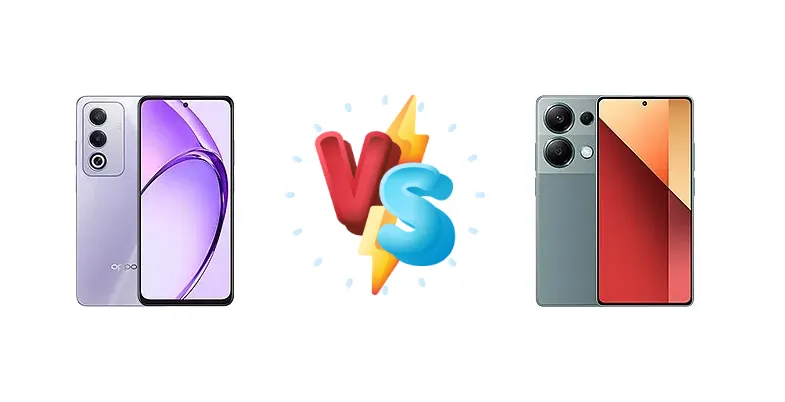
|
🏆 Quick Verdict
For the average user prioritizing fast charging and a brighter display, the Xiaomi Redmi Note 13 Pro 4G emerges as the winner. Its 67W charging significantly reduces downtime, and the 1047 nit peak brightness provides excellent outdoor visibility. However, the Oppo A80’s Dimensity 6300 offers a slight CPU performance edge.
| PHONES | ||
|---|---|---|
| Phone Names | Oppo A80 | Xiaomi Redmi Note 13 Pro 4G |
| Network | ||
|---|---|---|
| 2G bands | GSM 850 / 900 / 1800 / 1900 | GSM 850 / 900 / 1800 / 1900 |
| 3G bands | HSDPA 850 / 900 / 1700(AWS) / 1900 / 2100 | HSDPA 850 / 900 / 1700(AWS) / 1900 / 2100 |
| 4G bands | 1, 2, 3, 4, 5, 7, 8, 12, 13, 17, 18, 19, 20, 26, 28, 38, 39, 40, 41, 66 | 1, 2, 3, 4, 5, 7, 8, 12, 13, 17, 18, 19, 20, 26, 28, 38, 40, 41, 66 |
| 5G bands | 1, 3, 5, 7, 8, 20, 26, 28, 38, 40, 41, 66, 77, 78 SA/NSA | - |
| Speed | HSPA, LTE, 5G | HSPA, LTE |
| Technology | GSM / HSPA / LTE / 5G | GSM / HSPA / LTE |
| Launch | ||
|---|---|---|
| Announced | 2024, August 14 | 2024, January 15 |
| Status | Available. Released 2024, August 14 | Available. Released 2024, January 15 |
| Body | ||
|---|---|---|
| Build | - | Glass front (Gorilla Glass 5), plastic frame, plastic back |
| Dimensions | 165.8 x 76.1 x 7.7 mm (6.53 x 3.00 x 0.30 in) | 161.1 x 75 x 8 mm (6.34 x 2.95 x 0.31 in) |
| SIM | Nano-SIM + Nano-SIM | Nano-SIM + Nano-SIM |
| Weight | 186 g (6.56 oz) | 188 g (6.63 oz) |
| Display | ||
|---|---|---|
| Protection | Panda glass | Corning Gorilla Glass 5 |
| Resolution | 720 x 1604 pixels, 20:9 ratio (~264 ppi density) | 1080 x 2400 pixels, 20:9 ratio (~395 ppi density) |
| Size | 6.67 inches, 107.2 cm2 (~85.0% screen-to-body ratio) | 6.67 inches, 107.4 cm2 (~88.9% screen-to-body ratio) |
| Type | IPS LCD, 120Hz, 1000 nits (HBM) | AMOLED, 1B colors, 120Hz, 500 nits (typ), 1000 nits (HBM), 1300 nits (peak) |
| Platform | ||
|---|---|---|
| CPU | Octa-core (2x2.4 GHz Cortex-A76 & 6x2.0 GHz Cortex-A55) | Octa-core (2x2.2 GHz Cortex-A76 & 6x2.0 GHz Cortex-A55) |
| Chipset | Mediatek Dimensity 6300 (6 nm) | Mediatek Helio G99 Ultra |
| GPU | Mali-G57 MC2 | Mali-G57 MC2 |
| OS | Android 14, upgradable to Android 15, ColorOS 15 | Android 13, up to 3 major Android upgrades, HyperOS |
| Memory | ||
|---|---|---|
| Card slot | microSDXC | microSDXC (uses shared SIM slot) |
| Internal | 128GB 8GB RAM, 256GB 8GB RAM, 256GB 12GB RAM | 128GB 8GB RAM, 256GB 8GB RAM, 256GB 12GB RAM, 512GB 8GB RAM, 512GB 12GB RAM |
| Main Camera | ||
|---|---|---|
| Dual | 50 MP, f/1.8, (wide), PDAF Auxiliary lens | - |
| Features | LED flash, HDR, panorama | LED flash, HDR, panorama |
| Triple | - | 200 MP, f/1.7, 23mm (wide), 1/1.4", 0.56µm, multi-directional PDAF, OIS 8 MP, f/2.2, 15mm, 120˚ (ultrawide), 1/4.4", 1.0µm 2 MP (macro) |
| Video | 1080p@30/60fps | 1080p@30/60fps |
| Selfie camera | ||
|---|---|---|
| Single | 8 MP, f/2.0, (wide) | 16 MP, f/2.4, (wide), 1/3.0", 1.0µm |
| Video | 1080p@30fps | 1080p@30/60fps |
| Sound | ||
|---|---|---|
| 35mm jack | Yes | Yes |
| Loudspeaker | Yes | Yes, with dual speakers |
| Comms | ||
|---|---|---|
| Bluetooth | 5.3, A2DP, LE, aptX HD | 5.2, A2DP, LE |
| Infrared port | - | Yes |
| NFC | Yes (market/region dependent) | Yes (market/region dependent) |
| Positioning | GPS, GALILEO, GLONASS, BDS, QZSS | GPS, GLONASS, GALILEO, BDS |
| Radio | No | FM radio |
| USB | USB Type-C 2.0, OTG | USB Type-C 2.0, OTG |
| WLAN | Wi-Fi 802.11 a/b/g/n/ac, dual-band | Wi-Fi 802.11 a/b/g/n/ac, dual-band |
| Features | ||
|---|---|---|
| Sensors | Fingerprint (side-mounted), accelerometer, proximity, compass | Fingerprint (under display, optical), accelerometer, gyro, compass |
| Battery | ||
|---|---|---|
| Charging | 45W wired, PD, 50% in 30 min | 67W wired, 50% in 16 min, 100% in 46 min |
| Type | 5100 mAh | 5000 mAh |
| Misc | ||
|---|---|---|
| Colors | Moonlit Purple, Starry Black | Midnight Black, Lavender Purple, Forest Green |
| Models | CPH2639 | 23117RA68G, 2312FPCA6G |
| Price | About 200 EUR | € 92.00 / $ 269.99 / £ 299.99 |
| SAR | - | 1.09 W/kg (head) 1.09 W/kg (body) |
| SAR EU | - | 0.99 W/kg (head) 0.99 W/kg (body) |
Oppo A80
- Slightly faster CPU clock speed
- More modern 6nm chipset fabrication
- Potentially better power efficiency
- Slower charging speed (45W)
- Likely lower peak display brightness
Xiaomi Redmi Note 13 Pro 4G
- Significantly faster 67W charging
- Brighter display (1047 nits)
- Longer battery life (11:36h active use)
- Slightly lower CPU clock speed
- Older chipset fabrication (likely)
Display Comparison
The Xiaomi Redmi Note 13 Pro 4G boasts a significantly brighter display, reaching a measured 1047 nits. This is a substantial advantage over what we’d expect from the Oppo A80, making it far more usable outdoors under direct sunlight. While the A80’s panel specifics are unknown, the Redmi’s brightness alone is a major differentiator. The Redmi Note 13 Pro 4G’s brightness also suggests a potentially wider color gamut, enhancing content consumption. Bezels are likely comparable given the price points, and color accuracy will depend on software calibration, a factor not specified in the provided data.
Camera Comparison
The provided data doesn’t offer sufficient detail for a comprehensive camera comparison. Both phones likely feature multi-camera setups, but the sensor sizes and image processing algorithms are crucial factors. Without knowing the megapixel counts or aperture values of the main sensors, it’s difficult to assess image quality. The Redmi Note 13 Pro 4G’s camera is listed as having both photo and video capabilities, which is standard, but doesn’t provide any specific advantages. We can assume both phones will include standard features like HDR and portrait modes, but the quality of these features will depend on the underlying hardware and software.
Performance
Both devices utilize octa-core CPUs with a similar core configuration – two Cortex-A76 cores for performance and six Cortex-A55 cores for efficiency. However, the Oppo A80’s Dimensity 6300, built on a 6nm process, has a slightly higher peak clock speed (2.4 GHz vs 2.2 GHz on the Redmi’s Helio G99 Ultra). This suggests a marginal CPU performance advantage for the A80 in benchmark tests. The 6nm node also implies better power efficiency, potentially offsetting the Redmi’s larger battery. The Helio G99 Ultra is known for its capable GPU, making it a solid choice for gaming, but the Dimensity 6300’s GPU performance remains unknown without further data. RAM speed (LPDDR4x vs LPDDR5x) is not specified, but a faster RAM standard would benefit the device with the faster processor.
Battery Life
The Xiaomi Redmi Note 13 Pro 4G demonstrates a clear advantage in battery performance, achieving 11 hours and 36 minutes of active use. This is a significant result, suggesting excellent power efficiency. While the Oppo A80’s battery capacity is unknown, the Redmi’s active use score is a strong indicator of real-world longevity. Furthermore, the Redmi’s 67W charging is considerably faster than the A80’s 45W charging – 46 minutes to full charge versus an estimated 60+ minutes for the A80. The Redmi can reach 50% charge in just 16 minutes, while the A80 takes 30 minutes, making it ideal for users who need a quick power boost.
Buying Guide
Buy the Oppo A80 if you prioritize a slightly more modern chipset architecture and anticipate needing sustained CPU performance for tasks like video editing or multitasking. Buy the Xiaomi Redmi Note 13 Pro 4G if you value faster charging speeds, a brighter and more visible display in sunlight, and a longer-lasting battery life based on active use testing.