
Oppo A80 vs. vivo V30e: A Deep Dive into Mid-Range Chipsets and Charging
| Phones Images | |||||
|---|---|---|---|---|---|
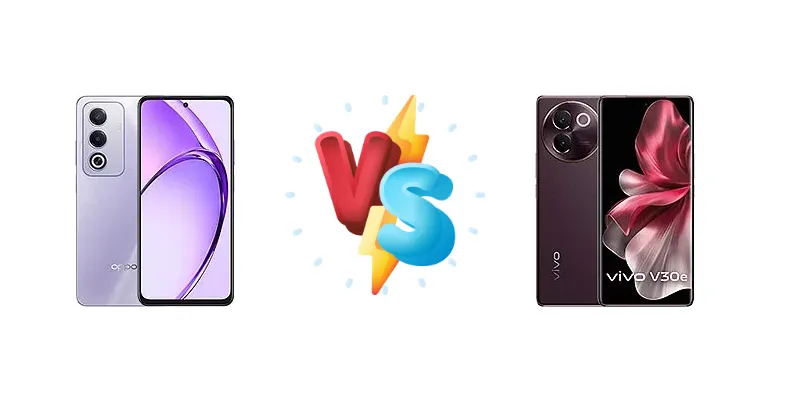
|
🏆 Quick Verdict
For the average user prioritizing sustained performance and potential future software support, the vivo V30e edges out the Oppo A80. The Snapdragon 6 Gen 1’s 4nm process offers better efficiency, translating to potentially less throttling during extended use, despite the A80’s slightly faster clock speeds on its prime core.
| PHONES | ||
|---|---|---|
| Phone Names | Oppo A80 | vivo V30e |
| Network | ||
|---|---|---|
| 2G bands | GSM 850 / 900 / 1800 / 1900 | GSM 850 / 900 / 1800 / 1900 |
| 3G bands | HSDPA 850 / 900 / 1700(AWS) / 1900 / 2100 | HSDPA 850 / 900 / 1700(AWS) / 1900 / 2100 - Malaysia |
| 4G bands | 1, 2, 3, 4, 5, 7, 8, 12, 13, 17, 18, 19, 20, 26, 28, 38, 39, 40, 41, 66 | 1, 2, 3, 4, 5, 7, 8, 18, 19, 20, 26, 28, 38, 39, 40, 41 - Malaysia |
| 5G bands | 1, 3, 5, 7, 8, 20, 26, 28, 38, 40, 41, 66, 77, 78 SA/NSA | 1, 3, 5, 7, 8, 20, 28, 38, 40, 41, 77, 78 SA/NSA - Malaysia |
| Speed | HSPA, LTE, 5G | HSPA, LTE, 5G |
| Technology | GSM / HSPA / LTE / 5G | GSM / HSPA / LTE / 5G |
| Launch | ||
|---|---|---|
| Announced | 2024, August 14 | 2024, May 02 |
| Status | Available. Released 2024, August 14 | Available. Released 2024, May 09 |
| Body | ||
|---|---|---|
| Build | - | Glass front, plastic frame, glass back or plastic back |
| Dimensions | 165.8 x 76.1 x 7.7 mm (6.53 x 3.00 x 0.30 in) | 164.4 x 74.8 x 7.7 mm (6.47 x 2.94 x 0.30 in) |
| SIM | Nano-SIM + Nano-SIM | Nano-SIM + Nano-SIM |
| Weight | 186 g (6.56 oz) | 179 g or 188 g (6.31 oz) |
| Display | ||
|---|---|---|
| Protection | Panda glass | Schott Xensation |
| Resolution | 720 x 1604 pixels, 20:9 ratio (~264 ppi density) | 1080 x 2400 pixels, 20:9 ratio (~388 ppi density) |
| Size | 6.67 inches, 107.2 cm2 (~85.0% screen-to-body ratio) | 6.78 inches, 111.0 cm2 (~90.3% screen-to-body ratio) |
| Type | IPS LCD, 120Hz, 1000 nits (HBM) | AMOLED, 1B colors, 120Hz, 1300 nits (peak) |
| Platform | ||
|---|---|---|
| CPU | Octa-core (2x2.4 GHz Cortex-A76 & 6x2.0 GHz Cortex-A55) | Octa-core (4x2.2 GHz Cortex-A78 & 4x1.8 GHz Cortex-A55) |
| Chipset | Mediatek Dimensity 6300 (6 nm) | Qualcomm SM6450 Snapdragon 6 Gen 1 (4 nm) |
| GPU | Mali-G57 MC2 | Adreno 710 |
| OS | Android 14, upgradable to Android 15, ColorOS 15 | Android 14, Funtouch 14 |
| Memory | ||
|---|---|---|
| Card slot | microSDXC | microSDXC (uses shared SIM slot) |
| Internal | 128GB 8GB RAM, 256GB 8GB RAM, 256GB 12GB RAM | 128GB 8GB RAM, 256GB 8GB RAM, 256GB 12GB RAM |
| Main Camera | ||
|---|---|---|
| Dual | 50 MP, f/1.8, (wide), PDAF Auxiliary lens | 50 MP, f/1.8, 26mm (wide), 1/1.95", 0.8µm, PDAF, OIS (India only) 8 MP, f/2.2, 120˚ (ultrawide), 1/4.0", 1.12µm |
| Features | LED flash, HDR, panorama | Ring-LED flash, panorama, HDR |
| Video | 1080p@30/60fps | 4K@30fps, 1080p@30fps |
| Selfie camera | ||
|---|---|---|
| Single | 8 MP, f/2.0, (wide) | 50 MP, f/2.5, 25mm (wide), AF - India 32 MP, f/2.0, 24mm (wide) - Malaysia |
| Video | 1080p@30fps | 4K@30fps (India only), 1080p@30fps |
| Sound | ||
|---|---|---|
| 35mm jack | Yes | No |
| Loudspeaker | Yes | Yes |
| Comms | ||
|---|---|---|
| Bluetooth | 5.3, A2DP, LE, aptX HD | 5.1, A2DP, LE |
| NFC | Yes (market/region dependent) | Yes (market/region dependent) |
| Positioning | GPS, GALILEO, GLONASS, BDS, QZSS | GPS, GLONASS, GALILEO, BDS, QZSS, NavIC |
| Radio | No | No |
| USB | USB Type-C 2.0, OTG | USB Type-C 2.0, OTG |
| WLAN | Wi-Fi 802.11 a/b/g/n/ac, dual-band | Wi-Fi 802.11 a/b/g/n/ac, dual-band |
| Features | ||
|---|---|---|
| Sensors | Fingerprint (side-mounted), accelerometer, proximity, compass | Fingerprint (under display, optical), accelerometer, gyro, proximity, compass |
| Battery | ||
|---|---|---|
| Charging | 45W wired, PD, 50% in 30 min | 44W wired, PD Reverse wired |
| Type | 5100 mAh | Li-Ion 5500 mAh |
| Misc | ||
|---|---|---|
| Colors | Moonlit Purple, Starry Black | Velvet Red (Coco Brown), Silk Blue, Sky Mirror |
| Models | CPH2639 | V2339 |
| Price | About 200 EUR | ₹ 23,999 |
Oppo A80
- Slightly faster peak CPU clock speeds
- 45W fast charging
- Potentially lower price point (depending on market)
- Less efficient 6nm process
- Older CPU architecture (Cortex-A76)
- Potentially more thermal throttling
vivo V30e
- More efficient 4nm process
- Modern CPU architecture (Cortex-A78)
- Reverse wired charging capability
- Slightly slower peak CPU clock speeds
- 44W charging is marginally slower
- Potential for higher price
Display Comparison
Neither Oppo nor vivo provide display specifications in the provided data. However, given the price bracket, we can anticipate both devices utilize LCD panels, likely with FHD+ resolution. The absence of LTPO technology suggests standard refresh rates (60Hz or 90Hz). Display quality will likely be a differentiating factor determined by color calibration and peak brightness, which are currently unknown.
Camera Comparison
Without sensor details, a direct camera comparison is impossible. However, the chipset’s ISP (Image Signal Processor) plays a crucial role. Qualcomm’s Snapdragon ISPs generally offer superior image processing capabilities, particularly in low-light conditions. The Snapdragon 6 Gen 1 likely provides better noise reduction and dynamic range compared to the Dimensity 6300. The presence of OIS (Optical Image Stabilization) on either device would be a significant advantage, but this information is unavailable. Focusing on the main sensor size would be key, as larger sensors capture more light.
Performance
The core of the difference lies in the chipsets. The Oppo A80’s Mediatek Dimensity 6300 (6nm) features a dual-core Cortex-A76 setup clocked at 2.4GHz, paired with six Cortex-A55 cores at 2.0GHz. The vivo V30e’s Snapdragon 6 Gen 1 (4nm) employs a quad-core Cortex-A78 configuration at 2.2GHz, alongside four Cortex-A55 cores at 1.8GHz. While the A80 boasts higher clock speeds on its prime cores, the Snapdragon 6 Gen 1 benefits from a more modern architecture and a smaller 4nm process. This translates to improved power efficiency and potentially better sustained performance, as the 4nm node generates less heat. The Snapdragon’s A78 cores are also more efficient than the A76 cores found in the Dimensity 6300. The impact of RAM speed (LPDDR4x vs LPDDR5x, assumed) is also a factor, with the latter offering faster data transfer rates, but this is not specified in the provided data.
Battery Life
Both devices offer fast charging, with the Oppo A80 supporting 45W wired charging (PD) and the vivo V30e at 44W wired charging (PD) with the added benefit of reverse wired charging. While the A80’s charging is marginally faster, the Snapdragon 6 Gen 1’s superior efficiency could offset the slight difference in charging wattage. The actual 0-100% charge time will depend on battery capacity, which is not provided. The Snapdragon’s efficiency could also translate to longer battery life during typical usage.
Buying Guide
Buy the Oppo A80 if you prioritize quick burst performance for everyday tasks and appreciate the slightly faster 45W charging. It’s ideal for users who primarily use their phone for social media, calls, and light web browsing. Buy the vivo V30e if you value sustained performance for gaming or demanding applications, and appreciate the efficiency benefits of the 4nm Snapdragon 6 Gen 1, potentially leading to longer battery life under load. It’s the better choice for power users and mobile gamers.