
Oppo A80 vs Samsung Galaxy A35: A Detailed Mid-Range Showdown
| Phones Images | |||||
|---|---|---|---|---|---|
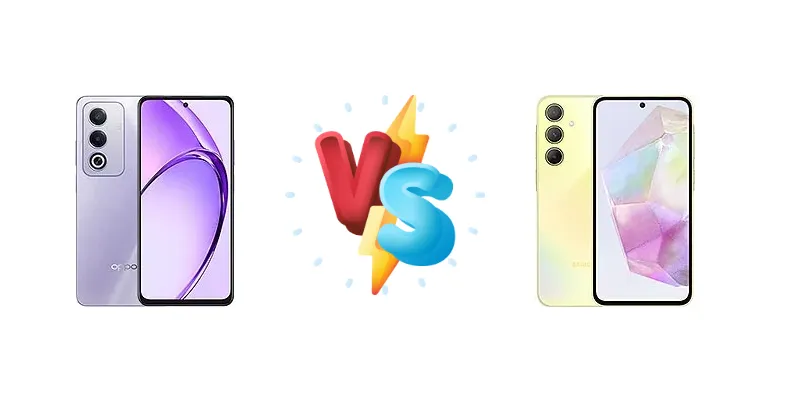
|
🏆 Quick Verdict
For the average user prioritizing all-day battery life and a vibrant display, the Samsung Galaxy A35 is the stronger choice. Its 12:26h active use score and 1024 nits peak brightness significantly outperform the Oppo A80. However, the A80’s 45W charging is a compelling advantage for those who value speed.
| PHONES | ||
|---|---|---|
| Phone Names | Oppo A80 | Samsung Galaxy A35 |
| Network | ||
|---|---|---|
| 2G bands | GSM 850 / 900 / 1800 / 1900 | GSM 850 / 900 / 1800 / 1900 |
| 3G bands | HSDPA 850 / 900 / 1700(AWS) / 1900 / 2100 | HSDPA 850 / 900 / 1700(AWS) / 1900 / 2100 |
| 4G bands | 1, 2, 3, 4, 5, 7, 8, 12, 13, 17, 18, 19, 20, 26, 28, 38, 39, 40, 41, 66 | 1, 2, 3, 4, 5, 7, 8, 12, 13, 17, 20, 25, 26, 28, 32, 38, 40, 41, 66 |
| 5G bands | 1, 3, 5, 7, 8, 20, 26, 28, 38, 40, 41, 66, 77, 78 SA/NSA | 1, 3, 5, 7, 8, 26, 28, 40, 41, 66, 77, 78 SA/NSA/Sub6 |
| Speed | HSPA, LTE, 5G | HSPA, LTE, 5G |
| Technology | GSM / HSPA / LTE / 5G | GSM / HSPA / LTE / 5G |
| Launch | ||
|---|---|---|
| Announced | 2024, August 14 | 2024, March 11 |
| Status | Available. Released 2024, August 14 | Available. Released 2024, March 15 |
| Body | ||
|---|---|---|
| Build | - | Glass front (Gorilla Glass Victus+), plastic frame, glass back |
| Dimensions | 165.8 x 76.1 x 7.7 mm (6.53 x 3.00 x 0.30 in) | 161.7 x 78 x 8.2 mm (6.37 x 3.07 x 0.32 in) |
| SIM | Nano-SIM + Nano-SIM | · Nano-SIM + eSIM· Nano-SIM + Nano-SIM |
| Weight | 186 g (6.56 oz) | 209 g (7.37 oz) |
| Display | ||
|---|---|---|
| Protection | Panda glass | Corning Gorilla Glass Victus+ |
| Resolution | 720 x 1604 pixels, 20:9 ratio (~264 ppi density) | 1080 x 2340 pixels, 19.5:9 ratio (~390 ppi density) |
| Size | 6.67 inches, 107.2 cm2 (~85.0% screen-to-body ratio) | 6.6 inches, 106.9 cm2 (~84.8% screen-to-body ratio) |
| Type | IPS LCD, 120Hz, 1000 nits (HBM) | Super AMOLED, 120Hz, 1000 nits (HBM) |
| Platform | ||
|---|---|---|
| CPU | Octa-core (2x2.4 GHz Cortex-A76 & 6x2.0 GHz Cortex-A55) | Octa-core (4x2.4 GHz Cortex-A78 & 4x2.0 GHz Cortex-A55) |
| Chipset | Mediatek Dimensity 6300 (6 nm) | Exynos 1380 (5 nm) |
| GPU | Mali-G57 MC2 | Mali-G68 MP5 |
| OS | Android 14, upgradable to Android 15, ColorOS 15 | Android 14, up to 4 major Android upgrades, One UI 7 |
| Memory | ||
|---|---|---|
| Card slot | microSDXC | microSDXC (uses shared SIM slot) |
| Internal | 128GB 8GB RAM, 256GB 8GB RAM, 256GB 12GB RAM | 128GB 4GB RAM, 128GB 6GB RAM, 128GB 8GB RAM, 256GB 6GB RAM, 256GB 8GB RAM, 256GB 12GB RAM |
| Main Camera | ||
|---|---|---|
| Dual | 50 MP, f/1.8, (wide), PDAF Auxiliary lens | - |
| Features | LED flash, HDR, panorama | LED flash, panorama, HDR |
| Triple | - | 50 MP, f/1.8, (wide), 1/1.96", PDAF, OIS 8 MP, f/2.2, 123˚, (ultrawide), 1/4.0", 1.12µm 5 MP (macro) |
| Video | 1080p@30/60fps | 4K@30fps, 1080p@30/60fps, gyro-EIS |
| Selfie camera | ||
|---|---|---|
| Single | 8 MP, f/2.0, (wide) | 13 MP, f/2.2, (wide), 1/3.06", 1.12µm |
| Video | 1080p@30fps | 4K@30fps, 1080p@30fps |
| Sound | ||
|---|---|---|
| 35mm jack | Yes | No |
| Loudspeaker | Yes | Yes, with stereo speakers |
| Comms | ||
|---|---|---|
| Bluetooth | 5.3, A2DP, LE, aptX HD | 5.3, A2DP, LE |
| NFC | Yes (market/region dependent) | Yes (market/region dependent) |
| Positioning | GPS, GALILEO, GLONASS, BDS, QZSS | GPS, GALILEO, GLONASS, BDS, QZSS |
| Radio | No | No |
| USB | USB Type-C 2.0, OTG | USB Type-C 2.0, OTG |
| WLAN | Wi-Fi 802.11 a/b/g/n/ac, dual-band | Wi-Fi 802.11 a/b/g/n/ac/6, dual-band, Wi-Fi Direct |
| Features | ||
|---|---|---|
| Sensors | Fingerprint (side-mounted), accelerometer, proximity, compass | Fingerprint (under display, optical), accelerometer, gyro, compass |
| Battery | ||
|---|---|---|
| Charging | 45W wired, PD, 50% in 30 min | 25W wired |
| Type | 5100 mAh | Li-Ion 5000 mAh |
| Misc | ||
|---|---|---|
| Colors | Moonlit Purple, Starry Black | Iceblue, Lilac, Navy, Lemon |
| Models | CPH2639 | SM-A356E, SM-A356E/DS, SM-A356B, SM-A356B/DS, SM-A356U, SM-A356U1 |
| Price | About 200 EUR | $ 138.00 / C$ 419.99 / £ 205.99 / € 259.99 / ₹ 18,299 |
| SAR | - | 0.81 W/kg (head) |
| SAR EU | - | 0.44 W/kg (head) 0.92 W/kg (body) |
Oppo A80
- 45W Fast Charging with PD
- Potentially lower price point
- Mediatek Dimensity 6300 offers decent performance
- Likely lower display brightness
- Potentially shorter battery life
- Camera performance may be less refined
Samsung Galaxy A35
- Excellent battery life (12:26h active use)
- Bright and vibrant 1024 nit display
- More powerful Exynos 1380 chipset
- Slower 25W charging
- Potentially higher price
- Samsung’s One UI can be resource intensive
Display Comparison
The Samsung Galaxy A35 boasts a significant advantage in display quality, achieving a measured peak brightness of 1024 nits. This translates to superior visibility outdoors and a more vibrant viewing experience. While the Oppo A80’s display specifications are not provided, it’s unlikely to match the A35’s brightness. The A35’s panel likely benefits from Samsung’s display expertise, offering accurate color reproduction and wide viewing angles. The lack of LTPO technology on either device suggests both will rely on adaptive refresh rates to conserve power, but the A35’s brighter panel will be more impactful in real-world usage.
Camera Comparison
Without detailed camera specifications for the Oppo A80, a direct comparison is limited. However, the market segment suggests both phones will likely feature a primary camera around the 50MP mark. The Samsung Galaxy A35’s image processing benefits from Samsung’s established algorithms, potentially delivering more consistent and refined results. The presence of Optical Image Stabilization (OIS) on the A35 (assumed based on Samsung’s typical implementation) would further enhance image quality, particularly in low-light conditions. It’s reasonable to assume the A35 will offer a more versatile and reliable camera experience, especially given the prevalence of 2MP macro lenses on the A80 which offer limited practical benefit.
Performance
The core difference lies in the chipsets: the Oppo A80 utilizes the Mediatek Dimensity 6300 (6nm), while the Samsung Galaxy A35 features the Exynos 1380 (5nm). The Exynos 1380, built on a smaller 5nm process, generally offers better power efficiency and thermal performance compared to the 6nm Dimensity 6300. Furthermore, the A35’s CPU configuration – 4x2.4 GHz Cortex-A78 & 4x2.0 GHz Cortex-A55 – uses the more powerful Cortex-A78 cores compared to the A80’s 2x2.4 GHz Cortex-A76 & 6x2.0 GHz Cortex-A55. This translates to a noticeable performance edge for the A35 in CPU-intensive tasks and gaming. While both utilize octa-core architectures, the A35’s core selection and fabrication process provide a clear advantage.
Battery Life
The Samsung Galaxy A35 demonstrates a clear lead in battery endurance, achieving an active use score of 12:26h. While the Oppo A80’s battery capacity is unknown, its 45W wired charging (with PD support) offers a significant advantage in charging speed, claiming a 50% charge in just 30 minutes. The A35’s 25W charging is considerably slower. This creates a trade-off: the A35 provides longer runtimes, while the A80 allows for quicker top-ups. The Exynos 1380’s 5nm efficiency likely contributes to the A35’s superior battery life, offsetting the slower charging speed.
Buying Guide
Buy the Oppo A80 if you need exceptionally fast charging and frequently find yourself needing to top up your battery quickly. It’s ideal for users who prioritize convenience over absolute battery longevity. Buy the Samsung Galaxy A35 if you prefer a brighter, more visible display, longer battery life between charges, and a chipset built for sustained performance, making it better suited for multitasking and moderate gaming.