
Oppo A80 vs Honor X9b: A Deep Dive into Mid-Range Chipsets
| Phones Images | |||||
|---|---|---|---|---|---|
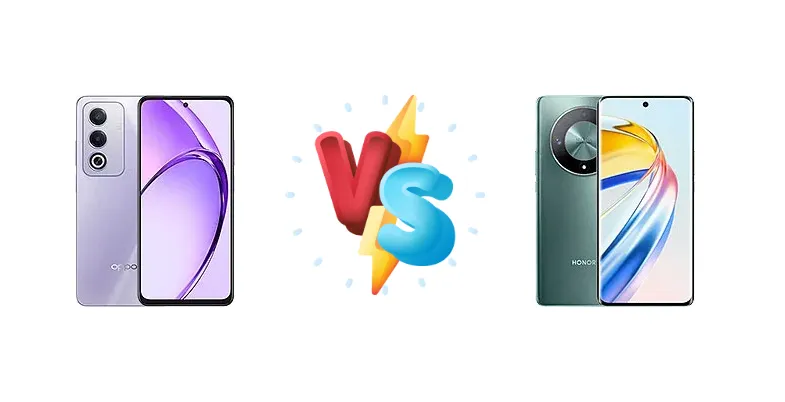
|
🏆 Quick Verdict
For the average user prioritizing sustained performance and future-proofing, the Honor X9b emerges as the stronger contender. The Snapdragon 6 Gen 1’s 4nm process and Cortex-A78 cores offer a noticeable advantage in demanding tasks, despite the Oppo A80’s faster charging capabilities.
| PHONES | ||
|---|---|---|
| Phone Names | Oppo A80 | Honor X9b |
| Network | ||
|---|---|---|
| 2G bands | GSM 850 / 900 / 1800 / 1900 | GSM 850 / 900 / 1800 / 1900 |
| 3G bands | HSDPA 850 / 900 / 1700(AWS) / 1900 / 2100 | HSDPA 850 / 900 / 1900 / 2100 |
| 4G bands | 1, 2, 3, 4, 5, 7, 8, 12, 13, 17, 18, 19, 20, 26, 28, 38, 39, 40, 41, 66 | 1, 2, 3, 4, 5, 7, 8, 20, 28, 32, 38, 40, 41 |
| 5G bands | 1, 3, 5, 7, 8, 20, 26, 28, 38, 40, 41, 66, 77, 78 SA/NSA | 1, 3, 7, 8, 20, 28, 38, 40, 41, 77, 78 SA/NSA |
| Speed | HSPA, LTE, 5G | HSPA, LTE, 5G |
| Technology | GSM / HSPA / LTE / 5G | GSM / HSPA / LTE / 5G |
| Launch | ||
|---|---|---|
| Announced | 2024, August 14 | 2023, October 18 |
| Status | Available. Released 2024, August 14 | Available. Released 2023, October |
| Body | ||
|---|---|---|
| Dimensions | 165.8 x 76.1 x 7.7 mm (6.53 x 3.00 x 0.30 in) | 163.6 x 75.5 x 8 mm (6.44 x 2.97 x 0.31 in) |
| SIM | Nano-SIM + Nano-SIM | Nano-SIM + Nano-SIM |
| Weight | 186 g (6.56 oz) | 185 g (6.53 oz) |
| Display | ||
|---|---|---|
| Protection | Panda glass | - |
| Resolution | 720 x 1604 pixels, 20:9 ratio (~264 ppi density) | 1220 x 2652 pixels, 19.5:9 ratio (~431 ppi density) |
| Size | 6.67 inches, 107.2 cm2 (~85.0% screen-to-body ratio) | 6.78 inches, 112.6 cm2 (~91.2% screen-to-body ratio) |
| Type | IPS LCD, 120Hz, 1000 nits (HBM) | AMOLED, 1B colors, 120Hz, 1200 nits (peak) |
| Platform | ||
|---|---|---|
| CPU | Octa-core (2x2.4 GHz Cortex-A76 & 6x2.0 GHz Cortex-A55) | Octa-core (4x2.2 GHz Cortex-A78 & 4x1.8 GHz Cortex-A55) |
| Chipset | Mediatek Dimensity 6300 (6 nm) | Qualcomm SM6450 Snapdragon 6 Gen 1 (4 nm) |
| GPU | Mali-G57 MC2 | Adreno 710 |
| OS | Android 14, upgradable to Android 15, ColorOS 15 | Android 13, Magic OS 7.2 |
| Memory | ||
|---|---|---|
| Card slot | microSDXC | No |
| Internal | 128GB 8GB RAM, 256GB 8GB RAM, 256GB 12GB RAM | 256GB 8GB RAM, 256GB 12GB RAM, 512GB 8GB RAM, 512GB 12GB RAM |
| Main Camera | ||
|---|---|---|
| Dual | 50 MP, f/1.8, (wide), PDAF Auxiliary lens | - |
| Features | LED flash, HDR, panorama | LED flash, panorama, HDR |
| Triple | - | 108 MP, f/1.8, (wide), 1/1.67", PDAF 5 MP, f/2.2, (ultrawide) 2 MP (macro) |
| Video | 1080p@30/60fps | 4K@30fps, 1080p@30fps |
| Selfie camera | ||
|---|---|---|
| Single | 8 MP, f/2.0, (wide) | 16 MP, f/2.5, (wide) |
| Video | 1080p@30fps | 1080p@30fps |
| Sound | ||
|---|---|---|
| 35mm jack | Yes | No |
| Loudspeaker | Yes | Yes |
| Comms | ||
|---|---|---|
| Bluetooth | 5.3, A2DP, LE, aptX HD | 5.1, A2DP, LE |
| Infrared port | - | Yes |
| NFC | Yes (market/region dependent) | Yes (market/region dependent) |
| Positioning | GPS, GALILEO, GLONASS, BDS, QZSS | GPS, GLONASS, GALILEO, BDS |
| Radio | No | No |
| USB | USB Type-C 2.0, OTG | USB Type-C 2.0, OTG |
| WLAN | Wi-Fi 802.11 a/b/g/n/ac, dual-band | Wi-Fi 802.11 a/b/g/n/ac, dual-band, Wi-Fi Direct |
| Features | ||
|---|---|---|
| Sensors | Fingerprint (side-mounted), accelerometer, proximity, compass | Fingerprint (under display, optical), accelerometer, gyro, proximity, compass |
| Battery | ||
|---|---|---|
| Charging | 45W wired, PD, 50% in 30 min | 35W wired Reverse wired |
| Type | 5100 mAh | Li-Po 5800 mAh |
| Misc | ||
|---|---|---|
| Colors | Moonlit Purple, Starry Black | Sunrise Orange, Midnight Black, Emerald Green |
| Models | CPH2639 | ALI-NX1 |
| Price | About 200 EUR | About 970 EUR |
Oppo A80
- Faster 45W charging significantly reduces downtime.
- Potentially lower price point due to Mediatek chipset.
- Slightly higher clocked primary cores (A76 vs A78)
- Less efficient 6nm process can lead to more heat.
- Older Cortex-A76 cores offer lower performance per clock.
- Lacks reverse wired charging.
Honor X9b
- More efficient 4nm Snapdragon 6 Gen 1 chipset.
- Modern Cortex-A78 cores deliver superior performance.
- Reverse wired charging adds versatility.
- Potentially better image processing from Qualcomm ISP.
- Slower 35W charging.
- Potentially higher price point.
Display Comparison
Neither device’s display specifications are provided, so a direct comparison is limited. However, given the price bracket, we can anticipate both utilizing LCD panels. The Honor X9b, benefiting from Qualcomm’s image signal processor, may exhibit slightly more accurate color reproduction. Bezels are likely comparable, and both will likely target FHD+ resolutions to balance clarity and battery life.
Camera Comparison
Without sensor details, a definitive camera comparison is impossible. However, Qualcomm’s Snapdragon ISPs generally offer superior image processing capabilities, potentially resulting in better dynamic range and noise reduction in the Honor X9b’s photos. The Oppo A80 may rely more heavily on software processing to compensate, which can sometimes lead to over-sharpening or unnatural colors. We anticipate both phones will include a standard suite of camera features, but the X9b’s ISP gives it an edge.
Performance
The core difference lies in the chipsets. The Honor X9b’s Snapdragon 6 Gen 1 (4nm) boasts four Cortex-A78 cores clocked at 2.2 GHz, offering a significant architectural advantage over the Oppo A80’s Dimensity 6300 (6nm) which uses two Cortex-A76 cores at 2.4 GHz. While the A76 cores have a higher clock speed, the A78 architecture is more efficient and delivers better performance per clock. The 4nm process of the Snapdragon further enhances efficiency, leading to less heat generation and potentially reduced throttling during prolonged gaming sessions. The Dimensity 6300’s six Cortex-A55 cores are paired with the X9b’s four A55 cores, so the core count is similar, but the higher tier cores on the X9b are the key differentiator.
Battery Life
The Oppo A80’s 45W wired charging is a clear advantage, promising a 50% charge in just 30 minutes. The Honor X9b’s 35W charging is slower, but the Snapdragon 6 Gen 1’s superior efficiency may offset this difference in real-world usage. The actual battery capacity of both devices is unknown, but the more efficient chipset in the X9b could translate to longer battery life despite a potentially smaller battery size. The X9b also offers reverse wired charging, a feature absent on the A80, adding to its versatility.
Buying Guide
Buy the Oppo A80 if you prioritize rapid charging and are a casual user who primarily focuses on social media, browsing, and light tasks. The 45W charging will minimize downtime. Buy the Honor X9b if you value smoother multitasking, better gaming performance, and a more efficient processor that will likely hold up better over time, even if it means slightly slower charging.