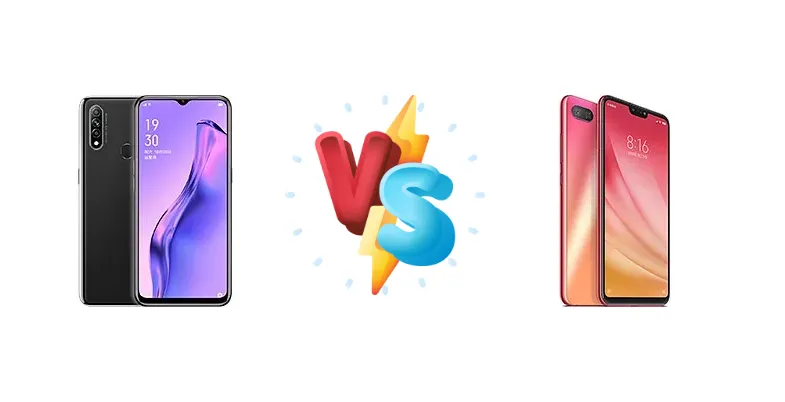
The budget smartphone market is fiercely competitive, offering incredible value for money. Today, we're pitting two popular contenders against each other: the Oppo A8 and the Xiaomi Mi 8 Lite. Both promise a lot, but which one delivers the best overall experience?
🏆 Quick Verdict
The Xiaomi Mi 8 Lite edges out the Oppo A8 thanks to its superior Snapdragon 660 chipset, faster charging, and slightly better camera capabilities. While the Oppo A8 offers a more modern design, the Mi 8 Lite provides a more polished and performant experience for the price.
| Network |
|---|
| 2G bands | GSM 850 / 900 / 1800 / 1900 | GSM 850 / 900 / 1800 / 1900 |
| 3G bands | HSDPA 850 / 900 / 2100 | HSDPA 850 / 900 / 1700(AWS) / 1900 / 2100 - Global |
| 4G bands | 1, 3, 5, 8, 34, 38, 39, 40, 41 | 1, 2, 3, 4, 5, 7, 8, 20, 28, 38, 40 - Global |
| Speed | HSPA, LTE | HSPA 42.2/5.76 Mbps, LTE (2CA) Cat6 300/50 Mbps |
| Technology | GSM / CDMA / HSPA / EVDO / LTE | GSM / CDMA / HSPA / LTE |
| | CDMA2000 1xEV-DO | 1, 3, 5, 7, 8, 34, 38, 39, 40, 41 - China |
| Launch |
|---|
| Announced | 2019, December. Released 2019, December | 2018, September. Released 2018, September |
| Status | Discontinued | Discontinued |
| Body |
|---|
| Build | Glass front, plastic back, plastic frame | Glass front, glass back, aluminum frame |
| Dimensions | 163.9 x 75.5 x 8.3 mm (6.45 x 2.97 x 0.33 in) | 156.4 x 75.8 x 7.5 mm (6.16 x 2.98 x 0.30 in) |
| SIM | Nano-SIM + Nano-SIM | Nano-SIM + Nano-SIM |
| Weight | 180 g (6.35 oz) | 169 g (5.96 oz) |
| Display |
|---|
| Resolution | 720 x 1600 pixels, 20:9 ratio (~269 ppi density) | 1080 x 2280 pixels, 19:9 ratio (~403 ppi density) |
| Size | 6.5 inches, 102.8 cm2 (~83.0% screen-to-body ratio) | 6.26 inches, 97.8 cm2 (~82.5% screen-to-body ratio) |
| Type | IPS LCD, 480 nits (typ) | IPS LCD |
| Platform |
|---|
| CPU | Octa-core (4x2.3 GHz Cortex-A53 & 4x1.8 GHz Cortex-A53) | Octa-core (4x2.2 GHz Kryo 260 Gold & 4x1.8 GHz Kryo 260 Silver) |
| Chipset | Mediatek MT6765V/CB Helio P35 (12 nm) | Qualcomm SDM660 Snapdragon 660 (14 nm) |
| GPU | PowerVR GE8320 | Adreno 512 |
| OS | Android 9.0 (Pie), ColorOS 6.1 | Android 8.1 (Oreo), upgradable to Android 10, MIUI 11 |
| Memory |
|---|
| Card slot | microSDXC (dedicated slot) | microSDXC (uses shared SIM slot) |
| Internal | 128GB 4GB RAM, 64GB 4GB RAM | 64GB 4GB RAM, 64GB 6GB RAM, 128GB 4GB RAM, 128GB 6GB RAM |
| | eMMC 5.1 | eMMC 5.1 |
| Main Camera |
|---|
| Dual | - | 12 MP, f/1.9, 1/2.55", 1.4µm, dual pixel PDAF
Auxiliary lens |
| Features | LED flash, HDR, panorama | LED flash, HDR, panorama |
| Triple | 12 MP, f/1.8, (wide), PDAF
2 MP (macro)
Auxiliary lens | - |
| Video | 1080p@30fps | 4K@30fps, 1080p@60/120fps, 1080p@30fps (gyro-EIS) |
| Selfie camera |
|---|
| Features | HDR | Auto HDR |
| Single | 8 MP, f/2.0 | 24 MP, f/2.0, 26mm (wide), 1/2.8", 0.9µm |
| Video | 1080p@30fps | 1080p@30fps |
| Sound |
|---|
| 3.5mm jack | Yes | No |
| 35mm jack | Yes | No |
| Loudspeaker | Yes | Yes |
| Comms |
|---|
| Bluetooth | 5.0, A2DP, LE | 5.0, A2DP, LE |
| NFC | No | No |
| Positioning | GPS, BDS | GPS, GLONASS, BDS |
| Radio | FM radio | No |
| USB | microUSB 2.0, OTG | USB Type-C |
| WLAN | Wi-Fi 802.11 a/b/g/n/ac, dual-band, Wi-Fi Direct | Wi-Fi 802.11 a/b/g/n/ac, dual-band, Wi-Fi Direct |
| Features |
|---|
| Sensors | Fingerprint (rear-mounted), accelerometer, proximity, compass | Fingerprint (rear-mounted), accelerometer, gyro, proximity, compass |
| Battery |
|---|
| Charging | - | 18W wired, QC3 |
| Type | Li-Po 4230 mAh | Li-Po 3350 mAh, non-removable |
| Misc |
|---|
| Colors | Green, Black | Midnight Black, Aurora Blue, Twilight Gold |
| Models | PDBM00 | M1808D2TG |
| Price | About 150 EUR | About 360 EUR |
| SAR | - | 0.75 W/kg (head) 1.58 W/kg (body) |
| Tests |
|---|
| Audio quality | - |
Noise -93.5dB / Crosstalk -35.4dB |
| Battery life | - |
Endurance rating 77h
|
| Camera | - |
Photo / Video |
| Display | - |
Contrast ratio: 1453 (nominal), 2.862 (sunlight) |
| Loudspeaker | - |
Voice 67dB / Noise 77dB / Ring 77dB
|
| Performance | - |
AnTuTu: 143257 (v7)
GeekBench: 5894 (v4.4)
GFXBench: 8fps (ES 3.1 onscreen) |
Oppo A8
- Modern design
- Larger screen (likely)
- Adequate performance for basic tasks
- Weaker chipset
- Slower charging
- Less impressive camera
Xiaomi Mi 8 Lite
- Superior performance (Snapdragon 660)
- Faster charging (QC3)
- Better camera quality
- Excellent battery life
- Older design
- Potentially larger bezels
Display Comparison
Both phones feature LCD displays, but the Mi 8 Lite boasts a significantly better contrast ratio (1453 nominal, 2.862 in sunlight) compared to the A8, suggesting richer colors and better visibility in bright conditions. The Mi 8 Lite also has a slightly smaller notch, contributing to a more immersive viewing experience. The A8 likely has a slightly larger screen size, but the Mi 8 Lite's display quality is superior.
Camera Comparison
While both offer decent camera capabilities, the Mi 8 Lite generally produces better photos and videos. The Snapdragon 660's image signal processor (ISP) contributes to improved image processing and dynamic range. The A8's camera is acceptable for casual snapshots, but lacks the refinement of the Mi 8 Lite.
Performance
This is where the Mi 8 Lite truly shines. The Snapdragon 660 chipset is noticeably more powerful than the Helio P35 in the Oppo A8. Expect smoother multitasking, faster app loading times, and better gaming performance on the Mi 8 Lite. The A8 will handle basic tasks adequately, but struggles with more demanding applications.
Battery Life
Both phones boast an impressive endurance rating of 77 hours. Real-world usage will vary, but both should easily last a full day on a single charge. The Mi 8 Lite's 18W fast charging provides a quicker top-up compared to the A8's likely slower charging speed.
Buying Guide
Who should buy the Oppo A8? Users prioritizing a modern aesthetic and a larger screen might find the A8 appealing. Who should buy the Xiaomi Mi 8 Lite? Those seeking better performance, faster charging, and a slightly more refined camera experience will likely prefer the Mi 8 Lite.
Frequently Asked Questions
❓ Which phone is better for gaming?
The Xiaomi Mi 8 Lite is significantly better for gaming due to its more powerful Snapdragon 660 chipset.
❓ Is the Oppo A8 worth buying if I only need a phone for basic tasks?
Yes, the Oppo A8 can handle basic tasks like calling, texting, and browsing. However, the Mi 8 Lite offers a more future-proof experience.