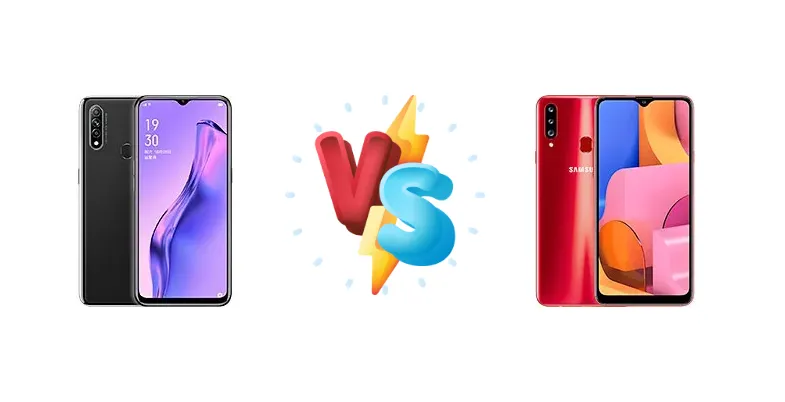
The Oppo A8 and Samsung Galaxy A20s represent a similar segment of the smartphone market – affordable devices aimed at first-time smartphone buyers or those seeking a reliable secondary device. However, beneath the similar price points lie key differences in their core hardware, particularly in their chipsets, which significantly impact performance and efficiency. This comparison dives deep into these differences to determine which phone offers the best value.
🏆 Quick Verdict
For the average user prioritizing sustained performance and efficiency, the Oppo A8 is the better choice. Its Mediatek Helio P35, built on a 12nm process, offers a slight edge over the Samsung Galaxy A20s’ Snapdragon 450 (14nm) in CPU performance and potentially better thermal management, despite the A20s having 15W charging.
| Network |
|---|
| 2G bands | GSM 850 / 900 / 1800 / 1900 | GSM 850 / 900 / 1800 / 1900 |
| 3G bands | HSDPA 850 / 900 / 2100 | HSDPA 850 / 900 / 1900 / 2100 - SM-A207F/DS |
| 4G bands | 1, 3, 5, 8, 34, 38, 39, 40, 41 | 1, 2, 3, 5, 7, 8, 20, 28, 34, 38, 39, 40, 41 - SM-A207F/DS |
| Speed | HSPA, LTE | HSPA, LTE |
| Technology | GSM / CDMA / HSPA / EVDO / LTE | GSM / HSPA / LTE |
| | CDMA2000 1xEV-DO | 1, 2, 3, 4, 5, 7, 8, 12, 13, 17, 20, 28, 38, 40, 41, 66 - SM-A207M/DS |
| Launch |
|---|
| Announced | 2019, December. Released 2019, December | 2019, September 24. Released 2019, October 05 |
| Status | Discontinued | Discontinued |
| Body |
|---|
| Build | Glass front, plastic back, plastic frame | Glass front, plastic back, plastic frame |
| Dimensions | 163.9 x 75.5 x 8.3 mm (6.45 x 2.97 x 0.33 in) | 163.3 x 77.5 x 8 mm (6.43 x 3.05 x 0.31 in) |
| SIM | Nano-SIM + Nano-SIM | · Nano-SIM· Nano-SIM + Nano-SIM |
| Weight | 180 g (6.35 oz) | 183 g (6.46 oz) |
| Display |
|---|
| Resolution | 720 x 1600 pixels, 20:9 ratio (~269 ppi density) | 720 x 1560 pixels, 19.5:9 ratio (~264 ppi density) |
| Size | 6.5 inches, 102.8 cm2 (~83.0% screen-to-body ratio) | 6.5 inches, 103.7 cm2 (~81.9% screen-to-body ratio) |
| Type | IPS LCD, 480 nits (typ) | IPS LCD |
| Platform |
|---|
| CPU | Octa-core (4x2.3 GHz Cortex-A53 & 4x1.8 GHz Cortex-A53) | Octa-core 1.8 GHz Cortex-A53 |
| Chipset | Mediatek MT6765V/CB Helio P35 (12 nm) | Qualcomm SDM450 Snapdragon 450 (14 nm) |
| GPU | PowerVR GE8320 | Adreno 506 |
| OS | Android 9.0 (Pie), ColorOS 6.1 | Android 9.0 (Pie), upgradable to Android 11, One UI Core 3.1 |
| Memory |
|---|
| Card slot | microSDXC (dedicated slot) | microSDXC (dedicated slot) |
| Internal | 128GB 4GB RAM, 64GB 4GB RAM | 32GB 2GB RAM, 32GB 3GB RAM, 64GB 4GB RAM |
| | eMMC 5.1 | eMMC 5.1 |
| Main Camera |
|---|
| Features | LED flash, HDR, panorama | LED flash, panorama, HDR |
| Triple | 12 MP, f/1.8, (wide), PDAF
2 MP (macro)
Auxiliary lens | 13 MP, f/1.8, 27mm (wide), PDAF
8 MP, f/2.2, 13mm (ultrawide), 1/4.0", 1.12µm
Auxiliary lens |
| Video | 1080p@30fps | 1080p@30fps |
| Selfie camera |
|---|
| Features | HDR | - |
| Single | 8 MP, f/2.0 | 8 MP, f/2.0 |
| Video | 1080p@30fps | 1080p@30fps |
| Sound |
|---|
| 3.5mm jack | Yes | Yes |
| 35mm jack | Yes | Yes |
| Loudspeaker | Yes | Yes |
| Comms |
|---|
| Bluetooth | 5.0, A2DP, LE | 4.2, A2DP, LE |
| NFC | No | No |
| Positioning | GPS, BDS | GPS, GLONASS, GALILEO, BDS |
| Radio | FM radio | FM radio |
| USB | microUSB 2.0, OTG | USB Type-C 2.0 |
| WLAN | Wi-Fi 802.11 a/b/g/n/ac, dual-band, Wi-Fi Direct | Wi-Fi 802.11 b/g/n, Wi-Fi Direct |
| Features |
|---|
| Sensors | Fingerprint (rear-mounted), accelerometer, proximity, compass | Fingerprint (rear-mounted), accelerometer, gyro, proximity, compass |
| Battery |
|---|
| Charging | - | 15W wired |
| Type | Li-Po 4230 mAh | Li-Po 4000 mAh, non-removable |
| Misc |
|---|
| Colors | Green, Black | Black, Blue, Red, Green |
| Models | PDBM00 | SM-A207F, SM-A207M, SM-A2070 |
| Price | About 150 EUR | About 250 EUR |
| SAR | - | 0.69 W/kg (head) 1.43 W/kg (body) |
| SAR EU | - | 0.35 W/kg (head) 0.83 W/kg (body) |
Oppo A8
- Potentially better CPU performance due to higher clock speeds.
- More efficient 12nm chipset may lead to longer battery life.
- Likely a more responsive user experience for everyday tasks.
- Slower charging speeds compared to the Samsung Galaxy A20s.
- Camera performance is likely similar to the A20s without specific sensor details.
Samsung Galaxy A20s
- Faster 15W wired charging.
- Benefit from Qualcomm’s software optimization.
- Samsung brand recognition and ecosystem.
- Less efficient 14nm chipset.
- Potentially lower CPU performance compared to the Oppo A8.
- May exhibit more thermal throttling under sustained load.
Display Comparison
Neither device is known for a standout display. Both likely feature LCD panels, typical for this price bracket. Specifics like resolution and brightness are not provided, but we can assume they are similar – likely 720p+ resolution. The lack of information prevents a detailed comparison of color accuracy or viewing angles. Bezels are expected to be noticeable on both devices, reflecting their budget positioning.
Camera Comparison
Without detailed sensor information, a direct camera comparison is difficult. Both phones likely feature a primary camera alongside supporting lenses (potentially depth or macro). Given the market segment, image quality will be adequate for social media sharing but not exceptional. The absence of Optical Image Stabilization (OIS) on either device suggests reliance on software processing for image stabilization. The A8 may have a slight edge if it utilizes a larger primary sensor, but this is speculative without further data. The 2MP macro cameras often found on phones in this class are generally of limited utility.
Performance
The core difference lies in the chipsets. The Oppo A8’s Mediatek Helio P35 (12nm) features an octa-core CPU with a split configuration of 4x2.3 GHz Cortex-A53 and 4x1.8 GHz Cortex-A53 cores. This contrasts with the Samsung Galaxy A20s’ Qualcomm Snapdragon 450 (14nm) which utilizes a uniform octa-core 1.8 GHz Cortex-A53 configuration. The 12nm fabrication process of the Helio P35 *should* translate to better power efficiency compared to the 14nm Snapdragon 450, potentially leading to longer battery life under similar usage. While both CPUs utilize the same Cortex-A53 architecture, the higher clock speeds on the P35’s prime cores suggest a slight performance advantage in CPU-intensive tasks. However, the Snapdragon 450 benefits from Qualcomm’s optimized software and potentially better GPU performance for basic gaming.
Battery Life
Battery capacity is not specified for either device. However, the Samsung Galaxy A20s boasts 15W wired charging, a clear advantage over the Oppo A8, which likely supports standard 10W charging. This means the A20s will recharge significantly faster. While the Helio P35’s efficiency *could* offset a slightly smaller battery capacity in the A8, the A20s’ faster charging is a tangible benefit for users who frequently need to top up their battery.
Buying Guide
Buy the Oppo A8 if you need a phone capable of handling everyday tasks with a bit more responsiveness and potentially longer sustained performance during light gaming. Buy the Samsung Galaxy A20s if you prioritize faster charging speeds and are primarily focused on basic smartphone functions like calling, texting, and light social media use, and value the Samsung brand ecosystem.
Frequently Asked Questions
❓ Will the Snapdragon 450 in the Galaxy A20s struggle with multitasking compared to the Helio P35 in the A8?
While both chipsets are entry-level, the Helio P35’s higher clock speeds on its performance cores give it a slight advantage in multitasking. You’re unlikely to experience significant issues with either phone for basic multitasking (switching between messaging, social media, and web browsing), but the A8 should handle more demanding scenarios slightly better.
❓ Is the 15W charging on the Galaxy A20s a game-changer for daily use?
For users who frequently find themselves needing to quickly top up their battery, the 15W charging on the Galaxy A20s is a significant benefit. It will reduce charging times considerably compared to the Oppo A8’s likely 10W charging, making it more convenient for those with busy lifestyles.
❓ Can either of these phones handle popular mobile games like PUBG Mobile or Call of Duty Mobile?
Both phones can *run* these games, but expect to play them at low to medium settings to maintain a playable frame rate. The Snapdragon 450 might have a slight edge in GPU performance, but neither chipset is designed for demanding gaming. Expect some frame drops and potential thermal throttling during extended gaming sessions.