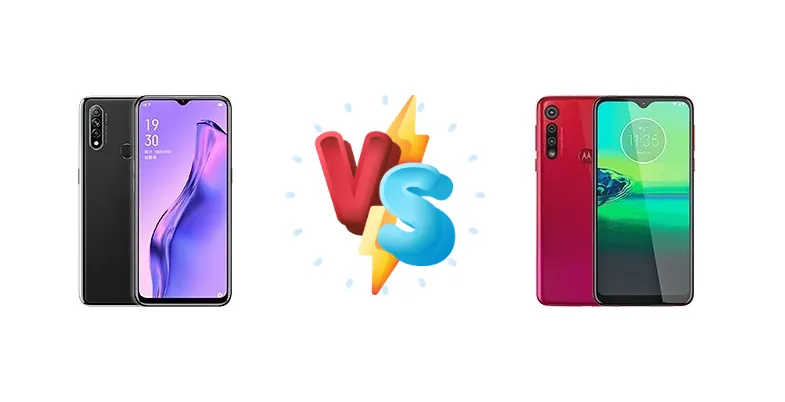
The Oppo A8 and Motorola Moto G8 Play represent a common battleground in the smartphone market: delivering essential features at an accessible price point. Both rely on Mediatek chipsets, but significant architectural differences between the Helio P35 in the A8 and the Helio P70M in the G8 Play dictate a noticeable performance gap. This comparison dives deep into those differences, and assesses which phone offers the best value for everyday users.
🏆 Quick Verdict
For most users, the Motorola Moto G8 Play is the better choice. Its Helio P70M chipset, featuring Cortex-A73 cores, provides a substantial performance uplift over the Oppo A8’s Helio P35, resulting in smoother multitasking and a more responsive user experience. While both phones target the budget segment, the G8 Play offers a more future-proof platform.
| Network |
|---|
| 2G bands | GSM 850 / 900 / 1800 / 1900 | GSM 850 / 900 / 1800 / 1900 |
| 3G bands | HSDPA 850 / 900 / 2100 | HSDPA 850 / 900 / 1700(AWS) / 1900 / 2100 |
| 4G bands | 1, 3, 5, 8, 34, 38, 39, 40, 41 | 1, 2, 3, 4, 5, 7, 8, 28, 66 - LATAM |
| Speed | HSPA, LTE | HSPA, LTE |
| Technology | GSM / CDMA / HSPA / EVDO / LTE | GSM / HSPA / LTE |
| | CDMA2000 1xEV-DO | - |
| Launch |
|---|
| Announced | 2019, December. Released 2019, December | 2019, October. Released 2019, October |
| Status | Discontinued | Discontinued |
| Body |
|---|
| Build | Glass front, plastic back, plastic frame | Glass front, plastic back, plastic frame |
| Dimensions | 163.9 x 75.5 x 8.3 mm (6.45 x 2.97 x 0.33 in) | 157.6 x 75.4 x 9 mm (6.20 x 2.97 x 0.35 in) |
| SIM | Nano-SIM + Nano-SIM | Nano-SIM + Nano-SIM |
| Weight | 180 g (6.35 oz) | 183.6 g (6.49 oz) |
| Display |
|---|
| Resolution | 720 x 1600 pixels, 20:9 ratio (~269 ppi density) | 720 x 1520 pixels, 19:9 ratio (~271 ppi density) |
| Size | 6.5 inches, 102.8 cm2 (~83.0% screen-to-body ratio) | 6.2 inches, 95.9 cm2 (~80.7% screen-to-body ratio) |
| Type | IPS LCD, 480 nits (typ) | IPS LCD |
| Platform |
|---|
| CPU | Octa-core (4x2.3 GHz Cortex-A53 & 4x1.8 GHz Cortex-A53) | Octa-core (4x2.1 GHz Cortex-A73 & 4x2.0 GHz Cortex-A53) |
| Chipset | Mediatek MT6765V/CB Helio P35 (12 nm) | Mediatek MT6771 Helio P70M (12 nm) |
| GPU | PowerVR GE8320 | Mali-G72 MP3 |
| OS | Android 9.0 (Pie), ColorOS 6.1 | Android 9.0 (Pie), upgradable to Android 10 |
| Memory |
|---|
| Card slot | microSDXC (dedicated slot) | microSDXC (uses shared SIM slot) |
| Internal | 128GB 4GB RAM, 64GB 4GB RAM | 32GB 2GB RAM |
| | eMMC 5.1 | eMMC 5.1 |
| Main Camera |
|---|
| Features | LED flash, HDR, panorama | LED flash, HDR, panorama |
| Triple | 12 MP, f/1.8, (wide), PDAF
2 MP (macro)
Auxiliary lens | 13 MP, f/2.0, (wide), 1.25µm, PDAF
8 MP, f/2.2, 117˚ (ultrawide), 1.12µm
Auxiliary lens |
| Video | 1080p@30fps | 1080p@30fps |
| Selfie camera |
|---|
| Features | HDR | HDR |
| Single | 8 MP, f/2.0 | 8 MP |
| Video | 1080p@30fps | 1080p@30fps |
| Sound |
|---|
| 3.5mm jack | Yes | Yes |
| 35mm jack | Yes | Yes |
| Loudspeaker | Yes | Yes |
| Comms |
|---|
| Bluetooth | 5.0, A2DP, LE | 4.2, A2DP, LE |
| NFC | No | No |
| Positioning | GPS, BDS | GPS, GLONASS, GALILEO |
| Radio | FM radio | FM radio |
| USB | microUSB 2.0, OTG | USB Type-C 2.0 |
| WLAN | Wi-Fi 802.11 a/b/g/n/ac, dual-band, Wi-Fi Direct | Wi-Fi 802.11 b/g/n |
| Features |
|---|
| Sensors | Fingerprint (rear-mounted), accelerometer, proximity, compass | Fingerprint (rear-mounted), accelerometer, gyro, proximity |
| Battery |
|---|
| Type | Li-Po 4230 mAh | Li-Po 4000 mAh, non-removable |
| Misc |
|---|
| Colors | Green, Black | Black onyx, Magenta red |
| Models | PDBM00 | XT2015, XT2015-2 |
| Price | About 150 EUR | About 90 EUR |
| SAR | - | 0.62 W/kg (head) 1.68 W/kg (body) |
Oppo A8
- Potentially longer software support from Oppo.
- Simple and straightforward user experience.
- Likely more affordable upfront cost.
- Significantly weaker performance compared to the Moto G8 Play.
- Struggles with multitasking and demanding apps.
- Less future-proof chipset.
Motorola Moto G8 Play
- Superior performance thanks to the Helio P70M chipset.
- Smoother multitasking and app launches.
- More responsive user experience.
- Motorola’s software update track record is less consistent than Oppo’s.
- May be slightly more expensive than the Oppo A8.
- Potentially shorter battery life under heavy load (though chipset efficiency mitigates this).
Display Comparison
Neither Oppo nor Motorola provide detailed display specifications for these models beyond resolution. However, both likely utilize IPS LCD panels common in this price bracket. The real differentiator lies under the hood. The chipset’s GPU will impact gaming frame rates, but without knowing the exact GPU models, it’s difficult to quantify. Bezels are expected to be substantial on both devices, reflecting their budget positioning. Color accuracy is likely to be standard for the segment, prioritizing power efficiency over color calibration.
Camera Comparison
Detailed camera specs are unavailable, but both phones likely feature a multi-camera setup with a primary sensor and supporting lenses. Given the price point, image processing will be heavily reliant on software algorithms. The P70M’s image signal processor (ISP) is likely more advanced, potentially leading to better dynamic range and noise reduction in the Moto G8 Play. The presence of a 2MP macro lens on either device is largely a marketing gimmick, offering limited practical benefit due to the small sensor size and lack of optical image stabilization (OIS).
Performance
The core difference between these phones is the chipset. The Oppo A8’s Mediatek MT6765V/CB Helio P35 utilizes a big.LITTLE architecture with four Cortex-A53 cores clocked at 2.3 GHz and another four at 1.8 GHz. The Motorola Moto G8 Play’s Helio P70M, however, features four more powerful Cortex-A73 cores clocked at 2.1 GHz alongside four Cortex-A53 cores at 2.0 GHz. This architectural shift is crucial; the A73 cores offer significantly higher single-core performance, translating to snappier app launches and smoother multitasking. While both are 12nm chips, the P70M’s superior core design provides a clear advantage. The A8 will struggle with demanding applications, while the G8 Play will handle them with greater ease.
Battery Life
Battery capacity is not specified in the provided data. However, both phones likely feature batteries in the 4000-5000 mAh range, typical for this segment. The Helio P70M’s increased efficiency, despite its higher performance, could offset any potential battery capacity difference. Charging wattage is also unknown, but both are likely to support standard 10W or 15W charging, resulting in 2-3 hour charge times from 0-100%.
Buying Guide
Buy the Oppo A8 if your primary needs are basic communication – calls, texts, and light social media – and you prioritize a potentially longer software support lifecycle from Oppo. Buy the Motorola Moto G8 Play if you value a more fluid user experience, enjoy occasional gaming, or frequently switch between applications. The G8 Play’s superior processing power makes it the better option for users who demand more from their smartphone.
Frequently Asked Questions
❓ Will the Motorola Moto G8 Play handle popular games like PUBG Mobile or Call of Duty Mobile?
The Helio P70M in the Moto G8 Play is capable of running PUBG Mobile and Call of Duty Mobile, but you’ll likely need to lower the graphics settings to medium or low to achieve a consistently smooth frame rate. The Oppo A8’s Helio P35 will struggle significantly with these titles, even on the lowest settings.
❓ How much of a difference will I notice in everyday tasks like browsing the web and checking social media?
The difference will be noticeable. The Moto G8 Play’s Cortex-A73 cores will result in faster page loading times, smoother scrolling, and quicker app launches compared to the Oppo A8. While both phones can handle basic tasks, the G8 Play will feel more responsive and less prone to lag.
❓ Is the software experience significantly different between Oppo’s ColorOS and Motorola’s near-stock Android?
Yes. Oppo’s ColorOS is heavily customized with a unique interface and a suite of additional features. Motorola’s software is closer to stock Android, offering a cleaner and more minimalist experience. Preference here is subjective; some users prefer the added features of ColorOS, while others prefer the simplicity of Motorola’s approach.