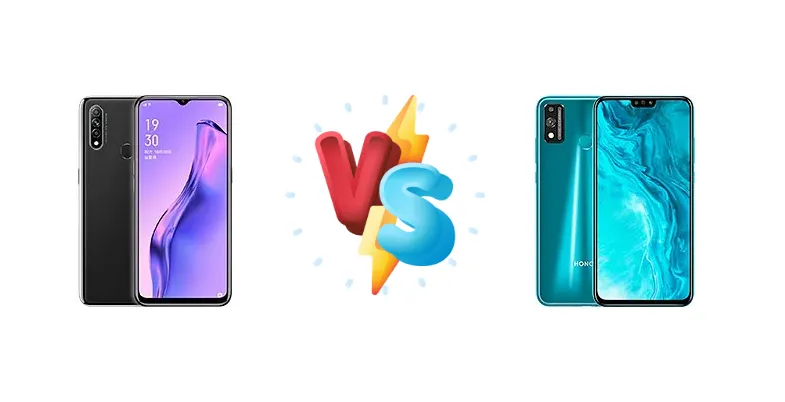
The Oppo A8 and Honor 9X Lite represent compelling options in the ultra-competitive budget smartphone market. Both aim to deliver essential features at an accessible price point, but they achieve this with different approaches to chipset selection. This comparison dissects the key differences between the MediaTek Helio P35-powered Oppo A8 and the HiSilicon Kirin 710F-equipped Honor 9X Lite, helping you determine which device best suits your needs.
🏆 Quick Verdict
For most users, the Honor 9X Lite offers a more compelling experience. The Kirin 710F chipset provides a noticeable performance uplift over the Helio P35 in the Oppo A8, translating to smoother multitasking and better gaming capabilities. While the Oppo A8 may have a slight edge in potential software optimization, the raw processing power of the 9X Lite makes it the winner.
| Network |
|---|
| 2G bands | GSM 850 / 900 / 1800 / 1900 | GSM 850 / 900 / 1800 / 1900 |
| 3G bands | HSDPA 850 / 900 / 2100 | HSDPA 850 / 900 / 1900 / 2100 |
| 4G bands | 1, 3, 5, 8, 34, 38, 39, 40, 41 | 1, 3, 7, 8, 20 |
| Speed | HSPA, LTE | HSPA 42.2/5.76 Mbps, LTE (2CA) Cat6 300/50 Mbps |
| Technology | GSM / CDMA / HSPA / EVDO / LTE | GSM / HSPA / LTE |
| | CDMA2000 1xEV-DO | - |
| Launch |
|---|
| Announced | 2019, December. Released 2019, December | 2020, April 17. Released 2020, May 14 |
| Status | Discontinued | Discontinued |
| Body |
|---|
| Build | Glass front, plastic back, plastic frame | - |
| Dimensions | 163.9 x 75.5 x 8.3 mm (6.45 x 2.97 x 0.33 in) | 160.4 x 76.6 x 7.8 mm (6.31 x 3.02 x 0.31 in) |
| SIM | Nano-SIM + Nano-SIM | Nano-SIM + Nano-SIM |
| Weight | 180 g (6.35 oz) | 188 g (6.63 oz) |
| Display |
|---|
| Resolution | 720 x 1600 pixels, 20:9 ratio (~269 ppi density) | 1080 x 2340 pixels, 19.5:9 ratio (~397 ppi density) |
| Size | 6.5 inches, 102.8 cm2 (~83.0% screen-to-body ratio) | 6.5 inches, 103.2 cm2 (~84.0% screen-to-body ratio) |
| Type | IPS LCD, 480 nits (typ) | IPS LCD |
| Platform |
|---|
| CPU | Octa-core (4x2.3 GHz Cortex-A53 & 4x1.8 GHz Cortex-A53) | Octa-core (4x2.2 GHz Cortex-A73 & 4x1.7 GHz Cortex-A53) |
| Chipset | Mediatek MT6765V/CB Helio P35 (12 nm) | Kirin 710F (12 nm) |
| GPU | PowerVR GE8320 | Mali-G51 MP4 |
| OS | Android 9.0 (Pie), ColorOS 6.1 | Android 9.0 (Pie), EMUI 9.1, Google Play Services |
| Memory |
|---|
| Card slot | microSDXC (dedicated slot) | microSDXC (dedicated slot) |
| Internal | 128GB 4GB RAM, 64GB 4GB RAM | 128GB 4GB RAM |
| | eMMC 5.1 | - |
| Main Camera |
|---|
| Dual | - | 48 MP, f/1.8, (wide), 1/2.0", 0.8µm, PDAF
Auxiliary lens |
| Features | LED flash, HDR, panorama | LED flash, HDR, panorama |
| Triple | 12 MP, f/1.8, (wide), PDAF
2 MP (macro)
Auxiliary lens | - |
| Video | 1080p@30fps | 1080p@30fps |
| Selfie camera |
|---|
| Features | HDR | - |
| Single | 8 MP, f/2.0 | 8 MP, f/2.0, (wide) |
| Video | 1080p@30fps | 1080p@30fps |
| Sound |
|---|
| 3.5mm jack | Yes | Yes |
| 35mm jack | Yes | Yes |
| Loudspeaker | Yes | Yes |
| Comms |
|---|
| Bluetooth | 5.0, A2DP, LE | 4.2, A2DP, LE |
| NFC | No | Yes (market/region dependent) |
| Positioning | GPS, BDS | GPS, GLONASS, BDS |
| Radio | FM radio | FM radio |
| USB | microUSB 2.0, OTG | microUSB 2.0 |
| WLAN | Wi-Fi 802.11 a/b/g/n/ac, dual-band, Wi-Fi Direct | Wi-Fi 802.11 a/b/g/n/ac, dual-band, Wi-Fi Direct |
| Features |
|---|
| Sensors | Fingerprint (rear-mounted), accelerometer, proximity, compass | Fingerprint (rear-mounted), accelerometer, proximity, compass |
| Battery |
|---|
| Charging | - | 10W wired |
| Type | Li-Po 4230 mAh | Li-Po 3750 mAh |
| Misc |
|---|
| Colors | Green, Black | Emerald Green, Midnight Black |
| Models | PDBM00 | JSN-L21, JSN-L22, JSN-L23 |
| Price | About 150 EUR | About 220 EUR |
Oppo A8
- Potentially cleaner software experience (depending on ColorOS version)
- May offer slightly faster CPU clock speeds on some cores (though architecture matters more)
- Unknown charging speed could be faster than Honor 9X Lite
- Less powerful chipset (Helio P35)
- Older CPU architecture (Cortex-A53)
- Likely slower overall performance
Honor 9X Lite
- More powerful chipset (Kirin 710F)
- Modern CPU architecture (Cortex-A73)
- Better performance for multitasking and gaming
- Slower 10W charging
- EMUI software may include bloatware
- Potential for software updates to be less frequent
Display Comparison
Neither Oppo nor Honor provide detailed display specifications beyond the basic resolution. However, given the price bracket, both likely utilize IPS LCD panels. The real differentiator lies under the hood. The Kirin 710F’s image signal processor (ISP) may offer slightly better image processing for photos taken on the 9X Lite, but without detailed brightness or color gamut data, it’s difficult to quantify. Bezels are likely comparable, reflecting the cost-conscious design of both devices.
Camera Comparison
Without detailed camera sensor information, a direct comparison is challenging. Both phones likely feature a multi-camera setup, but the quality will heavily depend on the primary sensor and image processing algorithms. The Kirin 710F’s ISP provides a potential advantage in image processing, potentially leading to better dynamic range and noise reduction in the Honor 9X Lite. It’s reasonable to assume both phones include a standard macro lens, but these are often of limited utility due to low resolution. Focusing on the primary sensor’s megapixel count and aperture would be more informative, but this data is unavailable.
Performance
The core difference between these phones is the chipset. The Honor 9X Lite’s Kirin 710F, built on a 12nm process, features a more modern CPU architecture with 4x2.2 GHz Cortex-A73 cores alongside 4x1.7 GHz Cortex-A53 cores. This contrasts with the Oppo A8’s MediaTek Helio P35, which utilizes 4x2.3 GHz Cortex-A53 cores and 4x1.8 GHz Cortex-A53 cores. The A73 cores in the Kirin 710F offer significantly improved single-core performance, crucial for responsive app launches and smoother UI navigation. While both are 12nm, the architectural advantage of the Kirin 710F translates to a more fluid user experience, particularly noticeable during demanding tasks. The Honor 9X Lite will handle more complex games and multitasking scenarios with greater ease.
Battery Life
Battery capacity is not specified for either device, making a direct comparison difficult. However, the Honor 9X Lite is limited to 10W wired charging, while the Oppo A8’s charging speed is unknown. A slower charging speed means longer times to reach a full charge. If battery life is paramount, a larger capacity battery (even with slower charging) is preferable. Without knowing the mAh ratings, it’s impossible to definitively declare a winner, but the 10W charging on the 9X Lite is a clear disadvantage for users who prioritize quick top-ups.
Buying Guide
Buy the Oppo A8 if your primary needs are basic smartphone functionality – calls, texts, and light social media – and you prioritize a potentially cleaner software experience. Buy the Honor 9X Lite if you value smoother performance for multitasking, enjoy mobile gaming, and appreciate a more capable processor for future-proofing, even if it means accepting a slower 10W charging speed.
Frequently Asked Questions
❓ Will the Kirin 710F in the Honor 9X Lite struggle with demanding games like PUBG Mobile?
While the Kirin 710F isn't a flagship-level processor, it's capable of running PUBG Mobile at medium settings with reasonable frame rates. Expect some occasional frame drops during intense action, but it's a playable experience. The Oppo A8's Helio P35 will likely require lower settings and may exhibit more noticeable lag.
❓ Is the 10W charging on the Honor 9X Lite a significant drawback?
Yes, 10W charging is relatively slow by today's standards. Expect it to take over 2.5-3 hours to fully charge the device from 0%. If you frequently need to top up your phone quickly, this is a considerable limitation. The Oppo A8's charging speed is unknown, but if it's significantly faster, it could be a deciding factor.
❓ Which phone is likely to receive more software updates?
Historically, Oppo has been more consistent with software updates for its A-series devices than Honor, particularly after Honor became independent. However, this can vary, and both brands have a mixed track record. Don't expect rapid updates to the latest Android versions on either device.