
Oppo A78 vs Xiaomi Redmi Note 12 Pro 4G: A Detailed Comparison
| Phones Images | |||||
|---|---|---|---|---|---|
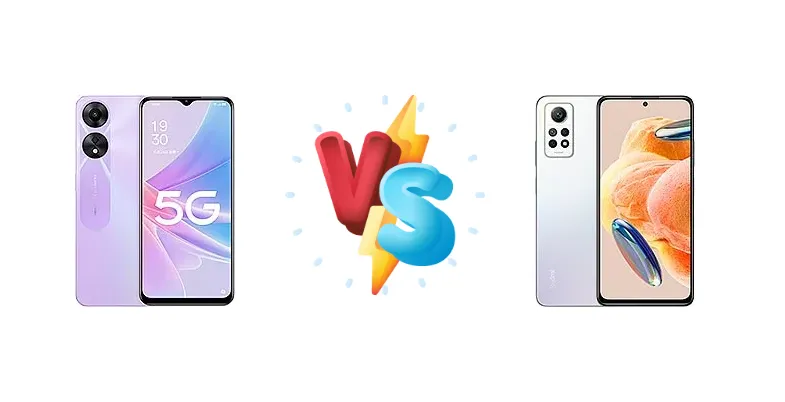
|
🏆 Quick Verdict
For the average user prioritizing faster charging and potentially smoother multitasking, the Xiaomi Redmi Note 12 Pro 4G emerges as the winner. Its 67W charging significantly reduces downtime, and the Snapdragon 732G, built on an 8nm process, offers a slight edge in sustained performance compared to the A78's Dimensity 700.
| PHONES | ||
|---|---|---|
| Phone Names | Oppo A78 | Xiaomi Redmi Note 12 Pro 4G |
| Network | ||
|---|---|---|
| 2G bands | GSM 850 / 900 / 1800 / 1900 | GSM 850 / 900 / 1800 / 1900 |
| 3G bands | HSDPA 800 / 850 / 900 / 1700(AWS) / 1900 / 2100 | HSDPA 850 / 900 / 1700(AWS) / 1900 / 2100 |
| 4G bands | 1, 2, 3, 4, 5, 7, 8, 12, 13, 17, 18, 19, 20, 26, 28, 38, 39, 40, 41, 66 | 1, 2, 3, 4, 5, 7, 8, 20, 28, 38, 40, 41, 66 |
| 5G bands | 1, 3, 5, 7, 8, 20, 28, 38, 40, 41, 66, 77, 78 SA/NSA | - |
| Speed | HSPA, LTE, 5G | HSPA, LTE |
| Technology | GSM / HSPA / LTE / 5G | GSM / HSPA / LTE |
| IP54 | - | |
| Launch | ||
|---|---|---|
| Announced | 2023, January 07 | 2023, March 03 |
| Status | Available. Released 2023, January 07 | Available. Released 2023, April 11 |
| Body | ||
|---|---|---|
| Dimensions | 163.8 x 75.1 x 8 mm (6.45 x 2.96 x 0.31 in) | 164.2 x 76.1 x 8.1 mm (6.46 x 3.00 x 0.32 in) |
| SIM | Nano-SIM + Nano-SIM | Nano-SIM + Nano-SIM |
| Weight | 188 g (6.63 oz) | 201.8 g (7.13 oz) |
| Display | ||
|---|---|---|
| Protection | Panda glass | - |
| Resolution | 720 x 1612 pixels, 20:9 ratio (~269 ppi density) | 1080 x 2400 pixels, 20:9 ratio (~395 ppi density) |
| Size | 6.56 inches, 103.4 cm2 (~84.0% screen-to-body ratio) | 6.67 inches, 107.4 cm2 (~86.0% screen-to-body ratio) |
| Type | IPS LCD, 90Hz, 480 nits (typ), 600 nits (HBM) | AMOLED, 120Hz, Dolby Vision, 700 nits (HBM), 1100 nits (peak) |
| Platform | ||
|---|---|---|
| CPU | Octa-core (2x2.2 GHz Cortex-A76 & 6x2.0 GHz Cortex-A55) | Octa-core (2x2.2 GHz Kryo 470 Gold & 6x1.8 GHz Kryo 470 Silver) |
| Chipset | Mediatek Dimensity 700 (7 nm) | Qualcomm SM7150 Snapdragon 732G (8 nm) |
| GPU | Mali-G57 MC2 | Adreno 618 |
| OS | Android 12, upgradable to Android 14, ColorOS 14 | Android 11, MIUI 13 |
| Memory | ||
|---|---|---|
| Card slot | microSDXC | microSDXC (uses shared SIM slot) |
| Internal | 128GB 4GB RAM, 128GB 8GB RAM, 256GB 8GB RAM | 128GB 6GB RAM, 128GB 8GB RAM, 256GB 8GB RAM |
| UFS 2.2 | UFS 2.2 | |
| Main Camera | ||
|---|---|---|
| Dual | 50 MP, f/1.8, 27mm (wide), PDAF Auxiliary lens | - |
| Features | LED flash, HDR, panorama | LED flash, HDR, panorama |
| Quad | - | 108 MP, f/1.9, (wide), 1/1.52", 0.7µm, PDAF 8 MP, 120˚, (ultrawide) 2 MP (macro) Auxiliary lens |
| Single | 8 MP, f/2.0, 27mm (wide) | - |
| Video | 1080p@30fps | 4K@30fps, 1080p@30/60fps |
| Selfie camera | ||
|---|---|---|
| Single | 8 MP, f/2.0, 27mm (wide) | 16 MP, f/2.4, (wide) |
| Video | 1080p@30fps | 1080p@30fps |
| Sound | ||
|---|---|---|
| 3.5mm jack | Yes | Yes |
| 35mm jack | Yes | Yes |
| Loudspeaker | Yes, with stereo speakers | Yes, with stereo speakers |
| Comms | ||
|---|---|---|
| Bluetooth | 5.3, A2DP, LE, aptX | 5.0, A2DP, LE |
| Infrared port | - | Yes |
| NFC | Yes | Yes (market/region dependent) |
| Positioning | GPS, GALILEO, GLONASS, BDS, QZSS | GPS, GLONASS, GALILEO, BDS |
| Radio | No | Unspecified |
| USB | USB Type-C 2.0, OTG | USB Type-C 2.0, OTG |
| WLAN | Wi-Fi 802.11 a/b/g/n/ac, dual-band | Wi-Fi 802.11 a/b/g/n/ac, dual-band |
| Features | ||
|---|---|---|
| Sensors | Fingerprint (side-mounted), accelerometer, proximity, compass | Fingerprint (side-mounted), accelerometer, gyro, compass |
| Battery | ||
|---|---|---|
| Charging | 33W wired, PD, 52% in 30 min, 100% in 67 min | 67W wired |
| Type | Li-Po 5000 mAh | Li-Po 5000 mAh |
| Misc | ||
|---|---|---|
| Colors | Glowing Black, Glowing Purple | Star Blue, Graphite Gray, Polar White, Ice blue |
| Models | CPH2483, CPH2495 | 2209116AG, 2209116AG |
| Price | € 188.99 / $ 102.92 / ₹ 16,290 | About 150 EUR |
Oppo A78
- Efficient Dimensity 700 chipset for everyday tasks
- Reliable performance for basic apps and browsing
- Potentially better power efficiency
- Slower 33W charging
- Chipset may throttle under sustained load
Xiaomi Redmi Note 12 Pro 4G
- Faster 67W charging for minimal downtime
- Snapdragon 732G offers better sustained performance
- Potentially superior image processing
- Slightly less power efficient than the Dimensity 700
- May run slightly warmer under heavy load
Display Comparison
Neither device boasts a flagship-level display, but details beyond the provided specs are needed for a full assessment. However, the core chipsets influence display responsiveness. The Snapdragon 732G's slightly more powerful GPU could translate to smoother scrolling and animations, assuming both phones utilize similar display refresh rates (which isn't specified). Without knowing panel type (IPS vs AMOLED) or peak brightness, it's difficult to declare a clear winner, but the Redmi Note 12 Pro 4G has a slight advantage due to the chipset.
Camera Comparison
Without detailed camera specifications (sensor size, aperture, OIS), a direct comparison is limited. However, the Redmi Note 12 Pro 4G's chipset generally offers better image signal processing (ISP) capabilities, potentially resulting in more detailed and vibrant photos, especially in challenging lighting conditions. The A78's Dimensity 700 ISP is adequate, but likely won't match the Snapdragon's processing power. It's safe to assume both phones include standard features like HDR and night mode, but the Redmi Note 12 Pro 4G likely has an edge in overall image quality.
Performance
The Qualcomm Snapdragon 732G (8nm) in the Redmi Note 12 Pro 4G and the MediaTek Dimensity 700 (7nm) in the Oppo A78 represent different approaches to mid-range performance. While both are octa-core CPUs with similar core configurations (2x high-performance, 6x efficiency), the Snapdragon 732G benefits from a more refined architecture (Kryo 470 Gold & Silver) and a smaller process node. This 8nm process generally leads to better thermal efficiency, meaning the Redmi Note 12 Pro 4G is less likely to throttle under sustained load, making it preferable for extended gaming sessions. The Dimensity 700, while capable, may exhibit more performance degradation over time during intensive tasks.
Battery Life
The Redmi Note 12 Pro 4G's 67W charging is a significant advantage over the Oppo A78's 33W charging. The Redmi Note 12 Pro 4G can reach 100% charge in approximately 67 minutes, while the A78 takes 100 minutes. This faster charging dramatically reduces downtime, a crucial factor for many users. While battery capacity isn't specified, the faster charging speed effectively mitigates any potential disadvantage from a slightly smaller battery in the Redmi Note 12 Pro 4G.
Buying Guide
Buy the Oppo A78 if you prioritize a balanced experience with a focus on efficient power consumption and a reliable chipset for everyday tasks. Buy the Xiaomi Redmi Note 12 Pro 4G if you value rapid charging, potentially better multitasking performance, and are willing to trade a bit of power efficiency for that speed. Gamers will likely find the Redmi Note 12 Pro 4G a more responsive choice.