
Oppo A78 vs OnePlus Nord CE 3 Lite: A Deep Dive into Budget 5G Contenders
| Phones Images | |||||
|---|---|---|---|---|---|
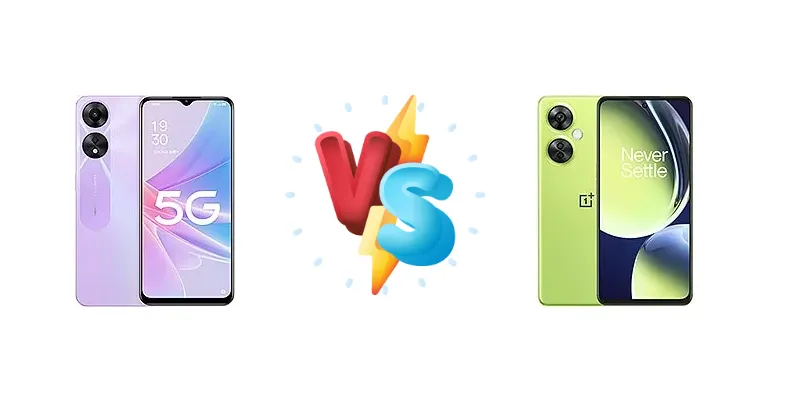
|
🏆 Quick Verdict
For most users, the OnePlus Nord CE 3 Lite emerges as the stronger choice. Its 67W SuperVOOC charging significantly reduces downtime, reaching 80% in just 30 minutes, a substantial advantage over the A78’s 33W charging. While both offer similar CPU performance, the faster charging and potentially more efficient Snapdragon 695 give it a slight edge.
| PHONES | ||
|---|---|---|
| Phone Names | Oppo A78 | OnePlus Nord CE 3 Lite |
| Network | ||
|---|---|---|
| 2G bands | GSM 850 / 900 / 1800 / 1900 | GSM 850 / 900 / 1800 / 1900 |
| 3G bands | HSDPA 800 / 850 / 900 / 1700(AWS) / 1900 / 2100 | HSDPA 800 / 850 / 900 / 1700(AWS) / 1900 / 2100 - International |
| 4G bands | 1, 2, 3, 4, 5, 7, 8, 12, 13, 17, 18, 19, 20, 26, 28, 38, 39, 40, 41, 66 | 1, 2, 3, 4, 5, 7, 8, 12, 13, 17, 18, 19, 20, 26, 28, 32, 38, 39, 40, 41, 66 - International |
| 5G bands | 1, 3, 5, 7, 8, 20, 28, 38, 40, 41, 66, 77, 78 SA/NSA | 1, 3, 5, 7, 8, 20, 28, 38, 40, 41, 66, 77, 78 SA/NSA - International |
| Speed | HSPA, LTE, 5G | HSPA, LTE, 5G |
| Technology | GSM / HSPA / LTE / 5G | GSM / HSPA / LTE / 5G |
| IP54 | 1, 3, 5, 8, 28, 40, 41, 77, 78 SA/NSA - India | |
| Launch | ||
|---|---|---|
| Announced | 2023, January 07 | 2023, April 04 |
| Status | Available. Released 2023, January 07 | Available. Released 2023, April 11 |
| Body | ||
|---|---|---|
| Build | - | Glass front, plastic frame, plastic back |
| Dimensions | 163.8 x 75.1 x 8 mm (6.45 x 2.96 x 0.31 in) | 165.5 x 76 x 8.3 mm (6.52 x 2.99 x 0.33 in) |
| SIM | Nano-SIM + Nano-SIM | Nano-SIM + Nano-SIM |
| Weight | 188 g (6.63 oz) | 195 g (6.88 oz) |
| Display | ||
|---|---|---|
| Protection | Panda glass | Corning Gorilla Glass |
| Resolution | 720 x 1612 pixels, 20:9 ratio (~269 ppi density) | 1080 x 2400 pixels, 20:9 ratio (~391 ppi density) |
| Size | 6.56 inches, 103.4 cm2 (~84.0% screen-to-body ratio) | 6.72 inches, 109.6 cm2 (~87.1% screen-to-body ratio) |
| Type | IPS LCD, 90Hz, 480 nits (typ), 600 nits (HBM) | IPS LCD, 120Hz, 550 nits (typ), 680 nits (peak) |
| Platform | ||
|---|---|---|
| CPU | Octa-core (2x2.2 GHz Cortex-A76 & 6x2.0 GHz Cortex-A55) | Octa-core (2x2.2 GHz Kryo 660 Gold & 6x1.7 GHz Kryo 660 Silver) |
| Chipset | Mediatek Dimensity 700 (7 nm) | Qualcomm SM6375 Snapdragon 695 5G (6 nm) |
| GPU | Mali-G57 MC2 | Adreno 619 |
| OS | Android 12, upgradable to Android 14, ColorOS 14 | Android 13, OxygenOS 13.1 |
| Memory | ||
|---|---|---|
| Card slot | microSDXC | microSDXC (uses shared SIM slot) |
| Internal | 128GB 4GB RAM, 128GB 8GB RAM, 256GB 8GB RAM | 128GB 8GB RAM, 256GB 8GB RAM |
| UFS 2.2 | UFS 2.2 | |
| Main Camera | ||
|---|---|---|
| Dual | 50 MP, f/1.8, 27mm (wide), PDAF Auxiliary lens | - |
| Features | LED flash, HDR, panorama | LED flash, HDR, panorama |
| Single | 8 MP, f/2.0, 27mm (wide) | - |
| Triple | - | 108 MP, f/1.8, (wide), 1/1.67", 0.64µm, PDAF 2 MP (macro) Auxiliary lens |
| Video | 1080p@30fps | 1080p@30fps |
| Selfie camera | ||
|---|---|---|
| Features | - | HDR, panorama |
| Single | 8 MP, f/2.0, 27mm (wide) | 16 MP, f/2.4, (wide), 1.0µm |
| Video | 1080p@30fps | 1080p@30fps |
| Sound | ||
|---|---|---|
| 3.5mm jack | Yes | Yes |
| 35mm jack | Yes | Yes |
| Loudspeaker | Yes, with stereo speakers | Yes, with stereo speakers |
| Comms | ||
|---|---|---|
| Bluetooth | 5.3, A2DP, LE, aptX | 5.1, A2DP, LE, aptX HD |
| NFC | Yes | Yes (market/region dependent) |
| Positioning | GPS, GALILEO, GLONASS, BDS, QZSS | GPS, GALILEO, GLONASS, BDS, QZSS |
| Radio | No | No |
| USB | USB Type-C 2.0, OTG | USB Type-C 2.0, OTG |
| WLAN | Wi-Fi 802.11 a/b/g/n/ac, dual-band | Wi-Fi 802.11 a/b/g/n/ac, dual-band |
| Features | ||
|---|---|---|
| Sensors | Fingerprint (side-mounted), accelerometer, proximity, compass | Fingerprint (side-mounted), accelerometer, gyro, proximity, compass |
| Battery | ||
|---|---|---|
| Charging | 33W wired, PD, 52% in 30 min, 100% in 67 min | 67W wired, 80% in 30 min |
| Type | Li-Po 5000 mAh | Li-Po 5000 mAh |
| Misc | ||
|---|---|---|
| Colors | Glowing Black, Glowing Purple | Pastel Lime, Chromatic Gray |
| Models | CPH2483, CPH2495 | CPH2467, CPH2465 |
| Price | € 188.99 / $ 102.92 / ₹ 16,290 | £ 169.98 / € 209.99 |
| SAR | - | 1.17 W/kg (head) 0.70 W/kg (body) |
| Tests | ||
|---|---|---|
| Performance | - | AnTuTu: 412006 (v9) GeekBench: 2052 (v5) GFXBench: 17fps (ES 3.1 onscreen) |
Oppo A78
- Established Oppo brand reputation
- Competent performance for everyday tasks
- Reliable MediaTek Dimensity 700 chipset
- Slower 33W charging
- Potentially less efficient chipset compared to Snapdragon 695
- Likely similar camera performance to the Nord CE 3 Lite
OnePlus Nord CE 3 Lite
- Significantly faster 67W SuperVOOC charging
- More power-efficient Snapdragon 695 5G chipset
- Potentially smoother software experience with OxygenOS
- OnePlus's software update track record can be inconsistent
- May not have the same brand recognition as Oppo in some markets
Display Comparison
Neither device boasts a standout display. Both likely feature LCD panels, a common trait in this price bracket. The focus here isn't on cutting-edge tech like LTPO or OLED. However, the display quality will likely be similar, with the user experience dictated more by software calibration than inherent panel capabilities. Bezels are expected to be moderate on both, and color accuracy will likely be adequate for everyday use, but not professional color work.
Camera Comparison
Camera performance is likely to be similar, relying heavily on software processing. Both phones will likely feature a primary camera and depth/macro sensors. The key specification to look for (which isn't provided) would be the megapixel count and aperture of the main sensor. Without that data, it's difficult to definitively say which will perform better. The inclusion of Optical Image Stabilization (OIS) on either device would be a significant advantage, but is not specified. The 2MP macro cameras on both are likely to offer limited utility, serving more as a feature checkbox than a genuinely useful tool.
Performance
The core difference lies in the chipsets. The Oppo A78’s MediaTek Dimensity 700 (7nm) and the OnePlus Nord CE 3 Lite’s Qualcomm Snapdragon 695 5G (6nm) both utilize octa-core CPUs with similar core configurations (2x high-performance, 6x efficiency). However, the Snapdragon 695, built on a more refined 6nm process, generally offers better power efficiency. While both CPUs peak at 2.2 GHz, the Snapdragon’s Kryo cores are architecturally different from the Cortex-A76 in the Dimensity 700, potentially leading to slightly better sustained performance. The 6nm node also suggests better thermal management, reducing the likelihood of throttling during extended gaming sessions. Both will handle everyday tasks and light multitasking without issue, but the Snapdragon 695 has a slight advantage in demanding scenarios.
Battery Life
The battery capacity isn't specified for either device, but both will likely fall in the 5000mAh range, typical for this price point. The real differentiator is charging speed. The OnePlus Nord CE 3 Lite’s 67W SuperVOOC charging is a game-changer, promising an 80% charge in just 30 minutes. The Oppo A78’s 33W charging, while respectable, takes 67 minutes to reach 100%. This means the Nord CE 3 Lite offers significantly less downtime, a crucial advantage for users who need to quickly replenish their battery. The more efficient Snapdragon 695 may also contribute to slightly better overall battery life.
Buying Guide
Buy the Oppo A78 if you prioritize a slightly more established brand reputation within the Oppo ecosystem and are comfortable with slower charging speeds. It’s a solid all-rounder for basic smartphone tasks. Buy the OnePlus Nord CE 3 Lite if you value rapid charging and a potentially more optimized software experience, particularly if you’re already invested in the OnePlus/OxygenOS environment. It’s the better option for users who are frequently on the go and need to quickly top up their battery.