
Google Pixel 7a vs Oppo A78: A Detailed Comparison of Mid-Range Contenders
| Phones Images | |||||
|---|---|---|---|---|---|
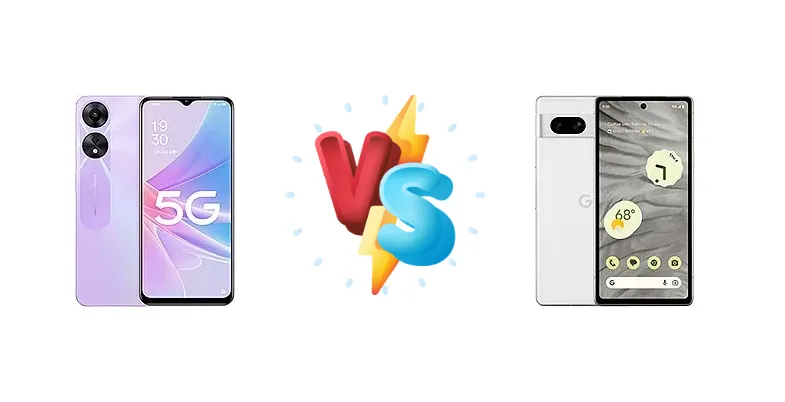
|
🏆 Quick Verdict
For most users, the Google Pixel 7a is the superior choice. Its Tensor G2 chipset provides significantly better performance, and its camera system is in a different league than the Oppo A78’s. While the A78 offers faster charging and a lower price, the Pixel 7a’s overall experience justifies the price premium.
| PHONES | ||
|---|---|---|
| Phone Names | Oppo A78 | Google Pixel 7a |
| Network | ||
|---|---|---|
| 2G bands | GSM 850 / 900 / 1800 / 1900 | GSM 850 / 900 / 1800 / 1900 |
| 3G bands | HSDPA 800 / 850 / 900 / 1700(AWS) / 1900 / 2100 | HSDPA 800 / 850 / 900 / 1700(AWS) / 1900 / 2100 |
| 4G bands | 1, 2, 3, 4, 5, 7, 8, 12, 13, 17, 18, 19, 20, 26, 28, 38, 39, 40, 41, 66 | 1, 2, 3, 4, 5, 7, 8, 12, 13, 14, 17, 20, 25, 26, 28, 29, 30, 38, 40, 41, 48, 66, 71 - GWKK3, G0DZQ |
| 5G bands | 1, 3, 5, 7, 8, 20, 28, 38, 40, 41, 66, 77, 78 SA/NSA | 1, 2, 3, 5, 7, 8, 12, 14, 20, 25, 28, 30, 38, 41, 48, 66, 71, 77, 78 SA/NSA/Sub6 - GWKK3 |
| Speed | HSPA, LTE, 5G | HSPA, LTE, 5G |
| Technology | GSM / HSPA / LTE / 5G | GSM / HSPA / LTE / 5G |
| IP54 | 1, 2, 3, 5, 7, 8, 12, 20, 25, 28, 38, 40, 41, 66, 75, 76, 77, 78, 79 SA/NSA/Sub6 - GHL1X, G82U8 | |
| Launch | ||
|---|---|---|
| Announced | 2023, January 07 | 2023, May 10 |
| Status | Available. Released 2023, January 07 | Available. Released 2023, May 10 |
| Body | ||
|---|---|---|
| Build | - | Glass front (Gorilla Glass 3), aluminum frame, plastic back |
| Dimensions | 163.8 x 75.1 x 8 mm (6.45 x 2.96 x 0.31 in) | 152 x 72.9 x 9 mm (5.98 x 2.87 x 0.35 in) |
| SIM | Nano-SIM + Nano-SIM | Nano-SIM + eSIM |
| Weight | 188 g (6.63 oz) | 193.5 g (6.84 oz) |
| - | IP67 dust/water resistant (up to 1m for 30 min) | |
| Display | ||
|---|---|---|
| Protection | Panda glass | Corning Gorilla Glass 3 |
| Resolution | 720 x 1612 pixels, 20:9 ratio (~269 ppi density) | 1080 x 2400 pixels, 20:9 ratio (~429 ppi density) |
| Size | 6.56 inches, 103.4 cm2 (~84.0% screen-to-body ratio) | 6.1 inches, 90.7 cm2 (~81.8% screen-to-body ratio) |
| Type | IPS LCD, 90Hz, 480 nits (typ), 600 nits (HBM) | OLED, HDR, 90Hz |
| - | Always-on display | |
| Platform | ||
|---|---|---|
| CPU | Octa-core (2x2.2 GHz Cortex-A76 & 6x2.0 GHz Cortex-A55) | Octa-core (2x2.85 GHz Cortex-X1 & 2x2.35 GHz Cortex-A78 & 4x1.80 GHz Cortex-A55) |
| Chipset | Mediatek Dimensity 700 (7 nm) | Google Tensor G2 (5 nm) |
| GPU | Mali-G57 MC2 | Mali-G710 MP7 |
| OS | Android 12, upgradable to Android 14, ColorOS 14 | Android 13, upgradable to Android 15, up to 5 major Android upgrades |
| Memory | ||
|---|---|---|
| Card slot | microSDXC | No |
| Internal | 128GB 4GB RAM, 128GB 8GB RAM, 256GB 8GB RAM | 128GB 8GB RAM |
| UFS 2.2 | UFS 3.1 | |
| Main Camera | ||
|---|---|---|
| Dual | 50 MP, f/1.8, 27mm (wide), PDAF Auxiliary lens | 64 MP, f/1.9, 26mm (wide), 1/1.73", 0.8µm, dual pixel PDAF, OIS 13 MP, f/2.2, 120˚ (ultrawide), 1.12µm |
| Features | LED flash, HDR, panorama | Dual-LED flash, Pixel Shift, Auto-HDR, panorama |
| Single | 8 MP, f/2.0, 27mm (wide) | - |
| Video | 1080p@30fps | 4K@30/60fps, 1080p@30/60/120/240fps, OIS |
| Selfie camera | ||
|---|---|---|
| Features | - | HDR, panorama |
| Single | 8 MP, f/2.0, 27mm (wide) | 13 MP, f/2.2, 20mm (ultrawide), 1.12µm |
| Video | 1080p@30fps | 4K@30fps, 1080p@30fps |
| Sound | ||
|---|---|---|
| 3.5mm jack | Yes | No |
| 35mm jack | Yes | No |
| Loudspeaker | Yes, with stereo speakers | Yes, with stereo speakers |
| Comms | ||
|---|---|---|
| Bluetooth | 5.3, A2DP, LE, aptX | 5.3, A2DP, LE |
| NFC | Yes | Yes |
| Positioning | GPS, GALILEO, GLONASS, BDS, QZSS | GPS, GLONASS, GALILEO, BDS, QZSS, NavIC |
| Radio | No | No |
| USB | USB Type-C 2.0, OTG | USB Type-C 3.2 |
| WLAN | Wi-Fi 802.11 a/b/g/n/ac, dual-band | Wi-Fi 802.11 a/b/g/n/ac/6e, tri-band |
| Features | ||
|---|---|---|
| Sensors | Fingerprint (side-mounted), accelerometer, proximity, compass | Fingerprint (under display, optical), accelerometer, gyro, proximity, compass, barometer |
| Battery | ||
|---|---|---|
| Charging | 33W wired, PD, 52% in 30 min, 100% in 67 min | 18W wired, PD3.0 7.5W wireless |
| Type | Li-Po 5000 mAh | Li-Po 4385 mAh |
| Misc | ||
|---|---|---|
| Colors | Glowing Black, Glowing Purple | Charcoal, Snow, Sea, Coral |
| Models | CPH2483, CPH2495 | GWKK3, GHL1X, G0DZQ, G82U8 |
| Price | € 188.99 / $ 102.92 / ₹ 16,290 | € 179.90 / $ 150.00 / £ 170.00 / ₹ 25,980 |
Oppo A78
- Faster charging with 33W wired support
- More affordable price point
- Solid build quality for the price
- Less powerful processor for demanding tasks
- Inferior camera performance compared to Pixel 7a
- Display lacks the brightness and color accuracy of the Pixel 7a
Google Pixel 7a
- Superior performance with Google Tensor G2
- Exceptional camera quality with Google’s image processing
- Brighter and more vibrant display
- Slower charging speed at 18W
- Higher price compared to Oppo A78
- May experience more heat under sustained load
Display Comparison
The Pixel 7a boasts a significantly brighter display, reaching a measured 1070 nits, compared to the Oppo A78’s unspecified brightness. This translates to better visibility outdoors under direct sunlight. While both likely utilize OLED panels, the Pixel 7a’s higher peak brightness and Google’s color calibration likely offer a more vibrant and accurate viewing experience. The A78’s display specifications are less detailed, suggesting a more standard, cost-optimized panel.
Camera Comparison
The Pixel 7a’s camera system is the clear winner. While specific sensor details are missing for both, Google’s computational photography prowess, powered by the Tensor G2’s image signal processor (ISP), elevates image quality significantly. The Pixel 7a excels in low-light photography and offers features like Magic Eraser and Photo Unblur. The Oppo A78’s camera, while adequate for casual snapshots, lacks the advanced processing capabilities of the Pixel 7a. Ignoring the likely inclusion of a low-resolution macro lens on the A78, the Pixel 7a’s video capabilities are also expected to be superior, offering better stabilization and dynamic range.
Performance
The core difference lies in the chipsets. The Google Pixel 7a’s Tensor G2 (5nm) is a substantial upgrade over the Oppo A78’s Mediatek Dimensity 700 (7nm). The Tensor G2’s Cortex-X1 prime core, clocked at 2.85 GHz, provides a significant performance boost in CPU-intensive tasks. The Dimensity 700, while capable for everyday use, will struggle with demanding games and multitasking. The 5nm fabrication process of the Tensor G2 also contributes to better thermal efficiency, reducing the likelihood of throttling during sustained workloads. The Pixel 7a’s likely use of faster LPDDR5x RAM further enhances performance.
Battery Life
The Oppo A78’s 33W wired charging is considerably faster than the Pixel 7a’s 18W charging. The A78 can reach 52% charge in 30 minutes and 100% in 67 minutes, while the Pixel 7a will take significantly longer. However, the Pixel 7a’s older endurance rating of 76 hours suggests efficient power management. While the A78’s battery capacity is unspecified, the faster charging speed is a significant advantage for users who prioritize quick top-ups. The Pixel 7a also offers 7.5W wireless charging, a feature absent on the A78.
Buying Guide
Buy the Oppo A78 if you prioritize fast charging and a budget-friendly price above all else, and don't heavily rely on mobile gaming or advanced camera features. Buy the Google Pixel 7a if you value a premium camera experience, smoother performance for demanding apps, and Google’s software features, even if it means sacrificing some charging speed and paying a higher price.