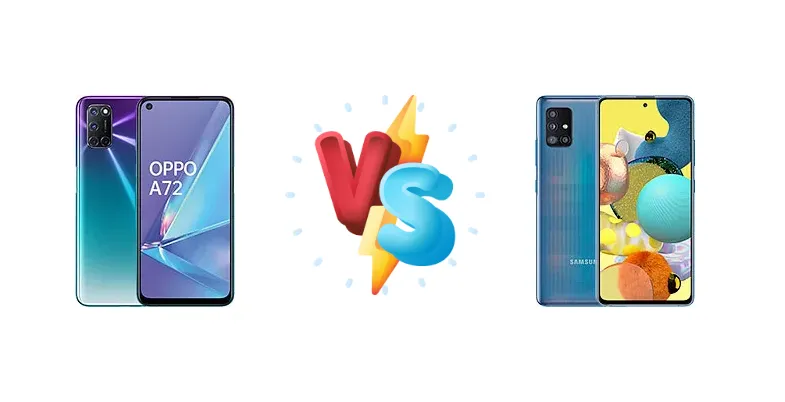
The Oppo A72 and Samsung Galaxy A51 5G UW represent distinct approaches to the mid-range smartphone market. The A72, typically positioned as a value-focused option, features the Snapdragon 665. The A51 5G UW, leveraging the Snapdragon 765G, aims for a blend of 5G connectivity and improved performance. This comparison dissects the key differences to determine which device delivers the best experience for your needs.
🏆 Quick Verdict
For the average user prioritizing performance and future-proofing with 5G, the Samsung Galaxy A51 5G UW is the superior choice. Its Snapdragon 765G chipset offers a noticeable performance uplift over the Oppo A72’s Snapdragon 665, justifying the potential price difference. However, the A72 remains a viable option for basic tasks and users on a tight budget.
| Network |
|---|
| 2G bands | GSM 850 / 900 / 1800 / 1900 | GSM 850 / 900 / 1800 / 1900 |
| 3G bands | HSDPA 850 / 900 / 1700(AWS) / 1900 / 2100 | HSDPA 850 / 900 / 1900 / 2100 |
| 4G bands | 1, 2, 3, 4, 5, 7, 8, 12, 17, 18, 19, 20, 26, 28, 38, 39, 40, 41, 66 - Global | 2, 4, 5, 13, 66 |
| 5G bands | - | 260, 261 mmWave |
| Speed | HSPA, LTE | HSPA, LTE, 5G |
| Technology | GSM / HSPA / LTE | GSM / HSPA / LTE / 5G |
| Launch |
|---|
| Announced | 2020, April 21. Released 2020, April 29 | 2020, August 14 |
| Status | Discontinued | Available. Released 2020, August 14 |
| Body |
|---|
| Build | - | Glass front (Gorilla Glass 3), plastic back, aluminum frame |
| Dimensions | 162 x 75.5 x 8.9 mm (6.38 x 2.97 x 0.35 in) | 158.8 x 73.4 x 8.6 mm (6.25 x 2.89 x 0.34 in) |
| SIM | Nano-SIM + Nano-SIM | Nano-SIM (pre-installed) |
| Weight | 192 g (6.77 oz) | 188.8 g (6.67 oz) |
| Display |
|---|
| Protection | Corning Gorilla Glass 3 | Corning Gorilla Glass 3 |
| Resolution | 1080 x 2400 pixels, 20:9 ratio (~405 ppi density) | 1080 x 2400 pixels, 20:9 ratio (~405 ppi density) |
| Size | 6.5 inches, 102.0 cm2 (~83.4% screen-to-body ratio) | 6.5 inches, 102.0 cm2 (~87.5% screen-to-body ratio) |
| Type | IPS LCD, 480 nits (typ) | Super AMOLED |
| Platform |
|---|
| CPU | Octa-core (4x2.0 GHz Kryo 260 Gold & 4x1.8 GHz Kryo 260 Silver) | Octa-core (1x2.4 GHz Kryo 475 Prime & 1x2.2 GHz Kryo 475 Gold & 6x1.8 GHz Kryo 475 Silver) |
| Chipset | Qualcomm SM6125 Snapdragon 665 (11 nm) | Qualcomm SM7250 Snapdragon 765G 5G (7 nm) |
| GPU | Adreno 610 | Adreno 620 |
| OS | Android 10, ColorOS 7.1 | Android 10, One UI 2 |
| Memory |
|---|
| Card slot | microSDXC (dedicated slot) | microSDXC (uses shared SIM slot) |
| Internal | 128GB 4GB RAM, 128GB 8GB RAM | 128GB 6GB RAM |
| | UFS 2.1 | UFS 2.1 |
| Main Camera |
|---|
| Features | LED flash, HDR, panorama | LED flash, panorama, HDR |
| Quad | 48 MP, f/1.7, (wide), 1/2.0", 0.8µm, PDAF
8 MP, f/2.2, 119˚ (ultrawide), 1/4.0", 1.12µm
Auxiliary lens
2 MP B/W, f/2.4 | 48 MP, f/2.0, 26mm (wide), 1/2.0", 0.8µm, PDAF
12 MP, f/2.2, 123˚ (ultrawide)
5 MP (macro)
Auxiliary lens |
| Single | - | 5 MP, AF |
| Video | 4K@30fps, 1080p@30/120fps, gyro-EIS | 4K@30fps, 1080p@30/120fps; gyro-EIS |
| Selfie camera |
|---|
| Features | HDR | HDR |
| Single | 16 MP, f/2.0, (wide), 1/3.06, 1.0µm | 32 MP, f/2.2, 26mm (wide), 1/2.8", 0.8µm |
| Video | 1080p@30fps | 4K@30fps, 1080p@30fps |
| Sound |
|---|
| 3.5mm jack | Yes | Yes |
| 35mm jack | Yes | Yes |
| Loudspeaker | Yes, with stereo speakers | Yes |
| | 24-bit/192kHz audio | - |
| Comms |
|---|
| Bluetooth | 5.0, A2DP, LE | 5.0, A2DP, LE |
| NFC | Yes | Yes |
| Positioning | GPS, GLONASS, GALILEO, BDS | GPS, GLONASS, GALILEO, BDS |
| Radio | No | FM radio, RDS, recording |
| USB | USB Type-C 2.0, OTG | USB Type-C 2.0, OTG |
| WLAN | Wi-Fi 802.11 a/b/g/n/ac, dual-band, Wi-Fi Direct | Wi-Fi 802.11 a/b/g/n/ac, dual-band, Wi-Fi Direct |
| Features |
|---|
| Sensors | Fingerprint (side-mounted), accelerometer, proximity, compass | Fingerprint (under display, optical), accelerometer, gyro, proximity, compass |
| | - | ANT+ |
| Battery |
|---|
| Charging | 18W wired | 15W wired |
| Stand-by | - | Up to 672 h |
| Talk time | - | Up to 5 h |
| Type | Li-Po 5000 mAh | Li-Po 4500 mAh |
| Misc |
|---|
| Colors | Twilight Black, Stream White, Sky Blue, Aurora Purple | Prism Bricks Blue |
| Models | CPH2067 | SM-A516V |
| Price | About 270 EUR | About 470 EUR |
| SAR | - | 0.70 W/kg (head) 1.25 W/kg (body) |
| SAR EU | 0.48 W/kg (head) 0.92 W/kg (body) | 0.59 W/kg (head) 1.32 W/kg (body) |
Oppo A72
- More affordable price point
- Faster wired charging (18W vs 15W)
- Sufficient for basic smartphone tasks
- Significantly less powerful processor
- Limited multitasking capabilities
- Less future-proof due to older chipset
Samsung Galaxy A51 5G UW
- Superior performance with Snapdragon 765G
- 5G connectivity for faster data speeds
- Better image processing capabilities
- Potentially higher price
- Slower wired charging (15W)
- May experience more thermal throttling under sustained load
Display Comparison
Neither device boasts a particularly standout display. While specific display specs (resolution, panel type) aren't provided, both likely utilize LCD panels common in this price bracket. The core difference lies in the processing power driving the display; the Snapdragon 765G in the A51 5G UW will handle UI elements and animations more fluidly. The A72's Snapdragon 665 may exhibit slight lag during fast scrolling or transitions.
Camera Comparison
Without detailed camera sensor information, a direct comparison is limited. However, the processing capabilities of the Snapdragon 765G in the A51 5G UW will likely result in superior image processing, particularly in low-light conditions. The A72’s Snapdragon 665 has a less powerful ISP (Image Signal Processor), potentially leading to softer images and less effective noise reduction. The presence of a dedicated 'Prime' core in the A51 5G UW's CPU also aids in faster image processing tasks.
Performance
The performance gap is the most significant differentiator. The Samsung Galaxy A51 5G UW’s Qualcomm SM7250 Snapdragon 765G (7nm) is a substantial upgrade over the Oppo A72’s SM6125 Snapdragon 665 (11nm). The 7nm process node allows for greater transistor density and improved power efficiency, translating to better sustained performance and reduced thermal throttling. The A51 5G UW’s CPU configuration – a 1x2.4 GHz Kryo 475 Prime core, 1x2.2 GHz Kryo 475 Gold core, and 6x1.8 GHz Kryo 475 Silver cores – provides a more robust architecture than the A72’s Octa-core (4x2.0 GHz Kryo 260 Gold & 4x1.8 GHz Kryo 260 Silver). This difference is particularly noticeable in demanding applications and gaming.
Battery Life
The Oppo A72 features 18W wired charging, while the Samsung Galaxy A51 5G UW offers 15W wired charging. While the A72 charges slightly faster on paper, the Snapdragon 765G’s improved power efficiency in the A51 5G UW could offset this difference in real-world usage. The actual battery life will depend heavily on usage patterns, but the A51 5G UW’s more efficient chipset is likely to provide comparable or even better longevity despite the potentially smaller battery capacity (not specified in the provided data).
Buying Guide
Buy the Oppo A72 if you need a reliable smartphone for everyday tasks like calling, texting, and light social media use, and prioritize affordability above all else. Buy the Samsung Galaxy A51 5G UW if you want a smoother multitasking experience, enjoy mobile gaming, and desire the benefits of 5G connectivity for faster download speeds and lower latency, even if it means spending a bit more.
Frequently Asked Questions
❓ Will the Snapdragon 765G in the A51 5G UW handle demanding games like PUBG or Call of Duty Mobile smoothly?
Yes, the Snapdragon 765G is capable of running PUBG and Call of Duty Mobile at medium to high settings with playable frame rates. While it won't match the performance of flagship chipsets, it offers a significantly better gaming experience than the Snapdragon 665 in the A72, which may struggle with consistent frame rates even at lower settings.
❓ Does the 5G connectivity on the Samsung Galaxy A51 5G UW actually make a noticeable difference in everyday use?
The benefit of 5G depends on your location and carrier coverage. If you live in an area with robust 5G infrastructure, you'll experience significantly faster download and upload speeds, as well as lower latency. This translates to quicker app downloads, smoother streaming, and more responsive online gaming. However, if 5G coverage is limited, you'll primarily be using 4G LTE, diminishing the advantage.
❓ Is the difference in charging speed (18W vs 15W) between the Oppo A72 and Samsung A51 5G UW significant?
While 18W is faster on paper, the difference in charging time from 0-100% may not be dramatically noticeable in real-world use. The A51 5G UW's more efficient chipset could offset the slower charging speed by consuming less power overall. Both phones will likely take around 2-3 hours for a full charge.