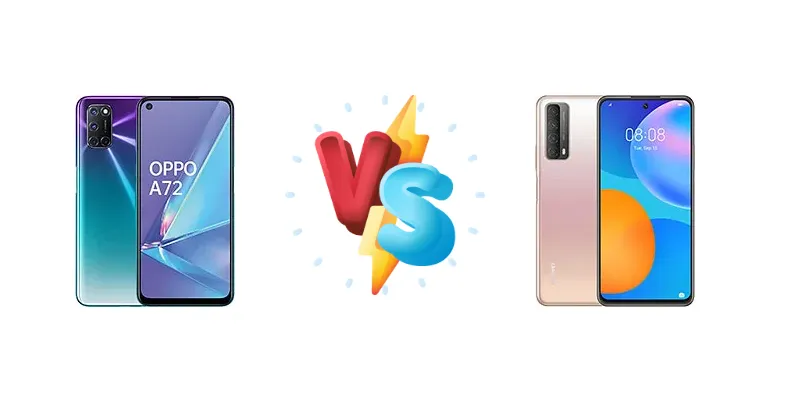
The Oppo A72 and Huawei P smart 2021 represent compelling options in the crowded budget smartphone market. While both aim to deliver essential features at an accessible price point, they diverge significantly in their core hardware. This comparison dissects the differences between Qualcomm’s Snapdragon 665 and Huawei’s Kirin 710A, examining their impact on performance, battery life, and overall user experience.
🏆 Quick Verdict
For the average user prioritizing consistent performance and a modern Android experience, the Oppo A72 emerges as the better choice. Its Snapdragon 665, despite being built on an older 11nm process, offers a more balanced and readily available software ecosystem compared to the Kirin 710A-powered Huawei P smart 2021.
| Network |
|---|
| 2G bands | GSM 850 / 900 / 1800 / 1900 | GSM 900 / 1800 / 1900 |
| 3G bands | HSDPA 850 / 900 / 1700(AWS) / 1900 / 2100 | HSDPA 850 / 900 / 1700(AWS) / 1900 / 2100 |
| 4G bands | 1, 2, 3, 4, 5, 7, 8, 12, 17, 18, 19, 20, 26, 28, 38, 39, 40, 41, 66 - Global | 1, 3, 5, 7, 8, 20, 28, 38, 40, 41 |
| Speed | HSPA, LTE | HSPA, LTE |
| Technology | GSM / HSPA / LTE | GSM / HSPA / LTE |
| Launch |
|---|
| Announced | 2020, April 21. Released 2020, April 29 | 2020, September 28. Released 2020, September 28 |
| Status | Discontinued | Discontinued |
| Body |
|---|
| Dimensions | 162 x 75.5 x 8.9 mm (6.38 x 2.97 x 0.35 in) | 165.7 x 76.9 x 9.3 mm (6.52 x 3.03 x 0.37 in) |
| SIM | Nano-SIM + Nano-SIM | Nano-SIM + Nano-SIM |
| Weight | 192 g (6.77 oz) | 206 g (7.27 oz) |
| Display |
|---|
| Protection | Corning Gorilla Glass 3 | - |
| Resolution | 1080 x 2400 pixels, 20:9 ratio (~405 ppi density) | 1080 x 2400 pixels, 20:9 ratio (~395 ppi density) |
| Size | 6.5 inches, 102.0 cm2 (~83.4% screen-to-body ratio) | 6.67 inches, 107.4 cm2 (~84.3% screen-to-body ratio) |
| Type | IPS LCD, 480 nits (typ) | IPS LCD |
| Platform |
|---|
| CPU | Octa-core (4x2.0 GHz Kryo 260 Gold & 4x1.8 GHz Kryo 260 Silver) | Octa-core (4x2.0 GHz Cortex-A73 & 4x1.7 GHz Cortex-A53) |
| Chipset | Qualcomm SM6125 Snapdragon 665 (11 nm) | Kirin 710A (14 nm) |
| GPU | Adreno 610 | Mali-G51 MP4 |
| OS | Android 10, ColorOS 7.1 | Android 10, EMUI 10.1, no Google Play Services |
| Memory |
|---|
| Card slot | microSDXC (dedicated slot) | microSDXC (dedicated slot) |
| Internal | 128GB 4GB RAM, 128GB 8GB RAM | 64GB 4GB RAM, 128GB 4GB RAM |
| | UFS 2.1 | - |
| Main Camera |
|---|
| Features | LED flash, HDR, panorama | LED flash, HDR, panorama |
| Quad | 48 MP, f/1.7, (wide), 1/2.0", 0.8µm, PDAF
8 MP, f/2.2, 119˚ (ultrawide), 1/4.0", 1.12µm
Auxiliary lens
2 MP B/W, f/2.4 | 48 MP, f/1.8, 26mm (wide), 1/2.0", 0.8µm, PDAF
8 MP, f/2.4, 120˚ (ultrawide), 1/4.0", 1.12µm
2 MP (macro)
Auxiliary lens |
| Video | 4K@30fps, 1080p@30/120fps, gyro-EIS | 1080p@30/60fps |
| Selfie camera |
|---|
| Features | HDR | HDR |
| Single | 16 MP, f/2.0, (wide), 1/3.06, 1.0µm | 8 MP, f/2.0, (wide) |
| Video | 1080p@30fps | 1080p@30fps |
| Sound |
|---|
| 3.5mm jack | Yes | Yes |
| 35mm jack | Yes | Yes |
| Loudspeaker | Yes, with stereo speakers | Yes |
| | 24-bit/192kHz audio | - |
| Comms |
|---|
| Bluetooth | 5.0, A2DP, LE | 5.1, A2DP, LE |
| NFC | Yes | No |
| Positioning | GPS, GLONASS, GALILEO, BDS | GPS, GLONASS, BDS |
| Radio | No | FM radio, built-in antenna |
| USB | USB Type-C 2.0, OTG | USB Type-C 2.0, OTG |
| WLAN | Wi-Fi 802.11 a/b/g/n/ac, dual-band, Wi-Fi Direct | Wi-Fi 802.11 b/g/n, Wi-Fi Direct |
| Features |
|---|
| Sensors | Fingerprint (side-mounted), accelerometer, proximity, compass | Fingerprint (side-mounted), accelerometer, proximity, compass |
| Battery |
|---|
| Charging | 18W wired | 22.5W wired, 46% in 30 min |
| Type | Li-Po 5000 mAh | Li-Po 5000 mAh |
| Misc |
|---|
| Colors | Twilight Black, Stream White, Sky Blue, Aurora Purple | Crush Green, Blush Gold, Midnight Black |
| Models | CPH2067 | PPA-LX1, PPA-LX2 |
| Price | About 270 EUR | About 230 EUR |
| SAR EU | 0.48 W/kg (head) 0.92 W/kg (body) | - |
| Tests |
|---|
| Battery life | - | Endurance rating 119h |
| Camera | - |
Photo / Video |
| Display | - |
Contrast ratio: 1252:1 (nominal) |
| Loudspeaker | - |
-28.8 LUFS (Average) |
| Performance | - |
AnTuTu: 169253 (v8)
GeekBench: 1334 (v5.1)
GFXBench: 7fps (ES 3.1 onscreen) |
Oppo A72
- More readily available Android updates and ecosystem.
- Snapdragon 665 offers better sustained performance.
- Potentially better app compatibility.
- Slower charging speed (18W vs 22.5W).
- Display specifications are largely unknown.
Huawei P smart 2021
- Faster 22.5W wired charging.
- Measured 442 nits peak display brightness.
- Excellent battery endurance (119h).
- Kirin 710A may throttle under heavy load.
- Potential limitations with Google Mobile Services.
Display Comparison
The Huawei P smart 2021 boasts a measured peak brightness of 442 nits and a 1252:1 contrast ratio, suggesting a visually acceptable, though not exceptional, viewing experience. While the Oppo A72’s display specifications are not provided, the contrast ratio is identical. The lack of information on the Oppo A72’s panel technology makes a direct comparison difficult, but the Huawei’s brightness level indicates it will perform better in direct sunlight. Both phones share the same contrast ratio, meaning similar black levels and color depth.
Camera Comparison
Both devices are listed as having 'Photo / Video' capabilities, offering minimal insight. Without specific sensor details, it’s difficult to assess camera quality. However, the market segment suggests both will rely on software processing to enhance image quality. The absence of information regarding sensor size or aperture makes a meaningful comparison impossible. It's reasonable to assume both phones will struggle in low-light conditions without dedicated night modes.
Performance
The core difference lies in the chipsets. The Oppo A72 utilizes the Qualcomm Snapdragon 665, fabricated on an 11nm process, featuring an octa-core CPU with Kryo 260 Gold and Silver cores clocked up to 2.0 GHz and 1.8 GHz respectively. The Huawei P smart 2021 is powered by the Kirin 710A, built on a less efficient 14nm process, also with an octa-core CPU (4x2.0 GHz Cortex-A73 & 4x1.7 GHz Cortex-A53). While both CPUs have similar peak clock speeds, the Snapdragon 665’s architecture generally provides better sustained performance and efficiency. The 14nm Kirin 710A will likely exhibit more thermal throttling under prolonged load. Furthermore, the Oppo A72 benefits from wider software compatibility and access to Qualcomm’s optimizations.
Battery Life
Both the Oppo A72 and Huawei P smart 2021 achieve an impressive endurance rating of 119 hours, indicating comparable battery life under similar usage patterns. However, they differ in charging speeds. The Huawei P smart 2021 supports 22.5W wired charging, achieving 46% charge in 30 minutes, while the Oppo A72 is limited to 18W. This faster charging capability gives the Huawei an edge for users who prioritize quick top-ups, despite the identical overall endurance.
Buying Guide
Buy the Oppo A72 if you need a phone with a reliably updated Android experience and prioritize consistent application performance for everyday tasks. Buy the Huawei P smart 2021 if you value extended battery life and are comfortable with Huawei’s EMUI software, potentially facing limitations with Google Mobile Services.
Frequently Asked Questions
❓ Does the Kirin 710A in the Huawei P smart 2021 struggle with demanding games like PUBG Mobile?
The Kirin 710A is capable of running PUBG Mobile, but likely at lower graphics settings to maintain a stable frame rate. The 14nm process and less efficient architecture mean it's more prone to thermal throttling during extended gaming sessions, potentially leading to stuttering and reduced performance. The Snapdragon 665 in the Oppo A72 will likely offer a smoother experience, even if not at the highest settings.
❓ How significant is the difference in charging speed between the 18W Oppo A72 and the 22.5W Huawei P smart 2021?
The Huawei P smart 2021’s 22.5W charging is noticeably faster, gaining 46% charge in just 30 minutes. While the Oppo A72’s 18W charging is adequate, it will take considerably longer to fully recharge the battery. This difference is particularly beneficial for users who frequently need to quickly top up their phone’s battery.
❓ What is the impact of Huawei’s situation with Google Mobile Services on the P smart 2021?
The Huawei P smart 2021 ships without Google Mobile Services (GMS), meaning no pre-installed Google apps like Gmail, YouTube, or the Play Store. Instead, it uses Huawei Mobile Services (HMS) and the AppGallery. While the AppGallery is growing, it still lacks the breadth of apps available on the Play Store, and some users may find workarounds necessary to access their favorite Google apps.