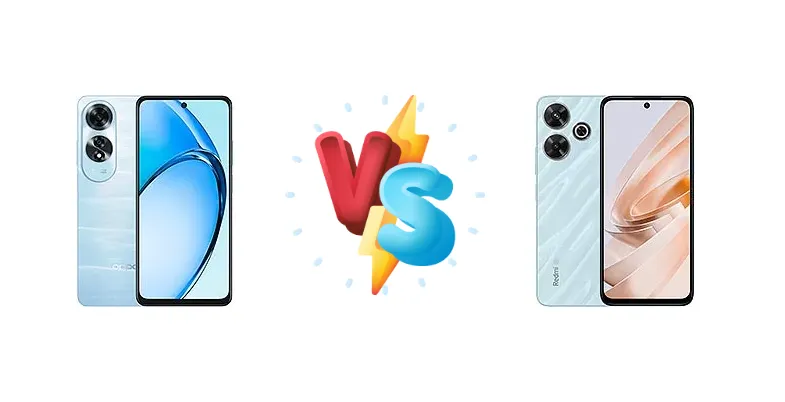
The sub-$200 smartphone market is fiercely competitive. The Oppo A60, powered by the Snapdragon 680, and the Xiaomi Redmi Note 13R, featuring the newer Snapdragon 4+ Gen 2, both aim to deliver a compelling experience without breaking the bank. This comparison will dissect their key differences, focusing on performance, charging, and overall value to help you choose the right device.
🏆 Quick Verdict
For most users, the Xiaomi Redmi Note 13R emerges as the better choice. While the Oppo A60 offers faster 45W charging, the Redmi Note 13R’s Snapdragon 4+ Gen 2, built on a more efficient 4nm process, provides a noticeable performance uplift and improved power efficiency, making it the more future-proof option.
| Network |
|---|
| 2G bands | GSM 850 / 900 / 1800 / 1900 | GSM 850 / 900 / 1800 / 1900 |
| 3G bands | HSDPA 850 / 900 / 2100 | HSDPA 850 / 900 / 2100 |
| 4G bands | 1, 3, 5, 7, 8, 20, 28, 38, 40, 41 | 1, 3, 5, 8, 34, 38, 39, 40, 41 |
| 5G bands | - | 1, 5, 8, 28, 41, 78 SA/NSA |
| Speed | HSPA, LTE | HSPA, LTE, 5G |
| Technology | GSM / HSPA / LTE | GSM / CDMA / HSPA / EVDO / LTE / 5G |
| Launch |
|---|
| Announced | 2024, April 26 | 2024, May 17 |
| Status | Available. Released 2024, April 26 | Available. Released 2024, May 17 |
| Body |
|---|
| Build | - | Glass front, plastic frame, glass back |
| Dimensions | 165.7 x 76 x 7.7 mm (6.52 x 2.99 x 0.30 in) | 168.6 x 76.3 x 8.2 mm (6.64 x 3.00 x 0.32 in) |
| SIM | Nano-SIM + Nano-SIM | Nano-SIM + Nano-SIM |
| Weight | 186 g (6.56 oz) | 205 g (7.23 oz) |
| Display |
|---|
| Resolution | 720 x 1604 pixels, 20:9 ratio (~264 ppi density) | 1080 x 2460 pixels (~396 ppi density) |
| Size | 6.67 inches, 107.2 cm2 (~85.2% screen-to-body ratio) | 6.79 inches, 109.5 cm2 (~85.1% screen-to-body ratio) |
| Type | IPS LCD, 90Hz, 950 nits (peak) | IPS LCD, 120Hz, 550 nits |
| Platform |
|---|
| CPU | Octa-core (4x2.4 GHz Kryo 265 Gold & 4x1.9 GHz Kryo 265 Silver) | Octa-core (2x2.3 GHz Cortex-A78 & 6x1.95 GHz Cortex-A55) |
| Chipset | Qualcomm SM6225 Snapdragon 680 4G (6 nm) | Qualcomm SM4450 Snapdragon 4+ Gen 2 (4 nm) |
| GPU | Adreno 610 | Adreno 613 |
| OS | Android 14, upgradable to Android 15, ColorOS 15 | Android 14, HyperOS |
| Memory |
|---|
| Card slot | microSDXC | No |
| Internal | 128GB 8GB RAM, 256GB 8GB RAM | 128GB 6GB RAM, 128GB 8GB RAM, 256GB 8GB RAM, 256GB 12GB RAM, 512GB 12GB RAM |
| Main Camera |
|---|
| Dual | 50 MP, f/1.8, 26mm (wide), 1/2.75", 0.64µm, PDAF
Auxiliary lens | 50 MP, f/1.8, (wide), 1/2.76", 0.64µm, PDAF
2 MP (macro) |
| Features | LED flash, HDR, panorama | LED flash, HDR |
| Video | 1080p@30fps | 1080p@30fps |
| Selfie camera |
|---|
| Single | 8 MP, f/2.0, 24mm (wide), 1/3.94", 1.12µm | 8 MP, (wide), 1/4.0", 1.12µm |
| Video | 1080p@30fps | 1080p@30fps |
| Sound |
|---|
| 35mm jack | Yes | Yes |
| Loudspeaker | Yes, with stereo speakers | Yes |
| Comms |
|---|
| Bluetooth | 5.0, A2DP, LE | 5.3, A2DP, LE |
| Infrared port | - | Yes |
| NFC | Unspecified | Yes |
| Positioning | GPS, GALILEO, GLONASS, BDS, QZSS | GPS, GLONASS, GALILEO, BDS |
| Radio | FM radio (market/region dependent) | No |
| USB | USB Type-C 2.0, OTG | USB Type-C |
| WLAN | Wi-Fi 802.11 a/b/g/n/ac, dual-band | Wi-Fi 802.11 a/b/g/n/ac, dual-band |
| Features |
|---|
| Sensors | Fingerprint (side-mounted), accelerometer, proximity, compass | Fingerprint (side-mounted), accelerometer, compass |
| Battery |
|---|
| Charging | 45W wired, 50% in 30 min | 33W wired |
| Type | Li-Ion 5000 mAh | 5030 mAh |
| Misc |
|---|
| Colors | Midnight Purple, Ripple Blue | Black, Blue, Silver |
| Models | CPH2631 | 2406ERN9CC |
| Price | £ 129.95 | About 180 EUR |
Oppo A60
- Faster 45W wired charging
- Potentially lower price point (depending on region)
- Established Oppo software experience
- Less efficient Snapdragon 680 chipset
- Older CPU architecture
- Potentially more throttling under load
Xiaomi Redmi Note 13R
- More efficient Snapdragon 4+ Gen 2 chipset
- Newer CPU architecture for better performance
- Improved power efficiency for longer battery life
- Slower 33W wired charging
- Xiaomi’s MIUI software can be polarizing
- May be slightly more expensive
Display Comparison
Neither Oppo nor Xiaomi provide display specs beyond resolution. Assuming both utilize standard IPS LCD panels common in this price bracket, the display experience will likely be similar. However, the Redmi Note 13R’s processor may allow for slightly smoother scrolling and animations. Bezels are expected to be comparable, and color accuracy will likely be standard for the segment, requiring calibration for professional use.
Camera Comparison
Without detailed camera specs, it’s difficult to make a definitive judgment. Both phones likely feature a primary camera and depth/macro sensors. However, the image signal processor (ISP) within the Snapdragon 4+ Gen 2 is more advanced, potentially leading to better image processing, especially in low-light conditions. The Redmi Note 13R’s processor will likely offer more sophisticated computational photography features. We can assume both phones will struggle with detail in challenging lighting, but the Redmi Note 13R has the edge.
Performance
The core difference lies in the chipsets. The Xiaomi Redmi Note 13R’s Snapdragon 4+ Gen 2 (4nm) is a significant upgrade over the Oppo A60’s Snapdragon 680 (6nm). The 4nm process inherently offers better power efficiency, translating to less heat and potentially less throttling during sustained workloads. While the A60’s CPU has a slightly higher peak clock speed on its prime cores (2.4 GHz vs 2.3 GHz), the 4+ Gen 2 utilizes newer Cortex-A78 cores, offering superior single-core performance. The A60's Kryo 265 Gold cores are older generation. This translates to a more responsive experience on the Redmi Note 13R, especially when multitasking or running demanding apps. The Redmi Note 13R's GPU will also provide a better gaming experience.
Battery Life
The Oppo A60 boasts 45W wired charging, promising a 50% charge in 30 minutes. The Redmi Note 13R is limited to 33W. However, the Snapdragon 4+ Gen 2’s superior efficiency means the Redmi Note 13R may not *need* to charge as frequently. While the A60 charges faster, the Redmi Note 13R’s better power management could result in comparable or even longer real-world battery life, depending on usage patterns. The actual battery capacity of both devices is not specified, but the efficiency of the chipset will be the deciding factor.
Buying Guide
Buy the Oppo A60 if you prioritize extremely fast charging and are primarily focused on basic tasks like calling, texting, and light social media use. The 45W charging will get you back up and running quickly. Buy the Xiaomi Redmi Note 13R if you value smoother multitasking, slightly better gaming performance, and a more efficient processor that will likely hold up better over time. It’s the better all-rounder for users who demand more from their smartphone.
Frequently Asked Questions
❓ Will the Redmi Note 13R’s Snapdragon 4+ Gen 2 handle demanding games like PUBG Mobile?
The Snapdragon 4+ Gen 2 is capable of running PUBG Mobile, but you’ll likely need to lower the graphics settings to achieve a consistently smooth frame rate. It’s a noticeable improvement over the Snapdragon 680 in gaming performance, but don’t expect flagship-level results.
❓ How much faster is the charging on the Oppo A60 in real-world use?
The Oppo A60’s 45W charging can add a significant amount of charge in a short time. While a full 0-100% charge time isn’t specified, 50% in 30 minutes is a solid figure. However, the Redmi Note 13R’s efficiency means you might not notice a huge difference in overall daily usage, as it consumes less power.
❓ Does the Snapdragon 680 in the Oppo A60 get hot during extended use?
The Snapdragon 680, built on a 6nm process, can get warm during prolonged gaming or video recording. The 6nm node isn't as efficient as the 4nm node in the Redmi Note 13R, meaning it's more prone to thermal throttling, potentially impacting performance over time.
❓ Which phone is better for long-term software support?
Both Oppo and Xiaomi typically offer a few years of software updates. However, Xiaomi’s MIUI has a history of more frequent updates, though they can sometimes be buggy. Long-term support will depend on the specific model and region, but Xiaomi generally has a slightly better track record.