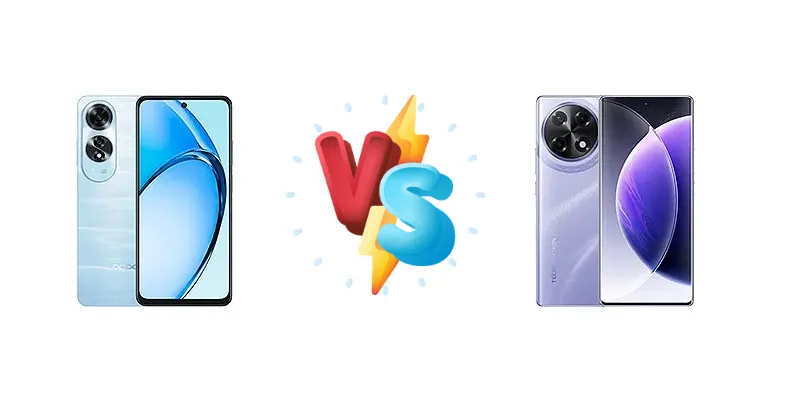
The sub-$200 smartphone market is fiercely competitive. The Oppo A60, powered by the Snapdragon 680, and the Tecno Camon 30S, featuring the MediaTek Helio G100, both aim to deliver a solid experience without breaking the bank. This comparison dives deep into their specifications to determine which device offers the best value for your money.
🏆 Quick Verdict
For the average user prioritizing consistent performance and slightly faster charging, the Oppo A60 emerges as the winner. While the Tecno Camon 30S offers a competitive chipset, the Snapdragon 680’s proven efficiency and 45W charging provide a smoother, more reliable experience.
| Network |
|---|
| 2G bands | GSM 850 / 900 / 1800 / 1900 | GSM 850 / 900 / 1800 / 1900 |
| 3G bands | HSDPA 850 / 900 / 2100 | HSDPA 850 / 900 / 2100 |
| 4G bands | 1, 3, 5, 7, 8, 20, 28, 38, 40, 41 | LTE |
| Speed | HSPA, LTE | HSPA, LTE |
| Technology | GSM / HSPA / LTE | GSM / HSPA / LTE |
| Launch |
|---|
| Announced | 2024, April 26 | 2024, October 10 |
| Status | Available. Released 2024, April 26 | Available. Released 2024, October 10 |
| Body |
|---|
| Dimensions | 165.7 x 76 x 7.7 mm (6.52 x 2.99 x 0.30 in) | 164.5 x 74.6 x 7.6 mm (6.48 x 2.94 x 0.30 in) |
| SIM | Nano-SIM + Nano-SIM | Nano-SIM + Nano-SIM |
| Weight | 186 g (6.56 oz) | - |
| Display |
|---|
| Protection | - | Corning Gorilla Glass |
| Resolution | 720 x 1604 pixels, 20:9 ratio (~264 ppi density) | 1080 x 2436 pixels (~393 ppi density) |
| Size | 6.67 inches, 107.2 cm2 (~85.2% screen-to-body ratio) | 6.78 inches, 109.9 cm2 (~89.5% screen-to-body ratio) |
| Type | IPS LCD, 90Hz, 950 nits (peak) | AMOLED, 120Hz, 1300 nits (HBM) |
| Platform |
|---|
| CPU | Octa-core (4x2.4 GHz Kryo 265 Gold & 4x1.9 GHz Kryo 265 Silver) | Octa-core (2x2.2 GHz Cortex-A76 & 6x2.0 GHz Cortex-A55) |
| Chipset | Qualcomm SM6225 Snapdragon 680 4G (6 nm) | Mediatek Helio G100 (6 nm) |
| GPU | Adreno 610 | Mali-G57 MC2 |
| OS | Android 14, upgradable to Android 15, ColorOS 15 | Android 14, up to 2 major Android upgrades, HIOS 14 |
| Memory |
|---|
| Card slot | microSDXC | Unspecified |
| Internal | 128GB 8GB RAM, 256GB 8GB RAM | 128GB 6GB RAM, 128GB 8GB RAM, 256GB 8GB RAM |
| Main Camera |
|---|
| Dual | 50 MP, f/1.8, 26mm (wide), 1/2.75", 0.64µm, PDAF
Auxiliary lens | - |
| Features | LED flash, HDR, panorama | Dual-LED flash, HDR, panorama |
| Triple | - | 50 MP, f/1.9, (wide), 1/1.56", 1.0µm, PDAF, OIS
Auxiliary lenses |
| Video | 1080p@30fps | Yes |
| Selfie camera |
|---|
| Features | - | Dual-LED flash |
| Single | 8 MP, f/2.0, 24mm (wide), 1/3.94", 1.12µm | 13 MP |
| Video | 1080p@30fps | Yes |
| Sound |
|---|
| 35mm jack | Yes | No |
| Loudspeaker | Yes, with stereo speakers | Yes, with dual speakers |
| Comms |
|---|
| Bluetooth | 5.0, A2DP, LE | Yes |
| Infrared port | - | Yes |
| NFC | Unspecified | Yes |
| Positioning | GPS, GALILEO, GLONASS, BDS, QZSS | GPS |
| Radio | FM radio (market/region dependent) | FM radio |
| USB | USB Type-C 2.0, OTG | USB Type-C 2.0, OTG |
| WLAN | Wi-Fi 802.11 a/b/g/n/ac, dual-band | Yes |
| Features |
|---|
| Sensors | Fingerprint (side-mounted), accelerometer, proximity, compass | Fingerprint (under display, optical), accelerometer, gyro, proximity, compass |
| Battery |
|---|
| Charging | 45W wired, 50% in 30 min | 33W wired, 0-100% in 45 min |
| Type | Li-Ion 5000 mAh | 5000 mAh |
| Misc |
|---|
| Colors | Midnight Purple, Ripple Blue | Nebula Violet, Blue, Celestial Black, Dawn Gold |
| Models | CPH2631 | CLA5 |
| Price | £ 129.95 | About 200 EUR |
Oppo A60
- Faster 45W charging
- Qualcomm Snapdragon 680 offers proven stability
- Potentially better thermal management
- Older chipset architecture compared to Helio G100
- Display specifications unknown
Tecno Camon 30S
- Newer MediaTek Helio G100 chipset
- Potentially lower price point
- Cortex-A76 cores offer higher peak performance
- Slower 33W charging
- MediaTek chipsets can sometimes exhibit more throttling
- Display specifications unknown
Display Comparison
Neither Oppo nor Tecno provide display specifications in the provided data. However, given the price bracket, both likely utilize LCD panels with 60Hz refresh rates. The real-world difference will likely come down to color calibration and peak brightness, which are unknown. Bezels are also likely to be similar, prioritizing cost-effectiveness over premium aesthetics.
Camera Comparison
Without sensor details, a direct camera comparison is difficult. However, the market segment suggests both phones will feature multi-camera setups with a primary sensor, likely around 50MP. The image processing algorithms will be key differentiators. Oppo generally focuses on natural-looking images, while Tecno often leans towards more vibrant, saturated colors. The absence of OIS on either device suggests reliance on software stabilization. Any secondary cameras (ultrawide, macro) are likely to be of limited quality.
Performance
The core difference lies in the chipsets. The Oppo A60’s Snapdragon 680 (6nm) employs a Kryo CPU architecture, known for its balance of power and efficiency. Its octa-core configuration (4x2.4 GHz & 4x1.9 GHz) provides a solid foundation for multitasking. The Tecno Camon 30S utilizes the MediaTek Helio G100 (6nm), featuring a Cortex-A76 based CPU (2x2.2 GHz & 6x2.0 GHz). While the A76 cores offer higher peak performance, the Snapdragon 680’s optimized software integration and potentially better thermal management could lead to more sustained performance during extended gaming sessions. The 6nm process node in both chips suggests comparable power efficiency.
Battery Life
The Oppo A60 boasts 45W wired charging, promising a 50% charge in 30 minutes. The Tecno Camon 30S offers 33W wired charging, taking 45 minutes for a full charge. While battery capacity isn’t specified, the faster charging of the Oppo A60 is a significant advantage for users who prioritize quick top-ups. The difference in charging speed will be noticeable in daily use, especially for those who frequently run low on battery.
Buying Guide
Buy the Oppo A60 if you need a dependable daily driver with a focus on stable performance for everyday tasks and moderate gaming. It’s ideal for users who value Qualcomm’s optimized software and slightly quicker charging speeds. Buy the Tecno Camon 30S if you prioritize a newer chipset architecture and are willing to potentially trade off some sustained performance for a potentially lower price point, and don't mind a slower charging cycle.
Frequently Asked Questions
❓ Will the Helio G100 in the Tecno Camon 30S overheat during prolonged gaming sessions?
While the Helio G100 offers decent performance, MediaTek chips in this price range can sometimes be prone to thermal throttling under sustained load. The Snapdragon 680 in the Oppo A60 is generally known for better thermal efficiency, potentially leading to more consistent performance during longer gaming sessions.
❓ How does the 45W charging on the Oppo A60 compare to the 33W charging on the Tecno Camon 30S in real-world use?
The Oppo A60’s 45W charging will provide a noticeably faster top-up. While the Tecno Camon 30S will still charge adequately, the Oppo A60 can gain a significant amount of battery life in a shorter period, making it more convenient for users who are often on the go.
❓ Is the difference in CPU architecture between the Snapdragon 680 and Helio G100 noticeable for everyday tasks like browsing and social media?
For typical daily usage, the difference in CPU architecture will be minimal. Both chipsets are capable of handling everyday tasks smoothly. The Snapdragon 680’s optimization and software integration might provide a slightly more fluid experience, but the difference will likely be subtle.