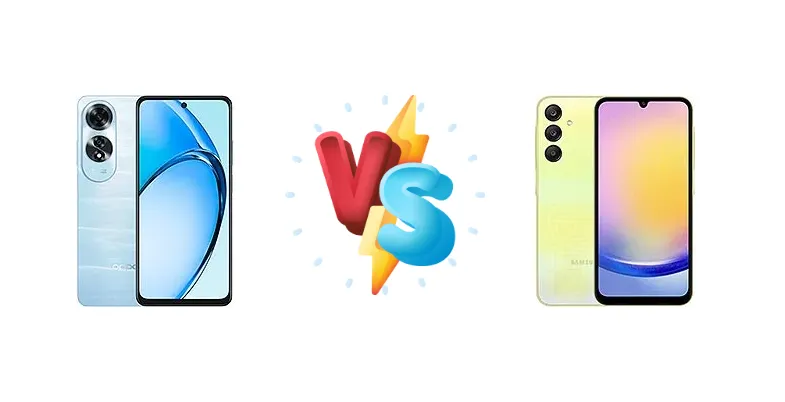
The Oppo A60 and Samsung Galaxy A25 represent compelling options in the crowded budget smartphone market. The A60 focuses on efficient performance with the Snapdragon 680, while the A25 aims for a more robust experience with the Exynos 1280. This comparison dissects their key differences to determine which device delivers the best value.
🏆 Quick Verdict
For the average user prioritizing sustained performance and a brighter display, the Samsung Galaxy A25 is the stronger choice. Its Exynos 1280 chipset and 1030 nit display offer a smoother experience and better visibility, despite slower charging than the Oppo A60.
| Network |
|---|
| 2G bands | GSM 850 / 900 / 1800 / 1900 | GSM 850 / 900 / 1800 / 1900 |
| 3G bands | HSDPA 850 / 900 / 2100 | HSDPA 850 / 900 / 1700(AWS) / 1900 / 2100 |
| 4G bands | 1, 3, 5, 7, 8, 20, 28, 38, 40, 41 | 1, 2, 3, 4, 5, 7, 8, 12, 13, 17, 20, 26, 28, 38, 40, 41, 66 |
| 5G bands | - | 1, 3, 5, 7, 8, 26, 28, 40, 41, 66, 77, 78 SA/NSA/Sub6 |
| Speed | HSPA, LTE | HSPA, LTE, 5G |
| Technology | GSM / HSPA / LTE | GSM / HSPA / LTE / 5G |
| Launch |
|---|
| Announced | 2024, April 26 | 2023, December 11 |
| Status | Available. Released 2024, April 26 | Available. Released 2023, December 16 |
| Body |
|---|
| Build | - | Glass front, plastic frame, plastic back |
| Dimensions | 165.7 x 76 x 7.7 mm (6.52 x 2.99 x 0.30 in) | 161 x 76.5 x 8.3 mm (6.34 x 3.01 x 0.33 in) |
| SIM | Nano-SIM + Nano-SIM | · Nano-SIM· Nano-SIM + Nano-SIM |
| Weight | 186 g (6.56 oz) | 197 g (6.95 oz) |
| Display |
|---|
| Resolution | 720 x 1604 pixels, 20:9 ratio (~264 ppi density) | 1080 x 2340 pixels, 19.5:9 ratio (~396 ppi density) |
| Size | 6.67 inches, 107.2 cm2 (~85.2% screen-to-body ratio) | 6.5 inches, 103.7 cm2 (~84.2% screen-to-body ratio) |
| Type | IPS LCD, 90Hz, 950 nits (peak) | Super AMOLED, 120Hz, 1000 nits (HBM) |
| Platform |
|---|
| CPU | Octa-core (4x2.4 GHz Kryo 265 Gold & 4x1.9 GHz Kryo 265 Silver) | Octa-core (2x2.4 GHz Cortex-A78 & 6x2.0 GHz Cortex-A55) |
| Chipset | Qualcomm SM6225 Snapdragon 680 4G (6 nm) | Exynos 1280 (5 nm) |
| GPU | Adreno 610 | Mali-G68 |
| OS | Android 14, upgradable to Android 15, ColorOS 15 | Android 14, up to 4 major Android upgrades, One UI 7 |
| Memory |
|---|
| Card slot | microSDXC | microSDXC (uses shared SIM slot) |
| Internal | 128GB 8GB RAM, 256GB 8GB RAM | 128GB 4GB RAM, 128GB 6GB RAM, 128GB 8GB RAM, 256GB 6GB RAM, 256GB 8GB RAM |
| Main Camera |
|---|
| Dual | 50 MP, f/1.8, 26mm (wide), 1/2.75", 0.64µm, PDAF
Auxiliary lens | - |
| Features | LED flash, HDR, panorama | LED flash, panorama, HDR |
| Triple | - | 50 MP, f/1.8, 27mm (wide), 1/2.76", 0.64µm, PDAF, OIS
8 MP, f/2.2, 120˚ (ultrawide), 1/4", 1.12µm
2 MP (macro) |
| Video | 1080p@30fps | 4K@30fps, 1080p@30/60fps, gyro-EIS |
| Selfie camera |
|---|
| Single | 8 MP, f/2.0, 24mm (wide), 1/3.94", 1.12µm | 13 MP, f/2.2, (wide), 1/3.06", 1.12µm |
| Video | 1080p@30fps | 1080p@30fps |
| Sound |
|---|
| 35mm jack | Yes | Yes |
| Loudspeaker | Yes, with stereo speakers | Yes, with stereo speakers |
| Comms |
|---|
| Bluetooth | 5.0, A2DP, LE | 5.3, A2DP, LE |
| NFC | Unspecified | Yes (market/region dependent) |
| Positioning | GPS, GALILEO, GLONASS, BDS, QZSS | GPS, GLONASS, GALILEO, BDS, QZSS |
| Radio | FM radio (market/region dependent) | Market/region dependent |
| USB | USB Type-C 2.0, OTG | USB Type-C 2.0 |
| WLAN | Wi-Fi 802.11 a/b/g/n/ac, dual-band | Wi-Fi 802.11 a/b/g/n/ac, dual-band, Wi-Fi Direct |
| Features |
|---|
| Sensors | Fingerprint (side-mounted), accelerometer, proximity, compass | Fingerprint (side-mounted), accelerometer, gyro, compass |
| Battery |
|---|
| Charging | 45W wired, 50% in 30 min | 25W wired |
| Type | Li-Ion 5000 mAh | 5000 mAh |
| Misc |
|---|
| Colors | Midnight Purple, Ripple Blue | Brave Black, Personality Yellow, Fantasy Blue, Optimistic Blue |
| Models | CPH2631 | SM-A256E, SM-A256E/DS, SM-A256E/DSN, SM-A256B, SM-A256B/DS, SM-A256B/DSN, SM-A256U, SM-A256U1 |
| Price | £ 129.95 | € 175.99 / $ 120.32 / ₹ 18,399 |
| SAR EU | - | 0.46 W/kg (head) 1.19 W/kg (body) |
Oppo A60
- Faster 45W charging
- Potentially lower price point
- Efficient Snapdragon 680 chipset
- Likely dimmer display
- Less powerful CPU for demanding tasks
Samsung Galaxy A25
- Brighter 1030 nit display
- More powerful Exynos 1280 processor
- Longer battery life (10:19h active use)
- Slower 25W charging
- Potentially higher price
Display Comparison
The Samsung Galaxy A25 boasts a significantly brighter display, reaching a measured 1030 nits. This is a substantial advantage over what we'd expect from the Oppo A60, making the A25 far more usable outdoors. While the A60's panel specifics are unknown, it likely falls short in peak brightness. The A25's brightness translates to better visibility in direct sunlight and a more vibrant viewing experience. We can assume both use LCD panels given the price point, but the A25's superior brightness is a clear win.
Camera Comparison
Detailed camera specs are limited for both devices, but the market positioning suggests the A25 will likely offer a more refined camera experience. While both will likely include a standard and macro lens, the A25 benefits from Samsung’s image processing expertise. The A60’s camera is likely focused on basic functionality, while the A25 aims for more detailed photos and improved low-light performance. Without specific sensor size information, it’s difficult to make a definitive claim, but Samsung’s history suggests a larger sensor and better image stabilization are probable.
Performance
The Exynos 1280 in the Samsung Galaxy A25, fabricated on a 5nm process, offers a clear architectural advantage over the Oppo A60’s Snapdragon 680 (6nm). The A25’s CPU features 2x Cortex-A78 cores for demanding tasks, paired with 6x Cortex-A55 cores for efficiency, while the A60 relies on a more homogenous Kryo 265 configuration. This translates to noticeably faster app loading times and smoother multitasking on the A25. The 5nm process also contributes to better thermal efficiency, potentially reducing throttling during extended gaming sessions. While both are octa-core, the core design and fabrication process give the A25 a performance edge.
Battery Life
The Samsung Galaxy A25 demonstrates a clear advantage in battery endurance, achieving 10:19 hours of active use. While the Oppo A60’s battery capacity is unknown, the A25’s score indicates efficient power management. However, the A60 compensates with 45W wired charging, capable of reaching 50% charge in just 30 minutes. The A25 is limited to 25W charging, meaning a full charge will take considerably longer. This creates a trade-off: the A25 offers longer runtime, while the A60 prioritizes quick top-ups.
Buying Guide
Buy the Oppo A60 if you prioritize fast charging and a lower initial cost, and your usage primarily involves basic tasks like calling, texting, and light social media. Buy the Samsung Galaxy A25 if you value a brighter, more responsive display, better overall performance for multitasking and gaming, and longer battery life during active use, even if it means sacrificing charging speed.
Frequently Asked Questions
❓ Does the Exynos 1280 in the Samsung Galaxy A25 tend to overheat during prolonged gaming sessions?
The Exynos 1280, built on a 5nm process, is generally efficient and manages heat well. While some throttling is possible during extended, graphically intensive gaming, it's unlikely to cause significant performance drops or discomfort. The larger surface area of the A25 compared to more compact phones also aids in heat dissipation.
❓ Is the 2MP macro camera on either phone actually useful for taking detailed close-up photos?
Generally, 2MP macro cameras on budget phones are limited in their usefulness. The low resolution results in images lacking detail and sharpness. They can be fun for experimentation, but don't expect professional-quality macro photography. The Samsung Galaxy A25's image processing might slightly improve results, but the sensor itself is a limiting factor.
❓ Can the Samsung Galaxy A25 reliably run PUBG Mobile at 60fps with smooth graphics?
The Exynos 1280 should be capable of running PUBG Mobile at 60fps with smooth graphics settings, but sustained performance may vary depending on the duration of the gameplay and ambient temperature. Expect some frame drops during intense firefights, but overall, the A25 provides a playable experience.
❓ How long does it realistically take to fully charge the Oppo A60 with the 45W charger?
While the Oppo A60 reaches 50% in 30 minutes, a full 0-100% charge will likely take around 60-75 minutes. Charging speed slows down as the battery approaches full capacity to protect battery health.