
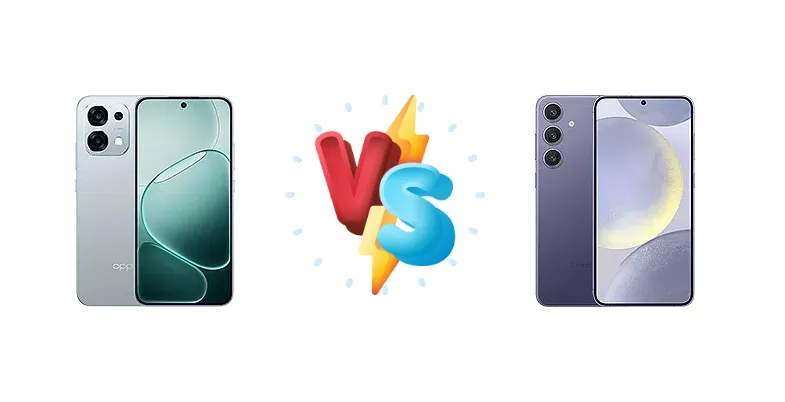
Oppo A6 Pro vs Samsung Galaxy S24+: A Detailed Comparison
| Phones Images | |||||
|---|---|---|---|---|---|
|
🏆 Quick Verdict
For the average user prioritizing a premium experience and long-term software support, the Samsung Galaxy S24+ is the clear winner. Its significantly more powerful Snapdragon 8 Gen 3 (or Exynos 2400) chipset and brighter display justify the higher price. However, the Oppo A6 Pro offers compelling value for budget-conscious buyers.
| PHONES | ||
|---|---|---|
| Phone Names | Oppo A6 Pro | Samsung Galaxy S24+ |
| Network | ||
|---|---|---|
| 2G bands | GSM 850 / 900 / 1800 / 1900 | GSM 850 / 900 / 1800 / 1900 |
| 3G bands | HSDPA 800 / 850 / 900 / 1700(AWS) / 1900 / 2100 - version 1,2 | HSDPA 850 / 900 / 1700(AWS) / 1900 / 2100 |
| 4G bands | 1, 2, 3, 4, 5, 7, 8, 12, 17, 18, 19, 20, 26, 28, 32, 38, 39, 40, 41, 42, 48, 66 - version 1 | 1, 2, 3, 4, 5, 7, 8, 12, 13, 17, 18, 19, 20, 25, 26, 28, 32, 38, 39, 40, 41, 66 - International |
| 5G bands | 1, 2, 3, 5, 7, 8, 12, 20, 26, 28, 38, 40, 41, 66, 71, 77, 78 SA/NSA - version 1 | 1, 2, 3, 5, 7, 8, 12, 20, 25, 26, 28, 38, 40, 41, 66, 75, 77, 78 SA/NSA/Sub6 - International |
| Speed | HSPA, LTE, 5G | HSPA, LTE (up to 7CA), 5G |
| Technology | GSM / HSPA / LTE / 5G | GSM / CDMA / HSPA / EVDO / LTE / 5G |
| Launch | ||
|---|---|---|
| Announced | 2025, September 23 | 2024, January 17 |
| Status | Available. Released 2025, September 29 | Available. Released 2024, January 24 |
| Body | ||
|---|---|---|
| Build | - | Glass front (Gorilla Glass Victus 2), glass back (Gorilla Glass Victus 2), aluminum frame |
| Dimensions | 158.2 x 75 x 8 mm (6.23 x 2.95 x 0.31 in) | 158.5 x 75.9 x 7.7 mm (6.24 x 2.99 x 0.30 in) |
| SIM | Nano-SIM + Nano-SIM | · Nano-SIM + Nano-SIM + eSIM + eSIM (max 2 at a time) - INT· Nano-SIM + eSIM + eSIM (max 2 at a time) - USA· Nano-SIM + Nano-SIM - CN |
| Weight | 185 g (6.53 oz) | 196 g or 197 g (6.91 oz) |
| Display | ||
|---|---|---|
| Protection | AGC DT-Star D+ | Corning Gorilla Glass Victus 2 |
| Resolution | 1080 x 2372 pixels (~397 ppi density) | 1440 x 3120 pixels, 19.5:9 ratio (~513 ppi density) |
| Size | 6.57 inches, 105.0 cm2 (~88.5% screen-to-body ratio) | 6.7 inches, 110.2 cm2 (~91.6% screen-to-body ratio) |
| Type | AMOLED, 1B colors, 120Hz, 600 nits (typ), 1400 nits (HBM) | Dynamic LTPO AMOLED 2X, 120Hz, HDR10+, 2600 nits (peak) |
| Platform | ||
|---|---|---|
| CPU | Octa-core (2x2.4 GHz Cortex-A76 & 6x2.0 GHz Cortex-A55) | 8-core (1x3.39GHz Cortex-X4 & 3x3.1GHz Cortex-A720 & 2x2.9GHz Cortex-A720 & 2x2.2GHz Cortex-A520)10-core (1x3.2GHz Cortex-X4 & 2x2.9GHz Cortex-A720 & 3x2.6GHz Cortex-A720 & 4x1.95GHz Cortex-A520) |
| Chipset | Mediatek Dimensity 6300 (6 nm) | Qualcomm SM8650-AC Snapdragon 8 Gen 3 (4 nm) - USA/Canada/ChinaExynos 2400 (4 nm) - International |
| GPU | Mali-G57 MC2 | Adreno 750 (1 GHz) - USA/Canada/ChinaXclipse 940 - International |
| OS | Android 15, ColorOS 15 | Android 14, up to 7 major Android upgrades, One UI 8.0 |
| Memory | ||
|---|---|---|
| Card slot | microSDXC | No |
| Internal | 128GB 6GB RAM, 256GB 8GB RAM, 256GB 12GB RAM | 256GB 12GB RAM, 512GB 12GB RAM |
| Main Camera | ||
|---|---|---|
| Dual | 50 MP, f/1.8, (wide), PDAF Auxiliary lens | - |
| Features | LED flash, HDR, panorama | LED flash, auto-HDR, panorama |
| Triple | - | 50 MP, f/1.8, 24mm (wide), 1/1.56", 1.0µm, dual pixel PDAF, OIS 10 MP, f/2.4, 67mm (telephoto), 1/3.94", 1.0µm, PDAF, OIS, 3x optical zoom 12 MP, f/2.2, 13mm, 120˚ (ultrawide), 1/2.55" 1.4µm, Super Steady video |
| Video | 1080p@30/60/120fps | 8K@24/30fps, 4K@30/60fps, 1080p@30/60/120/240fps, HDR10+, stereo sound rec., gyro-EIS |
| Selfie camera | ||
|---|---|---|
| Features | Panorama | HDR, HDR10+ |
| Single | 16 MP, f/2.4, (wide) | 12 MP, f/2.2, 26mm (wide), 1/3.2", 1.12µm, dual pixel PDAF |
| Video | 1080p@30fps | 4K@30/60fps, 1080p@30fps |
| Sound | ||
|---|---|---|
| 35mm jack | No | No |
| Loudspeaker | Yes, with stereo speakers | Yes, with stereo speakers |
| Comms | ||
|---|---|---|
| Bluetooth | 5.4, A2DP, LE, aptX HD | 5.3, A2DP, LE |
| NFC | Yes (market/region dependent) | Yes |
| Positioning | GPS, GALILEO, GLONASS, BDS, QZSS | GPS, GLONASS, BDS, GALILEO, QZSS |
| Radio | Unspecified | No |
| USB | USB Type-C 2.0, OTG | USB Type-C 3.2, DisplayPort 1.2, OTG |
| WLAN | Wi-Fi 802.11 a/b/g/n/ac, dual-band | Wi-Fi 802.11 a/b/g/n/ac/6e, tri-band, Wi-Fi Direct |
| Features | ||
|---|---|---|
| Sensors | Fingerprint (under display, optical), accelerometer, gyro, proximity, compass | Fingerprint (under display, ultrasonic), accelerometer, gyro, proximity, compass, barometer |
| Battery | ||
|---|---|---|
| Charging | 80W wired, 33W PPS, 13.5W PD Reverse wired charging | 45W wired, PD3.0, 65% in 30 min 15W wireless (Qi) 4.5W reverse wireless |
| Type | Market-dependent versions:· Si/C Li-Ion 7000 mAh - version 1· 6500 mAh - version 2 | Li-Ion 4900 mAh |
| Misc | ||
|---|---|---|
| Colors | Lunar Titanium, Stellar Blue, Coral Pink, Rosewood Red | Onyx Black, Marble Grey, Cobalt Violet, Amber Yellow, Jade Green, Sandstone Orange, Sapphire Blue |
| Models | CPH2781 | SM-S926B, SM-S926B/DS, SM-S926U, SM-S926U1, SM-S926W, SM-S926N, SM-S9260, SM-S926E, SM-S926E/DS |
| Price | About 240 EUR | $ 429.50 / € 549.00 / £ 445.98 |
| SAR | - | 1.16 W/kg (head) 0.84 W/kg (body) |
| SAR EU | - | 0.74 W/kg (head) 1.25 W/kg (body) |
Oppo A6 Pro
- Significantly faster wired charging (80W)
- More affordable price point
- Reverse wired charging capability
- Less powerful processor
- Likely inferior display quality
- Less advanced camera system
Samsung Galaxy S24+
- Superior performance with Snapdragon 8 Gen 3/Exynos 2400
- Brighter and likely higher-resolution display
- More advanced camera system
- Higher price
- Slower wired charging (45W)
- No reverse wired charging
Display Comparison
The Samsung Galaxy S24+ boasts a significantly brighter display, reaching a measured 1452 nits, ensuring excellent visibility even in direct sunlight. While the Oppo A6 Pro’s display specifications are not provided, it’s likely to be considerably dimmer. The S24+’s panel likely utilizes LTPO technology for adaptive refresh rates, contributing to improved battery efficiency. The S24+’s superior brightness and likely higher resolution translate to a more immersive and visually appealing experience.
Camera Comparison
The Samsung Galaxy S24+ is expected to feature a more sophisticated camera system, though specific details are not provided. The Oppo A6 Pro’s camera specifications are also limited. However, given the price difference, the S24+ likely benefits from a larger main sensor, more advanced image stabilization (OIS), and superior image processing algorithms. The S24+’s video recording capabilities will also be significantly better. While the A6 Pro may suffice for casual photography, the S24+ is geared towards users who prioritize image quality and versatility.
Performance
The performance gap between these devices is substantial. The Samsung Galaxy S24+ utilizes either the Qualcomm Snapdragon 8 Gen 3 (4nm) or the Exynos 2400 (4nm), both built on a more advanced 4nm process compared to the Oppo A6 Pro’s Mediatek Dimensity 6300 (6nm). The Snapdragon 8 Gen 3’s Cortex-X4 prime core clocked at 3.39GHz, coupled with its advanced GPU, delivers significantly faster processing speeds and superior graphics performance. The Dimensity 6300, while capable for everyday tasks, will struggle with demanding games and applications. The S24+’s LPDDR5x RAM further enhances performance, while the A6 Pro’s RAM specification is unknown, but likely slower.
Battery Life
The Samsung Galaxy S24+ achieves an impressive 12:30h of active use, demonstrating excellent battery life despite its powerful processor and bright display. The Oppo A6 Pro’s battery capacity is not specified, but its less demanding chipset may offer comparable endurance. However, the A6 Pro’s 80W wired charging is a significant advantage, allowing for much faster charging speeds than the S24+’s 45W charging. The A6 Pro also offers reverse wired charging, a feature absent on the S24+.
Buying Guide
Buy the Oppo A6 Pro if you need a reliable daily driver with fast 80W charging and don’t demand the absolute highest performance. It’s ideal for users who prioritize battery convenience and affordability. Buy the Samsung Galaxy S24+ if you prefer a flagship-level experience with a superior display, a more capable camera system, and the assurance of long-term software updates and a more powerful processor for demanding tasks like gaming and video editing.