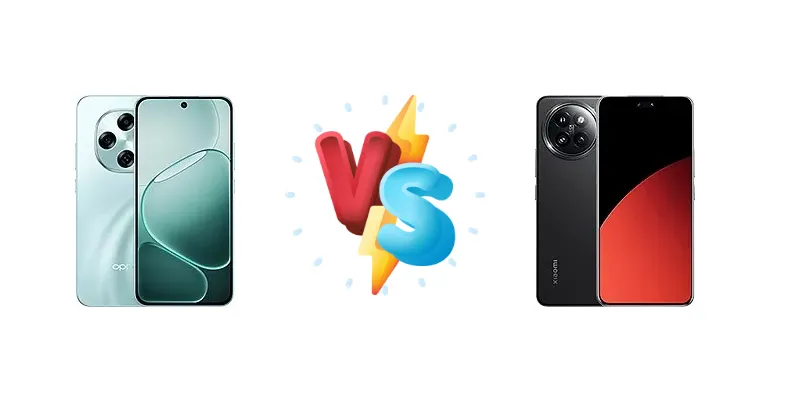
The Xiaomi Civi 4 Pro and Oppo A6 Pro represent compelling options in the increasingly competitive mid-range smartphone market, particularly within China. Both devices leverage 4nm chipsets, promising a blend of performance and efficiency. However, they diverge significantly in their silicon choices – Qualcomm’s Snapdragon 8s Gen 3 versus MediaTek’s Dimensity 7300 – and charging implementations, creating a clear battle for the performance-conscious user.
🏆 Quick Verdict
For the average user prioritizing raw performance and future-proofing, the Xiaomi Civi 4 Pro emerges as the stronger contender. The Snapdragon 8s Gen 3 offers a noticeable CPU and GPU advantage over the Dimensity 7300, making it better suited for demanding tasks and gaming. However, the Oppo A6 Pro’s 80W charging provides a faster top-up experience.
| Network |
|---|
| 2G bands | GSM 850 / 900 / 1800 / 1900 | GSM 850 / 900 / 1800 / 1900 |
| 3G bands | HSDPA 850 / 900 / 2100 | HSDPA 800 / 850 / 900 / 1700(AWS) / 1900 / 2100 |
| 4G bands | 1, 3, 5, 8, 28, 34, 38, 39, 40, 41, 42, 48 | 1, 3, 4, 5, 8, 18, 19, 26, 28, 34, 38, 39, 40, 41, 42, 48, 66 |
| 5G bands | 1, 3, 5, 8, 28, 38, 40, 41, 77, 78 SA/NSA | 1, 3, 5, 8, 28, 38, 40, 41, 48, 66, 77, 78 SA/NSA |
| Speed | HSPA, LTE, 5G | HSPA, LTE, 5G |
| Technology | GSM / HSPA / LTE / 5G | GSM / CDMA / HSPA / CDMA2000 / LTE / 5G |
| Launch |
|---|
| Announced | 2025, September 09 | 2024, March 21 |
| Status | Available. Released 2025, September 12 | Available. Released 2024, March 21 |
| Body |
|---|
| Build | - | Glass front (Gorilla Glass Victus 2), glass back or silicone polymer back (eco leather), aluminum frame |
| Dimensions | 158.2 x 75 x 8 mm (6.23 x 2.95 x 0.31 in) | 157.2 x 72.8 x 7.5 mm or 7.8 mm |
| SIM | Nano-SIM + Nano-SIM | Nano-SIM + Nano-SIM |
| Weight | 190 g (6.70 oz) | 177.6 or 179.3 g or 180.9 g (6.28 oz) |
| Display |
|---|
| Protection | Crystal Shield Glass | Corning Gorilla Glass Victus 2 |
| Resolution | 1080 x 2372 pixels (~397 ppi density) | 1236 x 2750 pixels, 20:9 ratio (~460 ppi density) |
| Size | 6.57 inches, 105.0 cm2 (~88.5% screen-to-body ratio) | 6.55 inches, 103.5 cm2 (~90.4% screen-to-body ratio) |
| Type | AMOLED, 1B colors, 120Hz, 600 nits (typ), 1400 nits (HBM) | AMOLED, 68B colors, 120Hz, Dolby Vision, HDR10+, 3000 nits (peak) |
| Platform |
|---|
| CPU | Octa-core (4x2.5 GHz Cortex-A78 & 4x2.0 GHz Cortex-A55) | Octa-core (1x3.0 GHz Cortex-X4 & 4x2.8 GHz Cortex-A720 & 3x2.0 GHz Cortex-A520) |
| Chipset | Mediatek Dimensity 7300 (4 nm) | Qualcomm SM8635 Snapdragon 8s Gen 3 (4 nm) |
| GPU | Mali-G615 MC2 | Adreno 735 |
| OS | Android 15, ColorOS 15 | Android 14, HyperOS |
| Memory |
|---|
| Card slot | No | No |
| Internal | 256GB 8GB RAM, 256GB 12GB RAM, 256GB 16GB RAM, 512GB 16GB RAM | 256GB 12GB RAM, 512GB 12GB RAM, 512GB 16GB RAM |
| Main Camera |
|---|
| Dual | 50 MP, f/1.8, 27mm (wide), PDAF, OIS
Auxiliary lens | - |
| Features | Color spectrum sensor, LED flash, HDR, panorama | Color spectrum sensor, Dual-LED flash, HDR, panorama, Leica lenses |
| Triple | - | 50 MP, f/1.6, 25mm (wide), 1/1.55", 1.0µm, PDAF, OIS
50 MP, f/2.0, 50mm (telephoto), 0.64µm, PDAF, 2x optical zoom
12 MP, f/2.2, 15mm, 120˚ (ultrawide), 1.12µm |
| Video | 4K@30fps, 1080p@30/60/120fps, gyro-EIS | 4K@24/30/60fps, 1080p@30/60/120/240/960fps, 720p@1920fps, HDR10+, BT.2020, 10-bit video, gyro-EIS |
| Selfie camera |
|---|
| Dual | - | 32 MP, f/2.0, 26mm (wide), 1/2.8", 0.8µm, AF
32 MP, f/2.4, 100˚ (ultrawide), 1/2.8", 0.8µm |
| Features | Panorama | HDR, panorama |
| Single | 16 MP, f/2.4, 23mm (wide) | - |
| Video | 1080p@30fps, gyro-EIS | 4K@30fps, 1080p@30/60fps; gyro-EIS |
| Sound |
|---|
| 35mm jack | No | No |
| Loudspeaker | Yes, with stereo speakers | Yes, with stereo speakers |
| Comms |
|---|
| Bluetooth | 5.4, A2DP, LE, aptX HD | 5.4, A2DP, LE, LHDC |
| Infrared port | - | Yes |
| NFC | Yes | Yes |
| Positioning | GPS, GALILEO, GLONASS, BDS, QZSS | GPS (L1), GLONASS (G1), BDS (B1I+B1c), GALILEO (E1), QZSS (L1) |
| Radio | No | No |
| USB | USB Type-C 2.0, OTG | USB Type-C 2.0, OTG |
| WLAN | Wi-Fi 802.11 a/b/g/n/ac/6, dual-band | Wi-Fi 802.11 a/b/g/n/ac/6, dual-band, Wi-Fi Direct |
| Features |
|---|
| Sensors | Fingerprint (under display, optical), accelerometer, gyro, proximity, compass | Fingerprint (under display, optical), accelerometer, gyro, proximity, compass |
| Battery |
|---|
| Charging | 80W wired, 33W PPS, 13.5W PD, 13.5W QC, UFCS
10W reverse wired | 67W wired, PD3.0, 100% in 40 minutes |
| Type | Si/C Li-Ion 7000 mAh | Li-Po 4700 mAh |
| Misc |
|---|
| Colors | Black, Blue, Gold | Black, Pink, Blue, Green |
| Models | PLN110 | 24053PY09C |
| Price | About 220 EUR | About 380 EUR |
Oppo A6 Pro (China)
- Faster 80W charging with multiple protocols
- Potentially better battery life due to Dimensity 7300's efficiency
- Competitive price point (likely)
- Less powerful chipset compared to Snapdragon 8s Gen 3
- Potentially slower image processing
Xiaomi Civi 4 Pro
- Superior performance with Snapdragon 8s Gen 3
- More advanced ISP for better image quality
- Smoother gaming experience
- Slower 67W charging
- Potentially higher power consumption
Display Comparison
While specific display details (resolution, panel type) are missing, both phones benefit from the efficiency of their 4nm chipsets, allowing for potentially higher refresh rates without significant battery drain. The focus here is on processing power to drive those displays smoothly. Without knowing the panel technology, it's difficult to assess color accuracy or peak brightness, but both manufacturers typically employ AMOLED panels in this segment.
Camera Comparison
Without detailed camera specifications, a direct comparison is limited. However, the chipset plays a crucial role in image signal processing (ISP). The Snapdragon 8s Gen 3’s ISP is likely more advanced, enabling faster image processing, better low-light performance, and more sophisticated computational photography features. The Oppo A6 Pro’s Dimensity 7300 ISP is still competent, but will likely lag behind in these areas. The absence of information on sensor sizes and OIS makes a definitive camera judgment impossible.
Performance
The core difference lies in the chipsets. The Xiaomi Civi 4 Pro’s Snapdragon 8s Gen 3, with its 1x3.0 GHz Cortex-X4 prime core, demonstrably outperforms the Oppo A6 Pro’s Dimensity 7300 (4x2.5 GHz Cortex-A78). The Snapdragon’s newer architecture (Cortex-A720 vs A78) translates to better single-core and multi-core performance. This advantage extends to the GPU; the Snapdragon’s Adreno GPU will deliver a smoother gaming experience and faster rendering times. The Dimensity 7300, while capable, is positioned a tier below, focusing on efficiency rather than outright speed. The Civi 4 Pro's LPDDR5x RAM further enhances its performance edge.
Battery Life
The Oppo A6 Pro’s 80W wired charging is a significant advantage. Coupled with PPS, PD, QC, and UFCS support, it offers broad compatibility and rapid charging speeds. Xiaomi’s Civi 4 Pro offers 67W charging, which, while still fast, takes approximately 40 minutes for a full charge. The difference in charging speed is substantial, benefiting users who prioritize quick top-ups. The actual battery life will depend on the mAh capacity (unspecified), but the Snapdragon 8s Gen 3’s higher power consumption may offset some of the Civi 4 Pro’s potential battery capacity advantage.
Buying Guide
Buy the Oppo A6 Pro (China) if you prioritize exceptionally fast charging speeds and a balanced, efficient experience for everyday tasks. It’s ideal for users who frequently top up their phones and don’t necessarily need the absolute highest performance. Buy the Xiaomi Civi 4 Pro if you demand superior processing power for gaming, content creation, or multitasking, and are willing to trade a slightly slower charging speed for a more capable chipset.
Frequently Asked Questions
❓ Will the Snapdragon 8s Gen 3 in the Xiaomi Civi 4 Pro handle demanding games like Genshin Impact at high settings?
Yes, the Snapdragon 8s Gen 3 is well-equipped to handle Genshin Impact and other graphically intensive games at high settings. Its Adreno GPU provides ample power for smooth gameplay, and the 4nm process helps manage thermals during extended gaming sessions. Expect a consistently high frame rate and a more immersive gaming experience compared to the Dimensity 7300.
❓ How much faster is the 80W charging on the Oppo A6 Pro compared to the 67W charging on the Xiaomi Civi 4 Pro in real-world use?
The 80W charging on the Oppo A6 Pro will noticeably reduce charging time. While Xiaomi claims 100% in 40 minutes, the Oppo A6 Pro should achieve a full charge in approximately 30-35 minutes, depending on battery capacity. This difference is particularly beneficial for users who need a quick top-up before leaving the house.
❓ Does the Dimensity 7300 in the Oppo A6 Pro struggle with multitasking or running multiple apps simultaneously?
The Dimensity 7300 is a capable chipset and should handle typical multitasking scenarios without issue. However, the Snapdragon 8s Gen 3 in the Civi 4 Pro offers a more robust multitasking experience, especially when dealing with numerous demanding applications. Users who frequently switch between many apps or run resource-intensive software will benefit from the Civi 4 Pro’s superior processing power.