
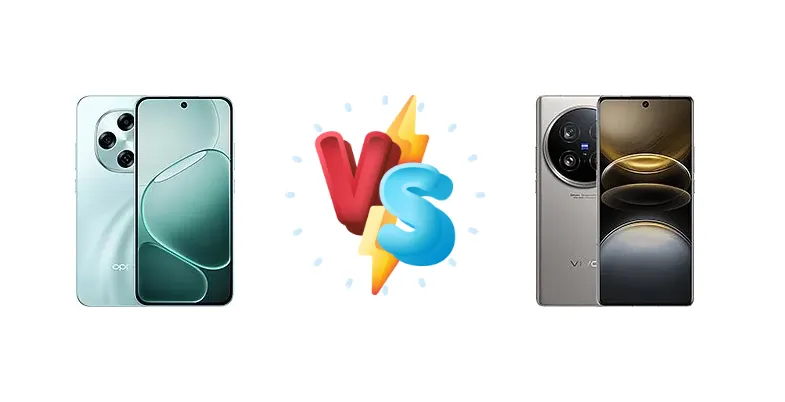
Oppo A6 Pro vs vivo X100 Ultra: A Detailed Comparison of Performance and Features
| Phones Images | |||||
|---|---|---|---|---|---|
|
🏆 Quick Verdict
For the average user prioritizing raw performance and a premium experience, the vivo X100 Ultra is the clear winner. Its Snapdragon 8 Gen 3 chipset and superior display brightness justify the higher price. However, the Oppo A6 Pro offers excellent value for those seeking a capable daily driver without breaking the bank.
| PHONES | ||
|---|---|---|
| Phone Names | Oppo A6 Pro (China) | vivo X100 Ultra |
| Network | ||
|---|---|---|
| 2G bands | GSM 850 / 900 / 1800 / 1900 | GSM 850 / 900 / 1800 / 1900 |
| 3G bands | HSDPA 850 / 900 / 2100 | HSDPA 800 / 850 / 900 / 1700(AWS) / 1900 / 2100 |
| 4G bands | 1, 3, 5, 8, 28, 34, 38, 39, 40, 41, 42, 48 | 1, 2, 3, 4, 5, 7, 8, 12, 17, 18, 19, 20, 25, 26, 28, 34, 38, 39, 40, 41, 42, 66 |
| 5G bands | 1, 3, 5, 8, 28, 38, 40, 41, 77, 78 SA/NSA | 1, 2, 3, 5, 7, 8, 12, 20, 25, 26, 28, 38, 40, 41, 66, 77, 78, 79 SA/NSA |
| Speed | HSPA, LTE, 5G | HSPA, LTE, 5G |
| Technology | GSM / HSPA / LTE / 5G | GSM / CDMA / HSPA / LTE / 5G |
| Launch | ||
|---|---|---|
| Announced | 2025, September 09 | 2024, May 13 |
| Status | Available. Released 2025, September 12 | Available. Released 2024, May 28 |
| Body | ||
|---|---|---|
| Build | - | Glass front, glass back, aluminum frame |
| Dimensions | 158.2 x 75 x 8 mm (6.23 x 2.95 x 0.31 in) | 164.1 x 75.6 x 9.2 mm (6.46 x 2.98 x 0.36 in) |
| SIM | Nano-SIM + Nano-SIM | Nano-SIM + Nano-SIM |
| Weight | 190 g (6.70 oz) | 229 g (8.08 oz) |
| Display | ||
|---|---|---|
| Protection | Crystal Shield Glass | - |
| Resolution | 1080 x 2372 pixels (~397 ppi density) | 1440 x 3200 pixels, 20:9 ratio (~517 ppi density) |
| Size | 6.57 inches, 105.0 cm2 (~88.5% screen-to-body ratio) | 6.78 inches, 111.4 cm2 (~89.8% screen-to-body ratio) |
| Type | AMOLED, 1B colors, 120Hz, 600 nits (typ), 1400 nits (HBM) | LTPO AMOLED, 1B colors, 120Hz, Dolby Vision, HDR, 3000 nits (peak) |
| Platform | ||
|---|---|---|
| CPU | Octa-core (4x2.5 GHz Cortex-A78 & 4x2.0 GHz Cortex-A55) | Octa-core (1x3.3 GHz Cortex-X4 & 3x3.2 GHz Cortex-A720 & 2x3.0 GHz Cortex-A720 & 2x2.3 GHz Cortex-A520) |
| Chipset | Mediatek Dimensity 7300 (4 nm) | Qualcomm SM8650-AB Snapdragon 8 Gen 3 (4 nm) |
| GPU | Mali-G615 MC2 | Adreno 750 |
| OS | Android 15, ColorOS 15 | Android 14, upgradable to Android 15, OriginOS 5 |
| Memory | ||
|---|---|---|
| Card slot | No | No |
| Internal | 256GB 8GB RAM, 256GB 12GB RAM, 256GB 16GB RAM, 512GB 16GB RAM | 256GB 12GB RAM, 512GB 16GB RAM, 1TB 16GB RAM |
| Main Camera | ||
|---|---|---|
| Dual | 50 MP, f/1.8, 27mm (wide), PDAF, OIS Auxiliary lens | - |
| Features | Color spectrum sensor, LED flash, HDR, panorama | Laser AF, color spectrum sensor, Zeiss optics, Zeiss T* lens coating, LED flash, panorama, HDR, 3D LUT import |
| Triple | - | 50 MP, f/1.8, 23mm (wide), 1/0.98", 1.6µm, dual pixel PDAF, gimbal OIS 200 MP, f/2.7, 85mm (periscope telephoto), 1/1.4", 0.56µm, multi-directional PDAF, OIS, 3.7x optical zoom, macro 3.4:1 50 MP, f/2.2, 14mm, 116˚ (ultrawide), 1/2.0", 0.8µm, AF |
| Video | 4K@30fps, 1080p@30/60/120fps, gyro-EIS | 8K@30fps, 4K@30/60/120fps, 1080p@30/60/120/240fps, gyro-EIS, Dolby Vision HDR |
| Selfie camera | ||
|---|---|---|
| Features | Panorama | HDR |
| Single | 16 MP, f/2.4, 23mm (wide) | 50 MP, f/2.5, 24mm (wide), 1/2.76", 0.64µm, AF |
| Video | 1080p@30fps, gyro-EIS | 4K@30/60fps, 1080p@30/60fps |
| Sound | ||
|---|---|---|
| 35mm jack | No | No |
| Loudspeaker | Yes, with stereo speakers | Yes, with stereo speakers |
| Comms | ||
|---|---|---|
| Bluetooth | 5.4, A2DP, LE, aptX HD | 5.4, A2DP, LE, aptX HD, aptX Adaptive, aptX Lossless, LHDC |
| Infrared port | - | Yes |
| NFC | Yes | Yes |
| Positioning | GPS, GALILEO, GLONASS, BDS, QZSS | GPS (L1+L5), BDS (B1I+B1c+B2a), GALILEO (E1+E5a), QZSS (L1+L5), GLONASS |
| Radio | No | No |
| USB | USB Type-C 2.0, OTG | USB Type-C 3.2, OTG, DisplayPort |
| WLAN | Wi-Fi 802.11 a/b/g/n/ac/6, dual-band | Wi-Fi 802.11 a/b/g/n/ac/6/7, dual-band |
| Features | ||
|---|---|---|
| Sensors | Fingerprint (under display, optical), accelerometer, gyro, proximity, compass | Fingerprint (under display, ultrasonic), accelerometer, gyro, proximity, compass |
| Battery | ||
|---|---|---|
| Charging | 80W wired, 33W PPS, 13.5W PD, 13.5W QC, UFCS 10W reverse wired | 80W wired, PD, PPS, QC, UFCS 30W wireless Reverse wired Reverse wireless |
| Type | Si/C Li-Ion 7000 mAh | Si/C Li-Ion 5500 mAh |
| Misc | ||
|---|---|---|
| Colors | Black, Blue, Gold | Titanium, White, Grey |
| Models | PLN110 | V2366GA, V2366HA |
| Price | About 220 EUR | About 980 EUR |
Oppo A6 Pro (China)
- Excellent value for money
- Fast 80W wired charging
- Efficient Dimensity 7300 chipset
- Less powerful chipset compared to Snapdragon 8 Gen 3
- Missing wireless charging
vivo X100 Ultra
- Flagship-level performance with Snapdragon 8 Gen 3
- Brighter display for outdoor visibility
- 30W wireless charging for added convenience
- Higher price point
- Potentially more expensive repairs
Display Comparison
The vivo X100 Ultra boasts a significantly brighter display, reaching a measured 1801 nits. This is crucial for outdoor visibility, especially in direct sunlight. While both phones support 80W charging, the X100 Ultra adds 30W wireless charging, a feature absent in the A6 Pro. Details regarding panel technology (LTPO, refresh rate) for the A6 Pro are missing, but the X100 Ultra’s brightness advantage is a clear win for multimedia consumption and outdoor use.
Camera Comparison
Context data lacks detailed camera specifications for both devices. However, given the X100 Ultra’s flagship positioning, it likely features a more sophisticated camera system with larger sensors and advanced image processing capabilities. The A6 Pro, being a mid-range device, will likely prioritize affordability over cutting-edge camera technology. Without specific sensor details, it’s reasonable to assume the X100 Ultra will deliver superior image quality, especially in low-light conditions.
Performance
The core difference lies in the chipsets. The vivo X100 Ultra’s Snapdragon 8 Gen 3 (4nm) is a substantial upgrade over the Oppo A6 Pro’s Dimensity 7300 (4nm). The Snapdragon 8 Gen 3 features a more advanced CPU architecture – a 1x3.3 GHz Cortex-X4 prime core versus the A6 Pro’s 4x2.5 GHz Cortex-A78 cores – translating to faster application loading, smoother multitasking, and superior gaming performance. The Snapdragon’s Adreno GPU also provides a significant graphical advantage. While both are 4nm chips, the architectural improvements in the Snapdragon 8 Gen 3 offer better performance per watt.
Battery Life
The vivo X100 Ultra demonstrates impressive battery life, achieving 12:55h in active use. While the A6 Pro’s battery capacity is unknown, both devices share 80W wired charging, ensuring relatively quick top-ups. The X100 Ultra’s additional 30W wireless charging provides greater convenience. The longer active use score of the X100 Ultra suggests a more efficient combination of chipset and battery optimization.
Buying Guide
Buy the Oppo A6 Pro (China) if you need a reliable smartphone for everyday tasks, social media, and light gaming, and prioritize value for money. You'll appreciate its fast 80W charging and efficient Dimensity 7300 chipset. Buy the vivo X100 Ultra if you demand the absolute best performance for demanding games, content creation, and benefit from a brighter, more vibrant display, and are willing to pay a premium for it. The Snapdragon 8 Gen 3 and extended battery life cater to power users.