
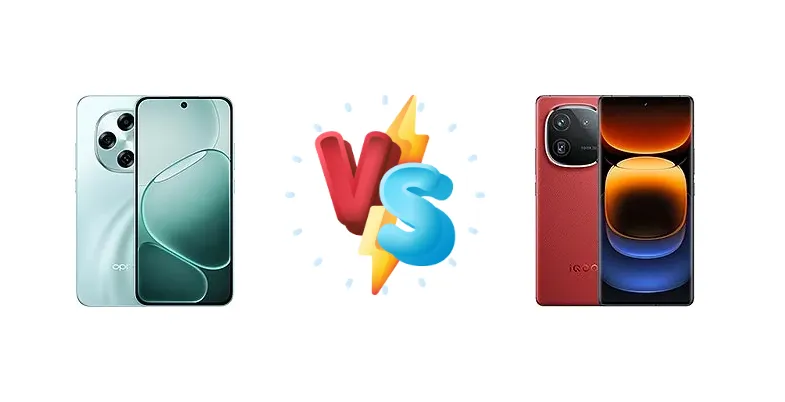
vivo iQOO 12 Pro vs Oppo A6 Pro: A Detailed Performance and Charging Showdown
| Phones Images | |||||
|---|---|---|---|---|---|
|
🏆 Quick Verdict
For users prioritizing raw power and future-proofing, the vivo iQOO 12 Pro is the clear winner. Its Snapdragon 8 Gen 3 chipset delivers significantly higher performance. However, the Oppo A6 Pro offers a compelling balance of features and affordability, making it ideal for everyday users and those less demanding of peak performance.
| PHONES | ||
|---|---|---|
| Phone Names | Oppo A6 Pro (China) | vivo iQOO 12 Pro |
| Network | ||
|---|---|---|
| 2G bands | GSM 850 / 900 / 1800 / 1900 | GSM 850 / 900 / 1800 / 1900 |
| 3G bands | HSDPA 850 / 900 / 2100 | HSDPA 800 / 850 / 900 / 1700(AWS) / 1900 / 2100 |
| 4G bands | 1, 3, 5, 8, 28, 34, 38, 39, 40, 41, 42, 48 | 1, 2, 3, 4, 5, 7, 8, 12, 17, 18, 19, 20, 25, 26, 28, 34, 38, 39, 40, 41, 42, 66 |
| 5G bands | 1, 3, 5, 8, 28, 38, 40, 41, 77, 78 SA/NSA | 1, 2, 3, 5, 7, 8, 12, 20, 25, 26, 28, 66, 38, 40, 41, 77, 78 SA/NSA |
| Speed | HSPA, LTE, 5G | HSPA, LTE, 5G |
| Technology | GSM / HSPA / LTE / 5G | GSM / CDMA / HSPA / CDMA2000 / LTE / 5G |
| Launch | ||
|---|---|---|
| Announced | 2025, September 09 | 2023, November 07 |
| Status | Available. Released 2025, September 12 | Available. Released 2023, November 14 |
| Body | ||
|---|---|---|
| Dimensions | 158.2 x 75 x 8 mm (6.23 x 2.95 x 0.31 in) | 164.6 x 75.4 x 8.6 mm or 8.8 mm |
| SIM | Nano-SIM + Nano-SIM | Nano-SIM + Nano-SIM |
| Weight | 190 g (6.70 oz) | 205 g or 210 g (7.23 oz) |
| Display | ||
|---|---|---|
| Protection | Crystal Shield Glass | - |
| Resolution | 1080 x 2372 pixels (~397 ppi density) | 1440 x 3200 pixels, 20:9 ratio (~518 ppi density) |
| Size | 6.57 inches, 105.0 cm2 (~88.5% screen-to-body ratio) | 6.78 inches, 111.0 cm2 (~89.4% screen-to-body ratio) |
| Type | AMOLED, 1B colors, 120Hz, 600 nits (typ), 1400 nits (HBM) | LTPO AMOLED, 1B colors, 144Hz, HDR10+, 1600 nits (HBM), 3000 nits (peak) |
| Platform | ||
|---|---|---|
| CPU | Octa-core (4x2.5 GHz Cortex-A78 & 4x2.0 GHz Cortex-A55) | Octa-core (1x3.3 GHz Cortex-X4 & 3x3.2 GHz Cortex-A720 & 2x3.0 GHz Cortex-A720 & 2x2.3 GHz Cortex-A520) |
| Chipset | Mediatek Dimensity 7300 (4 nm) | Qualcomm SM8650-AB Snapdragon 8 Gen 3 (4 nm) |
| GPU | Mali-G615 MC2 | Adreno 750 |
| OS | Android 15, ColorOS 15 | Android 14, up to 2 major Android upgrades, Funtouch 14 (International), OriginOS 4 (China) |
| Memory | ||
|---|---|---|
| Card slot | No | No |
| Internal | 256GB 8GB RAM, 256GB 12GB RAM, 256GB 16GB RAM, 512GB 16GB RAM | 256GB 16GB RAM, 512GB 16GB RAM, 1TB 16GB RAM |
| Main Camera | ||
|---|---|---|
| Dual | 50 MP, f/1.8, 27mm (wide), PDAF, OIS Auxiliary lens | - |
| Features | Color spectrum sensor, LED flash, HDR, panorama | Color spectrum sensor, Dual-LED flash, HDR, panorama |
| Triple | - | 50 MP, f/1.7, 23mm (wide), 1/1.3", 1.2µm, ulti-directional PDAF, OIS 64 MP, f/2.6, 70mm (periscope telephoto), 1/2.0", PDAF, OIS, 3x optical zoom 50 MP, f/2.0, 15mm, 119˚ (ultrawide), AF |
| Video | 4K@30fps, 1080p@30/60/120fps, gyro-EIS | 8K@30fps, 4K@24/30/60fps, 1080p@30/60/120/240fps, gyro-EIS |
| Selfie camera | ||
|---|---|---|
| Features | Panorama | HDR |
| Single | 16 MP, f/2.4, 23mm (wide) | 16 MP, f/2.5, (wide) |
| Video | 1080p@30fps, gyro-EIS | 1080p@30fps, gyro-EIS |
| Sound | ||
|---|---|---|
| 35mm jack | No | No |
| Loudspeaker | Yes, with stereo speakers | Yes, with stereo speakers |
| Comms | ||
|---|---|---|
| Bluetooth | 5.4, A2DP, LE, aptX HD | 5.4, A2DP, LE, aptX HD, aptX Adaptive, aptX Lossless |
| Infrared port | - | Yes |
| NFC | Yes | Yes |
| Positioning | GPS, GALILEO, GLONASS, BDS, QZSS | GPS (L1+L5), GLONASS (G1), BDS (B1I+B1c+B2a), GALILEO (E1+E5a), QZSS (L1+L5) |
| Radio | No | No |
| USB | USB Type-C 2.0, OTG | USB Type-C 2.0, OTG |
| WLAN | Wi-Fi 802.11 a/b/g/n/ac/6, dual-band | Wi-Fi 802.11 a/b/g/n/ac/6/7, tri-band, Wi-Fi Direct |
| Features | ||
|---|---|---|
| Sensors | Fingerprint (under display, optical), accelerometer, gyro, proximity, compass | Fingerprint (under display, ultrasonic), accelerometer, gyro, proximity, compass |
| Battery | ||
|---|---|---|
| Charging | 80W wired, 33W PPS, 13.5W PD, 13.5W QC, UFCS 10W reverse wired | 120W wired 50W wireless 10W reverse wireless |
| Type | Si/C Li-Ion 7000 mAh | 5100 mAh |
| Misc | ||
|---|---|---|
| Colors | Black, Blue, Gold | Black, Red, White (BMW M branding) |
| Models | PLN110 | V2329A |
| Price | About 220 EUR | About 650 EUR |
Oppo A6 Pro (China)
- More affordable price point
- Fast 80W wired charging with multiple protocols
- Solid performance for everyday tasks
- Significantly less powerful chipset
- Likely inferior camera performance
- No wireless charging
vivo iQOO 12 Pro
- Flagship Snapdragon 8 Gen 3 performance
- Ultra-fast 120W wired and 50W wireless charging
- Superior camera capabilities (expected)
- Higher price tag
- Potential for thermal throttling under sustained load
- May be overkill for basic users
Display Comparison
While display specifications are missing for the Oppo A6 Pro, the iQOO 12 Pro is expected to feature a high-refresh-rate AMOLED panel. The core difference lies in the processing power driving the display. The Snapdragon 8 Gen 3’s integrated GPU will handle graphically intensive tasks and games with greater ease, resulting in smoother visuals. The iQOO 12 Pro’s 120W charging capability suggests a larger battery capacity, potentially impacting display-on time.
Camera Comparison
Without detailed camera specs for the Oppo A6 Pro, a direct comparison is limited. However, iQOO phones typically prioritize camera performance in their Pro models. The iQOO 12 Pro is likely to feature a more advanced image signal processor (ISP) within the Snapdragon 8 Gen 3, enabling superior image processing, dynamic range, and low-light performance. The iQOO 12 Pro’s larger sensor (assumed, based on its flagship positioning) will capture more light, resulting in clearer and more detailed photos. The Oppo A6 Pro will likely focus on providing adequate image quality for social media sharing.
Performance
The performance gap is substantial. The vivo iQOO 12 Pro’s Qualcomm Snapdragon 8 Gen 3 (4nm) is a flagship chipset boasting a 1x3.3 GHz Cortex-X4 prime core, significantly outperforming the Oppo A6 Pro’s Mediatek Dimensity 7300 (4nm) with its 4x2.5 GHz Cortex-A78 cores. This translates to a noticeable difference in app launch speeds, multitasking, and gaming performance. The Snapdragon’s architecture, with its newer core designs, offers improved IPC (Instructions Per Clock) and efficiency. The iQOO 12 Pro also benefits from potentially faster LPDDR5x RAM, further enhancing responsiveness.
Battery Life
The iQOO 12 Pro’s 120W wired charging is a game-changer, promising a full charge in under 20 minutes. The Oppo A6 Pro’s 80W charging is still fast, but significantly slower. While the iQOO 12 Pro also offers 50W wireless charging, the A6 Pro lacks wireless charging altogether. The Snapdragon 8 Gen 3’s improved power efficiency may partially offset the iQOO 12 Pro’s potentially larger battery capacity, but the charging speed advantage remains substantial. The inclusion of PPS, PD, and QC support on the A6 Pro offers wider compatibility, but doesn't match the sheer speed of the iQOO 12 Pro’s charging.
Buying Guide
Buy the Oppo A6 Pro (China) if you need a reliable daily driver with fast charging and a smooth experience for typical tasks like social media, browsing, and casual gaming. Buy the vivo iQOO 12 Pro if you prioritize uncompromising performance for demanding games, content creation, and want the fastest possible charging speeds, even if it comes at a higher price.