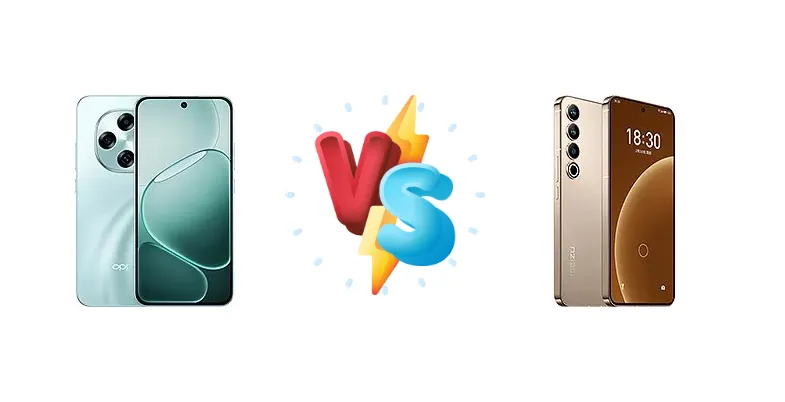
The Oppo A6 Pro (China) and Meizu 20 Pro represent distinct approaches to the Android smartphone market. The A6 Pro aims for a balance of features and affordability, while the Meizu 20 Pro positions itself as a premium flagship. This comparison dissects their key specifications to determine which device delivers the best experience for different user needs.
🏆 Quick Verdict
For the average user prioritizing raw performance and future-proofing, the Meizu 20 Pro is the clear winner. Its Snapdragon 8 Gen 2 chipset provides a significant performance advantage over the Oppo A6 Pro’s Dimensity 7300. However, the A6 Pro offers competitive charging and may appeal to budget-conscious buyers.
| Network |
|---|
| 2G bands | GSM 850 / 900 / 1800 / 1900 | GSM 850 / 900 / 1800 / 1900 |
| 3G bands | HSDPA 850 / 900 / 2100 | HSDPA 850 / 900 / 1900 / 2100 |
| 4G bands | 1, 3, 5, 8, 28, 34, 38, 39, 40, 41, 42, 48 | 1, 2, 3, 4, 5, 7, 8, 12, 28, 34, 38, 39, 40, 41 |
| 5G bands | 1, 3, 5, 8, 28, 38, 40, 41, 77, 78 SA/NSA | 1, 3, 5, 8, 28, 38, 41, 77, 78, 79 SA/NSA |
| Speed | HSPA, LTE, 5G | HSPA, LTE, 5G |
| Technology | GSM / HSPA / LTE / 5G | GSM / HSPA / LTE / 5G |
| Launch |
|---|
| Announced | 2025, September 09 | 2023, March 30 |
| Status | Available. Released 2025, September 12 | Available. Released 2023, June 20 |
| Body |
|---|
| Dimensions | 158.2 x 75 x 8 mm (6.23 x 2.95 x 0.31 in) | 164.2 x 76.4 x 7.8 mm (6.46 x 3.01 x 0.31 in) |
| SIM | Nano-SIM + Nano-SIM | Nano-SIM + Nano-SIM |
| Weight | 190 g (6.70 oz) | 209 g (7.37 oz) |
| | - | IP54 |
| Display |
|---|
| Protection | Crystal Shield Glass | - |
| Resolution | 1080 x 2372 pixels (~397 ppi density) | 1440 x 3200 pixels, 20:9 ratio (~515 ppi density) |
| Size | 6.57 inches, 105.0 cm2 (~88.5% screen-to-body ratio) | 6.81 inches, 112.0 cm2 (~89.3% screen-to-body ratio) |
| Type | AMOLED, 1B colors, 120Hz, 600 nits (typ), 1400 nits (HBM) | LTPO OLED, 120Hz, HDR10+, 500 nits (typ), 1800 nits (peak) |
| Platform |
|---|
| CPU | Octa-core (4x2.5 GHz Cortex-A78 & 4x2.0 GHz Cortex-A55) | Octa-core (1x3.2 GHz Cortex-X3 & 2x2.8 GHz Cortex-A715 & 2x2.8 GHz Cortex-A710 & 3x2.0 GHz Cortex-A510) |
| Chipset | Mediatek Dimensity 7300 (4 nm) | Qualcomm SM8550-AB Snapdragon 8 Gen 2 (4 nm) |
| GPU | Mali-G615 MC2 | Adreno 740 |
| OS | Android 15, ColorOS 15 | Android 13, Flyme 10 |
| Memory |
|---|
| Card slot | No | No |
| Internal | 256GB 8GB RAM, 256GB 12GB RAM, 256GB 16GB RAM, 512GB 16GB RAM | 128GB 12GB RAM, 256GB 12GB RAM, 512GB 12GB RAM |
| | - | UFS 4.0 - 512GB |
| Main Camera |
|---|
| Dual | 50 MP, f/1.8, 27mm (wide), PDAF, OIS
Auxiliary lens | - |
| Features | Color spectrum sensor, LED flash, HDR, panorama | Ring-LED flash, panorama, HDR |
| Triple | - | 50 MP, f/1.9, (wide), PDAF, OIS
50 MP f/1.9, (telephoto), PDAF, 2x optical zoom
50 MP, f/2.2, 129˚ (ultrawide) |
| Video | 4K@30fps, 1080p@30/60/120fps, gyro-EIS | 8K, 4K, 1080p; gyro-EIS |
| Selfie camera |
|---|
| Features | Panorama | HDR |
| Single | 16 MP, f/2.4, 23mm (wide) | 32 MP, f/2.5, (wide) |
| Video | 1080p@30fps, gyro-EIS | Yes |
| Sound |
|---|
| 3.5mm jack | - | No |
| 35mm jack | No | No |
| Loudspeaker | Yes, with stereo speakers | Yes, with stereo speakers |
| Comms |
|---|
| Bluetooth | 5.4, A2DP, LE, aptX HD | 5.3, A2DP, LE |
| Infrared port | - | Yes |
| NFC | Yes | Yes |
| Positioning | GPS, GALILEO, GLONASS, BDS, QZSS | GPS (L1+L5), GLONASS, BDS (B1I+B1c+B2a), GALILEO, QZSS |
| Radio | No | No |
| USB | USB Type-C 2.0, OTG | USB Type-C |
| WLAN | Wi-Fi 802.11 a/b/g/n/ac/6, dual-band | Wi-Fi 802.11 а/b/g/n/ac/6e/7, tri-band |
| Features |
|---|
| Sensors | Fingerprint (under display, optical), accelerometer, gyro, proximity, compass | Fingerprint (under display, ultrasonic), accelerometer, gyro, proximity, compass |
| Battery |
|---|
| Charging | 80W wired, 33W PPS, 13.5W PD, 13.5W QC, UFCS
10W reverse wired | 80W wired, PD3 PPS, QC4+
50W wireless |
| Type | Si/C Li-Ion 7000 mAh | Li-Po 5000 mAh |
| Misc |
|---|
| Colors | Black, Blue, Gold | Gray, Gold, Silver |
| Models | PLN110 | - |
| Price | About 220 EUR | About 530 EUR |
Oppo A6 Pro (China)
- Fast 80W wired charging
- Competitive price point
- Efficient Dimensity 7300 chipset for everyday tasks
- Less powerful processor compared to Snapdragon 8 Gen 2
- Lacks wireless charging
- Potentially lower-quality display
Meizu 20 Pro
- Flagship Snapdragon 8 Gen 2 performance
- 50W wireless charging support
- Likely superior display quality and camera capabilities
- Higher price tag
- Potentially more heat generation under heavy load
- May require proprietary charging brick for full speed
Display Comparison
While both devices lack detailed display specifications in the provided data, we can infer differences based on their positioning. The Meizu 20 Pro, as a flagship, likely features a higher-quality panel with potentially LTPO technology for adaptive refresh rates, resulting in improved power efficiency. The Oppo A6 Pro will likely use a standard AMOLED panel. Bezels are expected to be slimmer on the Meizu 20 Pro, contributing to a more immersive viewing experience. Color accuracy is also likely to be superior on the Meizu 20 Pro, given its flagship status.
Camera Comparison
Without detailed camera specs, it’s difficult to make a definitive judgment. However, flagship devices like the Meizu 20 Pro typically feature larger sensors and more advanced image processing algorithms. The Snapdragon 8 Gen 2’s ISP (Image Signal Processor) is also more capable than the Dimensity 7300’s, resulting in better dynamic range, noise reduction, and overall image quality. We can assume the Meizu 20 Pro will offer more versatile camera features and superior low-light performance. The Oppo A6 Pro will likely focus on providing a good, but not exceptional, camera experience.
Performance
The core difference lies in the chipsets. The Meizu 20 Pro’s Snapdragon 8 Gen 2 (4nm) is a significant leap ahead of the Oppo A6 Pro’s Dimensity 7300 (4nm). The Snapdragon 8 Gen 2 boasts a prime Cortex-X3 core clocked at 3.2 GHz, compared to the A6 Pro’s Cortex-A78 cores at 2.5 GHz. This translates to substantially faster CPU performance in benchmarks and real-world applications. The GPU in the Snapdragon 8 Gen 2 is also far more powerful, making the Meizu 20 Pro the superior choice for gaming. Both utilize a 4nm process, but Qualcomm’s architecture and optimizations provide better thermal efficiency, minimizing throttling during sustained workloads. The Meizu 20 Pro likely benefits from faster LPDDR5x RAM, further enhancing performance.
Battery Life
Both phones offer 80W wired charging, a significant advantage for quick top-ups. The Meizu 20 Pro adds 50W wireless charging, a feature absent in the Oppo A6 Pro. While battery capacity isn’t specified, the Meizu 20 Pro’s more efficient chipset and potentially optimized software could result in comparable or even better real-world battery life despite potentially having a similar capacity. The inclusion of PD3 PPS and QC4+ on the Meizu 20 Pro ensures broader compatibility with fast charging accessories.
Buying Guide
Buy the Oppo A6 Pro (China) if you need a reliable daily driver with fast charging and are comfortable with a slightly less powerful processor. It’s ideal for users who prioritize battery life and efficient performance for everyday tasks. Buy the Meizu 20 Pro if you demand top-tier performance for gaming, demanding applications, and want a more premium experience, and are willing to pay a premium for it.
Frequently Asked Questions
❓ Does the Dimensity 7300 in the Oppo A6 Pro struggle with graphically intensive games like Genshin Impact?
While the Dimensity 7300 is a capable chip, it will likely require lower graphics settings and potentially experience some frame drops in demanding games like Genshin Impact compared to the Snapdragon 8 Gen 2 in the Meizu 20 Pro. The 8 Gen 2's Adreno GPU is significantly more powerful.
❓ Is the 50W wireless charging on the Meizu 20 Pro significantly faster than standard wireless charging?
Yes, 50W wireless charging is considerably faster than the typical 15-25W wireless charging found on many smartphones. It will charge the Meizu 20 Pro much quicker wirelessly, approaching the speed of some wired charging solutions.
❓ What charging standards does the Oppo A6 Pro support, and does it require a specific charger for 80W speeds?
The Oppo A6 Pro supports 80W wired charging via UFCS, as well as 33W PPS, 13.5W PD, and 13.5W QC. To achieve the full 80W charging speed, you'll likely need to use a compatible Oppo SuperVOOC charger.
❓ How does the thermal management of the Dimensity 7300 compare to the Snapdragon 8 Gen 2 during prolonged gaming sessions?
The Snapdragon 8 Gen 2, despite its higher performance, generally exhibits better thermal efficiency due to Qualcomm's optimizations. The Dimensity 7300 may experience more noticeable throttling under sustained heavy load, potentially leading to reduced performance over time.