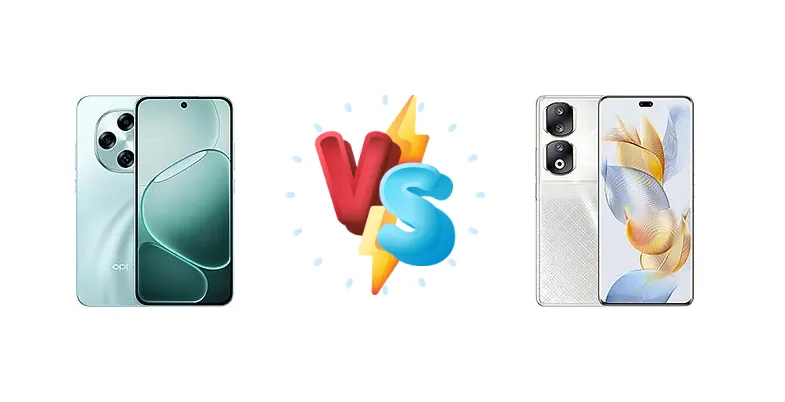
The Oppo A6 Pro (China) and Honor 90 Pro represent compelling options in the increasingly competitive mid-range to upper-mid-range smartphone market. While both devices utilize 4nm process technology, they diverge significantly in their chipset choices – Mediatek’s Dimensity 7300 versus Qualcomm’s Snapdragon 8+ Gen 1. This comparison will dissect these differences, focusing on real-world performance implications and user benefits.
🏆 Quick Verdict
For the average user prioritizing raw performance and sustained gaming, the Honor 90 Pro emerges as the stronger choice thanks to the Snapdragon 8+ Gen 1. However, the Oppo A6 Pro’s efficient Dimensity 7300 and versatile charging options make it a compelling alternative for those valuing battery life and charging flexibility.
| Network |
|---|
| 2G bands | GSM 850 / 900 / 1800 / 1900 | GSM 850 / 900 / 1800 / 1900 |
| 3G bands | HSDPA 850 / 900 / 2100 | HSDPA 800 / 850 / 900 / 1700(AWS) / 1900 / 2100 |
| 4G bands | 1, 3, 5, 8, 28, 34, 38, 39, 40, 41, 42, 48 | 1, 2, 3, 4, 5, 8, 19, 28, 34, 38, 39, 40, 41 |
| 5G bands | 1, 3, 5, 8, 28, 38, 40, 41, 77, 78 SA/NSA | 1, 5, 8, 28, 41, 77, 78 SA/NSA |
| Speed | HSPA, LTE, 5G | HSPA, LTE, 5G |
| Technology | GSM / HSPA / LTE / 5G | GSM / CDMA / HSPA / CDMA2000 / LTE / 5G |
| Launch |
|---|
| Announced | 2025, September 09 | 2023, May 29 |
| Status | Available. Released 2025, September 12 | Available. Released 2023, June 07 |
| Body |
|---|
| Dimensions | 158.2 x 75 x 8 mm (6.23 x 2.95 x 0.31 in) | 163.8 x 74.9 x 8.1 mm (6.45 x 2.95 x 0.32 in) |
| SIM | Nano-SIM + Nano-SIM | Nano-SIM + Nano-SIM |
| Weight | 190 g (6.70 oz) | 192 g (6.77 oz) |
| Display |
|---|
| Protection | Crystal Shield Glass | - |
| Resolution | 1080 x 2372 pixels (~397 ppi density) | 1224 x 2700 pixels (~437 ppi density) |
| Size | 6.57 inches, 105.0 cm2 (~88.5% screen-to-body ratio) | 6.78 inches, 111.5 cm2 (~90.9% screen-to-body ratio) |
| Type | AMOLED, 1B colors, 120Hz, 600 nits (typ), 1400 nits (HBM) | AMOLED, 1B colors, 120Hz, HDR, 1600 nits (peak) |
| Platform |
|---|
| CPU | Octa-core (4x2.5 GHz Cortex-A78 & 4x2.0 GHz Cortex-A55) | Octa-core (1x3.0 GHz Cortex-X2 & 3x2.5 GHz Cortex-A710 & 4x1.80 GHz Cortex-A510) |
| Chipset | Mediatek Dimensity 7300 (4 nm) | Qualcomm SM8475 Snapdragon 8+ Gen 1 (4 nm) |
| GPU | Mali-G615 MC2 | Adreno 730 |
| OS | Android 15, ColorOS 15 | Android 13, MagicOS 7.1 |
| Memory |
|---|
| Card slot | No | No |
| Internal | 256GB 8GB RAM, 256GB 12GB RAM, 256GB 16GB RAM, 512GB 16GB RAM | 256GB 12GB RAM, 256GB 16GB RAM, 512GB 16GB RAM |
| Main Camera |
|---|
| Dual | 50 MP, f/1.8, 27mm (wide), PDAF, OIS
Auxiliary lens | - |
| Features | Color spectrum sensor, LED flash, HDR, panorama | LED flash, HDR, panorama |
| Triple | - | 200 MP, f/1.9, (wide), 1/1.4", 0.56µm, PDAF
32 MP, f/2.4, (telephoto), PDAF, OIS, 2.5x optical zoom
12 MP, f/2.2, 112˚ (ultrawide), AF |
| Video | 4K@30fps, 1080p@30/60/120fps, gyro-EIS | 4K@30fps, 1080p@30/60fps, gyro-EIS |
| Selfie camera |
|---|
| Dual | - | 50 MP, f/2.4, 100˚, (ultrawide)
2 MP, f/2.4, (depth) |
| Features | Panorama | HDR |
| Single | 16 MP, f/2.4, 23mm (wide) | - |
| Video | 1080p@30fps, gyro-EIS | 4K@30fps, 1080p@30fps, gyro-EIS |
| Sound |
|---|
| 35mm jack | No | No |
| Loudspeaker | Yes, with stereo speakers | Yes, with stereo speakers |
| Comms |
|---|
| Bluetooth | 5.4, A2DP, LE, aptX HD | 5.2, A2DP, LE, aptX HD |
| NFC | Yes | Yes |
| Positioning | GPS, GALILEO, GLONASS, BDS, QZSS | GPS, GALILEO, GLONASS, BDS, QZSS |
| Radio | No | No |
| USB | USB Type-C 2.0, OTG | USB Type-C 2.0, OTG |
| WLAN | Wi-Fi 802.11 a/b/g/n/ac/6, dual-band | Wi-Fi 802.11 a/b/g/n/ac/6, dual-band, Wi-Fi Direct |
| Features |
|---|
| Sensors | Fingerprint (under display, optical), accelerometer, gyro, proximity, compass | Fingerprint (under display, optical), accelerometer, gyro, compass, ultrasound proximity |
| Battery |
|---|
| Charging | 80W wired, 33W PPS, 13.5W PD, 13.5W QC, UFCS
10W reverse wired | 90W wired, 3-56% in 15 min
5W reverse wired |
| Type | Si/C Li-Ion 7000 mAh | Li-Po 5000 mAh |
| Misc |
|---|
| Colors | Black, Blue, Gold | Midnight Black, Emerald Green, Diamond Silver, Peacock Blue |
| Models | PLN110 | REP-AN00 |
| Price | About 220 EUR | About 440 EUR |
Oppo A6 Pro (China)
- Wider charging protocol support (PPS, PD, QC, UFCS)
- Potentially better battery life due to Dimensity 7300's efficiency
- More versatile charging options
- Less powerful processor compared to Snapdragon 8+ Gen 1
- May struggle with extremely demanding games
Honor 90 Pro
- Significantly faster processor (Snapdragon 8+ Gen 1)
- Superior GPU performance for gaming
- Faster wired charging (90W)
- Less flexible charging protocol support
- Potentially shorter battery life under heavy load
Display Comparison
While display specs aren't provided, both phones likely feature high refresh rate OLED panels given their market positioning. However, the chipset's GPU capabilities will influence the smoothness of animations and gaming visuals. The Snapdragon 8+ Gen 1’s Adreno 730 GPU offers a significant advantage in graphical processing power compared to the Dimensity 7300’s Mali-G615 MC4, translating to higher frame rates and more detailed textures in games. Expect the Honor 90 Pro to handle graphically intensive titles with greater ease.
Camera Comparison
Without specific camera sensor details, it’s difficult to make a definitive judgment. However, the processing power of the Snapdragon 8+ Gen 1 in the Honor 90 Pro will likely enable more sophisticated image processing algorithms, potentially leading to better dynamic range and noise reduction. The ISP (Image Signal Processor) within the Snapdragon is generally considered more advanced, offering faster processing speeds and improved image quality. The Oppo A6 Pro’s Dimensity 7300 is still capable, but may not match the Honor 90 Pro’s image processing capabilities.
Performance
The core difference lies in the chipsets. The Snapdragon 8+ Gen 1 in the Honor 90 Pro boasts a prime Cortex-X2 core clocked at 3.0 GHz, designed for peak performance, alongside three Cortex-A710 cores at 2.5 GHz and four Cortex-A510 cores at 1.8 GHz. This configuration is geared towards handling demanding applications and multitasking. Conversely, the Oppo A6 Pro’s Dimensity 7300 utilizes four Cortex-A78 cores at 2.5 GHz and four Cortex-A55 cores at 2.0 GHz. While the Dimensity 7300 is a capable chip, the Snapdragon 8+ Gen 1’s architecture provides a clear performance advantage, particularly in sustained workloads. The 4nm fabrication process in both chips contributes to improved thermal efficiency, but the Snapdragon’s superior architecture will likely result in less throttling under prolonged stress.
Battery Life
Both phones offer fast charging, but with different approaches. The Honor 90 Pro’s 90W wired charging can reportedly charge the phone from 3-56% in 15 minutes, indicating a very rapid charging speed. The Oppo A6 Pro supports 80W wired charging, alongside 33W PPS, 13.5W PD, 13.5W QC, and UFCS, offering greater compatibility with various chargers. While the Honor 90 Pro charges faster overall, the Oppo A6 Pro’s wider charging protocol support provides more flexibility for users with existing chargers. The actual battery life will depend on the battery capacity (not provided), but the Dimensity 7300’s efficiency could translate to longer runtimes on the Oppo A6 Pro.
Buying Guide
Buy the Oppo A6 Pro (China) if you need a phone with a broader range of charging protocols (PPS, PD, QC, UFCS) and prioritize efficient power consumption for all-day use. Buy the Honor 90 Pro if you prefer a demonstrably faster processor for demanding tasks like gaming and video editing, and are willing to trade some charging flexibility for peak performance.
Frequently Asked Questions
❓ Does the Dimensity 7300 in the Oppo A6 Pro struggle with demanding games like Genshin Impact?
While the Dimensity 7300 is a capable chip, Genshin Impact and similar graphically intensive games will likely require reduced graphics settings to maintain a stable frame rate on the Oppo A6 Pro. The Snapdragon 8+ Gen 1 in the Honor 90 Pro will provide a smoother experience at higher settings.
❓ How does the 90W charging on the Honor 90 Pro compare to the 80W charging on the Oppo A6 Pro in real-world usage?
The Honor 90 Pro’s 90W charging is demonstrably faster, capable of adding a significant charge in just 15 minutes. While the Oppo A6 Pro’s 80W charging is still fast, it will take slightly longer to reach a full charge. However, the Oppo A6 Pro’s support for PPS, PD, and QC allows it to charge efficiently with a wider range of chargers.
❓ Is the reverse wired charging on either phone useful for charging accessories like earbuds?
The Oppo A6 Pro offers 10W reverse wired charging, which is sufficient for slowly topping up accessories like earbuds or smartwatches. The Honor 90 Pro’s 5W reverse charging is even slower, making it less practical for anything beyond emergency charging.