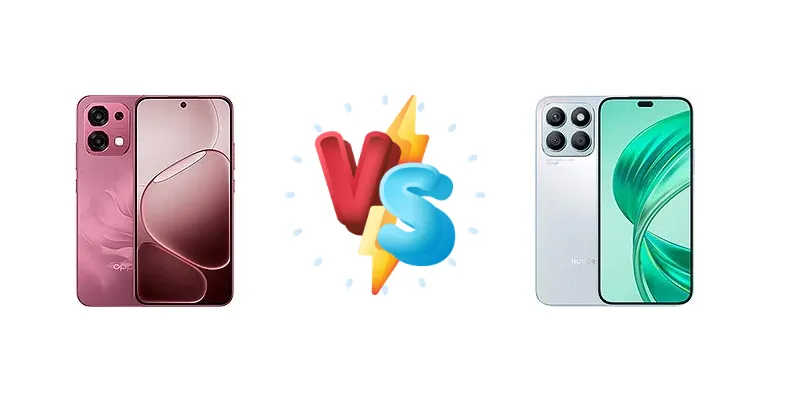
The Oppo A6 Pro 4G and Honor X8b represent compelling options in the competitive budget smartphone space. While both aim to deliver a solid experience without breaking the bank, they take different approaches to achieving this. The Oppo prioritizes rapid charging and a more powerful CPU core configuration, while the Honor focuses on a Qualcomm chipset known for efficiency and a balanced feature set. This comparison will dissect their key differences to help you determine which device best suits your needs.
🏆 Quick Verdict
For users prioritizing fast charging and potentially more demanding tasks, the Oppo A6 Pro 4G emerges as the winner. Its 80W charging and the higher clock speeds of the Cortex-A76 cores offer a noticeable advantage. However, the Honor X8b provides a solid, efficient experience for everyday use and benefits from Qualcomm's optimized software integration.
| Network |
|---|
| 2G bands | GSM 850 / 900 / 1800 / 1900 | GSM 850 / 900 / 1800 / 1900 |
| 3G bands | HSDPA 850 / 900 / 1900 / 2100 - International | HSDPA 850 / 900 / 1900 / 2100 |
| 4G bands | 1, 3, 5, 7, 8, 20, 28, 38, 40, 41 - International | LTE |
| Speed | HSPA, LTE | HSPA, LTE |
| Technology | GSM / HSPA / LTE | GSM / HSPA / LTE |
| Launch |
|---|
| Announced | 2025, September 23 | 2023, December 14 |
| Status | Available. Released 2025, September 23 | Available. Released 2023, December 22 |
| Body |
|---|
| Dimensions | 158.2 x 75 x 8 mm (6.23 x 2.95 x 0.31 in) | 161.1 x 74.6 x 6.8 mm (6.34 x 2.94 x 0.27 in) |
| SIM | Nano-SIM + Nano-SIM | Nano-SIM + Nano-SIM |
| Weight | 188 g (6.63 oz) | 166 g (5.86 oz) |
| Display |
|---|
| Protection | AGC DT-Star D+ | - |
| Resolution | 1080 x 2372 pixels (~397 ppi density) | 1080 x 2412 pixels, 20:9 ratio (~394 ppi density) |
| Size | 6.57 inches, 105.0 cm2 (~88.5% screen-to-body ratio) | 6.7 inches, 108.0 cm2 (~89.9% screen-to-body ratio) |
| Type | AMOLED, 1B colors, 120Hz, 600 nits (typ), 1400 nits (HBM) | AMOLED, 90Hz, 1200 nits (HBM), 2000 nits (peak) |
| Platform |
|---|
| CPU | Octa-core (2x2.2 GHz Cortex-A76 & 6x2.0 GHz Cortex-A55) | Octa-core (4x2.4 GHz Kryo 265 Gold & 4x1.9 GHz Kryo 265 Silver) |
| Chipset | Mediatek Helio G100 (6 nm) | Qualcomm SM6225 Snapdragon 680 4G (6 nm) |
| GPU | Mali-G57 MC2 | Adreno 610 |
| OS | Android 15, ColorOS 15 | Android 13, MagicOS 7.2 |
| Memory |
|---|
| Card slot | microSDXC | No |
| Internal | 128GB 8GB RAM, 256GB 8GB RAM | 128GB 8GB RAM, 256GB 6GB RAM, 256GB 8GB RAM, 512GB 8GB RAM |
| Main Camera |
|---|
| Dual | 50 MP, f/1.8, (wide), PDAF
Auxiliary lens | - |
| Features | LED flash, HDR, panorama | LED flash, HDR, panorama |
| Triple | - | 108 MP, f/1.8, 24mm (wide), 1/1.67", PDAF
5 MP, f/2.2, (ultrawide)
2 MP (macro) |
| Video | 1080p@30/60/120fps | 1080p@30fps |
| Selfie camera |
|---|
| Features | Panorama | LED flash |
| Single | 16 MP, f/2.4, (wide) | 50 MP, f/2.1, (wide) |
| Video | 1080p@30fps | 1080p@30fps |
| Sound |
|---|
| 35mm jack | No | No |
| Loudspeaker | Yes, with stereo speakers | Yes |
| Comms |
|---|
| Bluetooth | 5.4, A2DP, LE, aptX HD | 5.0, A2DP, LE |
| NFC | Yes (market/region dependent) | No |
| Positioning | GPS, GALILEO, GLONASS, BDS, QZSS | GPS, GLONASS, GALILEO, BDS |
| Radio | Unspecified | No |
| USB | USB Type-C 2.0, OTG | USB Type-C 2.0, OTG |
| WLAN | Wi-Fi 802.11 a/b/g/n/ac, dual-band | Wi-Fi 802.11 a/b/g/n/ac, dual-band, Wi-Fi Direct |
| Features |
|---|
| Sensors | Fingerprint (under display, optical), accelerometer, gyro, proximity | Fingerprint (side-mounted), accelerometer, compass |
| Battery |
|---|
| Charging | 80W wired, 33W PPS, 13.5W PD
Reverse wired charging | 35W wired |
| Type | Market-dependent versions:· Si/C Li-Ion 7000 mAh - version 1· 6500 mAh - version 2 | Li-Po 4500 mAh |
| Misc |
|---|
| Colors | Lunar Titanium, Stellar Blue, Coral Pink, Rosewood Red | Glamorous Green, Titanium Silver, Midnight Black, Blue |
| Models | CPH2799 | LLY-LX1, LLY-LX2, LLY-LX3 |
| Price | About 200 EUR | $ 369.00 / € 219.99 |
Oppo A6 Pro 4G
- Significantly faster 80W charging
- Potentially better CPU performance with Cortex-A76 cores
- Reverse wired charging capability
- Potential for more aggressive thermal throttling under sustained load
- Image processing may be overly saturated for some users
Honor X8b
- Efficient Snapdragon 680 chipset for smooth daily use
- Qualcomm's optimized software integration
- Potentially better battery life due to chipset efficiency
- Slower 35W charging
- Less powerful CPU for demanding tasks
Display Comparison
Neither device's display specifications are provided, so a direct comparison is limited. However, considering the price bracket, both likely utilize LCD panels. The absence of details like refresh rate or resolution suggests neither prioritizes a premium display experience. Users should expect standard viewing angles and color reproduction. Bezels are likely comparable, focusing on maximizing screen real estate within the budget constraints.
Camera Comparison
Without specific camera sensor details, a definitive comparison is challenging. Both phones likely feature a multi-camera setup, but the quality will heavily depend on the primary sensor and image processing algorithms. The inclusion of a 2MP macro lens on either device is likely a marketing feature with limited practical benefit. The image processing style will likely differ – Oppo often leans towards vibrant, saturated colors, while Honor typically aims for more natural tones. The absence of OIS (Optical Image Stabilization) on either device suggests low-light performance will be a compromise.
Performance
The core difference lies in the chipsets. The Oppo A6 Pro 4G utilizes the Mediatek Helio G100, built on a 6nm process, featuring an octa-core configuration with 2x2.2 GHz Cortex-A76 cores and 6x2.0 GHz Cortex-A55 cores. This configuration suggests a focus on burst performance, with the A76 cores handling demanding tasks. Conversely, the Honor X8b employs the Qualcomm Snapdragon 680, also on a 6nm process, with 4x2.4 GHz Kryo 265 Gold cores and 4x1.9 GHz Kryo 265 Silver cores. While the Snapdragon 680 has a slightly higher peak clock speed on its performance cores, the Helio G100's Cortex-A76 architecture is generally more efficient and capable. This translates to potentially better multitasking and smoother performance in graphically intensive applications on the Oppo. However, Qualcomm's software optimization often provides a more consistent experience.
Battery Life
The Oppo A6 Pro 4G’s 80W wired charging is a significant advantage over the Honor X8b’s 35W charging. This means the Oppo can potentially charge from 0-100% in under 40 minutes, while the Honor will likely take over an hour. The inclusion of 33W PPS and 13.5W PD on the Oppo also offers greater charging compatibility. While battery capacity isn't specified, the faster charging speed of the Oppo effectively mitigates any potential disadvantage from a slightly smaller battery. The Oppo also offers reverse wired charging, a feature absent on the Honor, allowing it to function as a power bank for other devices.
Buying Guide
Buy the Oppo A6 Pro 4G if you frequently find yourself needing to top up your battery quickly, or if you anticipate running more resource-intensive applications. Its 80W charging and more powerful CPU cores are ideal for power users. Buy the Honor X8b if you value a consistently smooth and efficient experience for everyday tasks like browsing, social media, and light gaming. The Snapdragon 680 offers a good balance of performance and battery life, making it a reliable daily driver.
Frequently Asked Questions
❓ Will the Helio G100 in the Oppo A6 Pro 4G overheat during prolonged gaming sessions?
While the Helio G100 is a capable chipset, its thermal performance will depend on the Oppo's cooling solution. The 6nm process helps with efficiency, but sustained gaming at high settings could lead to throttling. The Snapdragon 680 in the Honor X8b is generally known for better thermal management, potentially offering a more consistent experience during extended gameplay.
❓ Does the 35W charging on the Honor X8b feel significantly slower compared to the Oppo A6 Pro 4G's 80W charging?
Yes, the difference is substantial. 35W charging will take considerably longer to fully charge the Honor X8b, likely exceeding an hour. The Oppo A6 Pro 4G's 80W charging can top up the battery much faster, making it ideal for users who need a quick boost before heading out.
❓ Is the Snapdragon 680 in the Honor X8b powerful enough for playing popular games like PUBG Mobile?
The Snapdragon 680 can run PUBG Mobile, but you'll likely need to stick to medium graphics settings for a smooth experience. While it won't deliver the highest frame rates, it's capable of providing a playable experience for casual gamers. The Oppo A6 Pro 4G, with its more powerful CPU cores, may offer slightly better performance in demanding games.