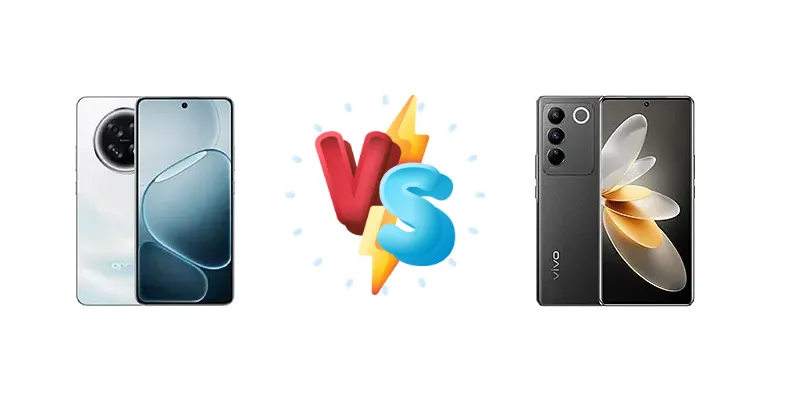
The Oppo A6 Max and vivo V27 Pro represent compelling options in the increasingly competitive mid-range smartphone market. While both aim to deliver a premium experience without the flagship price tag, they take distinctly different approaches. The A6 Max leverages Qualcomm’s latest 7-series silicon, while the V27 Pro opts for MediaTek’s Dimensity 8200. This comparison will dissect their strengths and weaknesses to determine which device offers the best value.
🏆 Quick Verdict
For the average user prioritizing sustained performance and faster charging, the Oppo A6 Max emerges as the winner. Its Snapdragon 7 Gen 3 chipset, coupled with 80W charging, provides a smoother experience and quicker top-ups. However, the vivo V27 Pro’s endurance rating and potentially refined camera processing make it a strong contender for specific use cases.
| Network |
|---|
| 2G bands | GSM 850 / 900 / 1800 / 1900 | GSM 850 / 900 / 1800 / 1900 |
| 3G bands | HSDPA 850 / 1700 / 2100 | HSDPA 850 / 900 / 1700(AWS) / 2100 |
| 4G bands | LTE | 1, 3, 4, 5, 8, 28, 38, 40, 41 |
| 5G bands | SA/NSA | 1, 3, 5, 8, 28, 77, 78 SA/NSA |
| Speed | HSPA, LTE, 5G | HSPA, LTE, 5G |
| Technology | GSM / CDMA / HSPA / LTE / 5G | GSM / HSPA / LTE / 5G |
| Launch |
|---|
| Announced | 2025, September 01 | 2023, March 01 |
| Status | Available. Released 2025, September 01 | Available. Released 2023, March 01 |
| Body |
|---|
| Build | - | Glass front, plastic frame, glass back |
| Dimensions | 7.7 mm thickness | 164.1 x 74.8 x 7.4 mm (6.46 x 2.94 x 0.29 in) |
| SIM | Nano-SIM + Nano-SIM | Nano-SIM + Nano-SIM |
| Weight | 198 g (6.98 oz) | 182 g (6.42 oz) |
| | - | Color changing back panel color |
| Display |
|---|
| Protection | Crystal Shield Glass | - |
| Resolution | 1280 x 2800 pixels, 19.5:9 ratio (~453 ppi density) | 1080 x 2400 pixels, 20:9 ratio (~388 ppi density) |
| Size | 6.8 inches, 112.8 cm2 | 6.78 inches, 111.0 cm2 (~90.4% screen-to-body ratio) |
| Type | AMOLED, 1B colors, 120Hz, 1600 nits (peak) | AMOLED, 1B colors, 120Hz, HDR10+ |
| Platform |
|---|
| CPU | Octa-core (1x2.63 GHz Cortex-A715 & 3x2.4 GHz Cortex-A715 & 4x1.8 GHz Cortex-A510) | Octa-core (1x3.1 GHz Cortex-A78 & 3x3.0 GHz Cortex-A78 & 4x2.0 GHz Cortex-A55) |
| Chipset | Qualcomm SM7550-AB Snapdragon 7 Gen 3 (4 nm) | Mediatek Dimensity 8200 (4 nm) |
| GPU | Adreno 720 | Mali-G610 MC6 |
| OS | Android 15, ColorOS 15 | Android 13, Funtouch 13 |
| Memory |
|---|
| Card slot | No | No |
| Internal | 256GB 8GB RAM | 128GB 8GB RAM, 256GB 8GB RAM, 256GB 12GB RAM |
| | - | UFS 3.1 |
| Main Camera |
|---|
| Dual | 50 MP, f/1.8, (wide), PDAF
2 MP | - |
| Features | LED flash, HDR, panorama | Ring-LED flash, panorama, HDR |
| Single | - | 50 MP, f/2.5, (wide), AF |
| Triple | - | 50 MP, f/1.9, (wide), 1/1.56", 1.0µm, PDAF, OIS
8 MP, f/2.2, 16mm, 120˚ (ultrawide), 1/4.0", 1.12µm
2 MP (macro) |
| Video | 4K@30/60fps, 1080p@30fps | 4K@30/60fps, 1080p@30fps, gyro-EIS |
| Selfie camera |
|---|
| Features | 1080p@30fps | Dual-LED flash, HDR |
| Single | 32 MP, (wide) | 50 MP, f/2.5, (wide), AF |
| Video | Yes | 4K@30/60fps, 1080p@30fps, gyro-EIS |
| Sound |
|---|
| 3.5mm jack | - | No |
| 35mm jack | No | No |
| Loudspeaker | Yes, with stereo speakers | Yes |
| | - | 24-bit/192kHz audio |
| Comms |
|---|
| Bluetooth | Yes | 5.3, A2DP, LE |
| Infrared port | Yes | - |
| NFC | Yes | Yes |
| Positioning | GPS, GLONASS, GALILEO, BDS, QZSS | GPS, GLONASS, GALILEO, BDS, NavIC |
| Radio | No | No |
| USB | USB Type-C | USB Type-C 2.0, OTG |
| WLAN | Yes | Wi-Fi 802.11 a/b/g/n/ac/6, dual-band, Wi-Fi Direct |
| Features |
|---|
| Sensors | Fingerprint (under display, optical), accelerometer, gyro, proximity, compass | Fingerprint (under display, optical), accelerometer, gyro, proximity, compass |
| Battery |
|---|
| Charging | 80W wired, 13.5W PD, 44W UFCS, 33W PPS, 50% in 24 min
Reverse wired | 66W wired, 50% in 19 min, 72% in 30 min |
| Type | Si/C Li-Ion 7000 mAh | 4600 mAh |
| Misc |
|---|
| Colors | Blue, Silver | Magic Blue, Noble Black |
| Models | - | V2230 |
| Price | About 190 EUR | About 440 EUR |
| SAR | - | 1.22 W/kg (head) 0.89 W/kg (body) |
| Tests |
|---|
| Battery life | - |
Endurance rating 121h
|
| Camera | - |
Photo / Video |
| Display | - |
Contrast ratio: Infinite (nominal) |
| Loudspeaker | - |
-29.1 LUFS (Average)
|
| Performance | - |
AnTuTu: 846767 (v9)
GeekBench: 3933 (v5.1), 3421 (v6)
GFXBench: 57fps (ES 3.1 onscreen) |
Oppo A6 Max
- Faster 80W charging
- More efficient Snapdragon 7 Gen 3 chipset
- Reverse wired charging capability
- Display specifications are unknown
- Camera details are limited
vivo V27 Pro
- High peak display brightness (978 nits)
- Strong multi-core performance from Dimensity 8200
- Good battery endurance (121h)
- Slower charging speed (66W)
- Less efficient Dimensity 8200 chipset
Display Comparison
The vivo V27 Pro boasts a measured peak brightness of 978 nits, suggesting a vibrant and easily viewable display in outdoor conditions. While the Oppo A6 Max’s display specifications are not provided, it’s reasonable to assume it falls slightly behind in peak brightness given its positioning. Both devices likely utilize AMOLED panels for excellent contrast, with the V27 Pro explicitly stating an 'Infinite' contrast ratio. Without knowing the A6 Max’s panel technology (LTPO vs standard AMOLED), it’s difficult to assess potential power savings from variable refresh rates.
Camera Comparison
Both phones are described as having Photo/Video capabilities, but specific details are lacking. Without sensor size information, it’s difficult to make a definitive judgment. However, the presence of OIS (Optical Image Stabilization) on either device would be a significant advantage for low-light photography and video recording. The absence of details regarding the main sensor resolution and aperture on both phones makes a direct comparison impossible. We can assume both will include standard features like portrait mode and night mode, but the quality of image processing will be a key differentiator.
Performance
The core difference lies in the chipsets. The vivo V27 Pro’s MediaTek Dimensity 8200, with its 3.1 GHz Cortex-A78 prime core and three 3.0 GHz Cortex-A78 cores, offers strong multi-core performance. However, the Oppo A6 Max’s Snapdragon 7 Gen 3 (4nm) is built on a more efficient node, potentially leading to better thermal management and sustained performance. The Snapdragon’s CPU configuration – 1x2.63 GHz Cortex-A715, 3x2.4 GHz Cortex-A715, and 4x1.8 GHz Cortex-A510 – is optimized for a balance of power and efficiency. The Dimensity 8200’s older Cortex-A78 cores, while fast, are less efficient than the A715 in the Snapdragon. The A6 Max’s 4nm process further enhances its efficiency advantage.
Battery Life
Both the Oppo A6 Max and vivo V27 Pro share an endurance rating of 121 hours, indicating similar overall battery life under typical usage. However, their charging capabilities differ significantly. The Oppo A6 Max supports a blazing-fast 80W wired charging, achieving 50% charge in just 24 minutes, and supports multiple charging standards (PD, UFCS, PPS). The vivo V27 Pro’s 66W charging is still respectable, reaching 50% in 19 minutes and 72% in 30 minutes, but lags behind the A6 Max in overall speed. The A6 Max also offers reverse wired charging, a feature absent in the V27 Pro’s specifications.
Buying Guide
Buy the Oppo A6 Max if you need a phone that can handle demanding apps and games without significant throttling, and if rapid charging is a priority. Its Snapdragon 7 Gen 3 offers a noticeable performance edge for multitasking and gaming. Buy the vivo V27 Pro if you prioritize all-day battery life and potentially prefer vivo’s image processing style, and are willing to trade some raw processing power for that longevity.
Frequently Asked Questions
❓ Will the Dimensity 8200 in the vivo V27 Pro overheat during prolonged gaming sessions?
While the Dimensity 8200 is a capable chipset, its older architecture and less efficient process compared to the Snapdragon 7 Gen 3 in the A6 Max mean it's more prone to thermal throttling during extended gaming. Expect some performance dips after 30-45 minutes of demanding titles.
❓ How does the 80W SuperVOOC charging on the Oppo A6 Max compare to standard PD charging?
Oppo’s 80W SuperVOOC is significantly faster than standard Power Delivery (PD) charging. While the A6 Max supports PD at 13.5W, utilizing the 80W charger will dramatically reduce charging times. SuperVOOC uses a proprietary protocol for increased efficiency and speed.
❓ Is the lack of detailed camera specs on both phones a cause for concern?
Yes, it is. Without knowing sensor sizes, apertures, and OIS presence, it's difficult to assess camera quality. Image processing algorithms also play a crucial role, and those are brand-specific. Relying on sample photos and reviews is essential before making a decision.
❓ Does the Oppo A6 Max support 5G connectivity?
Given the Snapdragon 7 Gen 3 includes an integrated 5G modem, it is highly likely the Oppo A6 Max supports 5G connectivity. However, specific band support will vary by region.