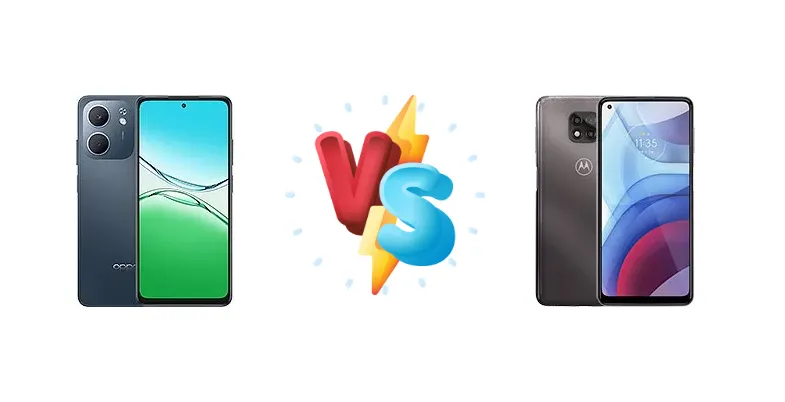
The Oppo A5x and Motorola Moto G Power (2021) represent distinct approaches to the budget smartphone market. The A5x arrives with a newer Mediatek Dimensity 6300 chipset and significantly faster charging, while the Moto G Power (2021) doubles down on Motorola’s reputation for exceptional battery endurance, powered by the Snapdragon 662. This comparison dissects the key differences to help you choose the right phone for your needs.
🏆 Quick Verdict
For most users, the Oppo A5x emerges as the stronger contender. Its Mediatek Dimensity 6300 chipset offers a noticeable performance uplift over the Snapdragon 662 in the Moto G Power, and the 45W charging is a game-changer. However, those prioritizing maximum battery life above all else will still find the Moto G Power a compelling option.
| Network |
|---|
| 2G bands | GSM 850 / 900 / 1800 / 1900 | GSM 850 / 900 / 1800 / 1900 |
| 3G bands | HSDPA 850 / 900 / 2100 | HSDPA 850 / 900 / 1700(AWS) / 1900 / 2100 |
| 4G bands | LTE | 1, 2, 3, 4, 5, 7, 8, 12, 13, 14, 17, 25, 26, 29, 30, 38, 41, 66, 71 |
| 5G bands | SA/NSA | - |
| Speed | HSPA, LTE, 5G | HSPA, LTE |
| Technology | GSM / HSPA / LTE / 5G | GSM / CDMA / HSPA / EVDO / LTE |
| | - | CDMA2000 1xEV-DO |
| Launch |
|---|
| Announced | 2025, May 23 | 2021, January 08 |
| Status | Available. Released 2025, May 25 | Available. Released 2021, January 14 |
| Body |
|---|
| Build | - | Glass front, plastic back, plastic frame |
| Dimensions | 165.7 x 76.2 x 8 mm (6.52 x 3.00 x 0.31 in) | 165.3 x 75.9 x 9.5 mm (6.51 x 2.99 x 0.37 in) |
| SIM | Nano-SIM + Nano-SIM | Nano-SIM |
| Weight | 193 g (6.81 oz) | 206.5 g (7.30 oz) |
| | - | Water-repellent coating |
| Display |
|---|
| Protection | Unspecified | - |
| Resolution | 720 x 1604 pixels, 20:9 ratio (~264 ppi density) | 720 x 1600 pixels, 20:9 ratio (~266 ppi density) |
| Size | 6.67 inches, 107.2 cm2 (~84.9% screen-to-body ratio) | 6.6 inches, 105.2 cm2 (~83.8% screen-to-body ratio) |
| Type | IPS LCD, 120Hz, 1000 nits (HBM) | IPS LCD |
| Platform |
|---|
| CPU | Octa-core (2x2.4 GHz Cortex-A76 & 6x2.0 GHz Cortex-A55) | Octa-core (4x2.0 GHz Kryo 260 Gold & 4x1.8 GHz Kryo 260 Silver) |
| Chipset | Mediatek Dimensity 6300 (6 nm) | Qualcomm SM6115 Snapdragon 662 (11 nm) |
| GPU | Mali-G57 MC2 | Adreno 610 |
| OS | Android 15, ColorOS 15 | Android 10 |
| Memory |
|---|
| Card slot | microSDXC | microSDXC (dedicated slot) |
| Internal | 64GB 4GB RAM, 128GB 4GB RAM, 128GB 6GB RAM | 32GB 3GB RAM, 64GB 4GB RAM |
| | - | eMMC 5.1 |
| Main Camera |
|---|
| Features | LED flash, HDR, panorama | LED flash, HDR, panorama |
| Single | 32 MP, f/1.9, (wide), AF | - |
| Triple | - | 48 MP, f/1.7, (wide), 1/2.0", 0.8µm, PDAF
2 MP (macro)
Auxiliary lens |
| Video | Yes | 1080p@30/60fps, gyro-EIS |
| Selfie camera |
|---|
| Features | - | HDR |
| Single | 5 MP, f/2.2, (wide) | 8 MP, f/2.0, 1.12µm |
| Video | Yes | 1080p@30fps, gyro-EIS |
| Sound |
|---|
| 3.5mm jack | - | Yes |
| 35mm jack | Yes | Yes |
| Loudspeaker | Yes | Yes |
| Comms |
|---|
| Bluetooth | 5.1, A2DP, LE | 5.0, A2DP, LE |
| NFC | No | No |
| Positioning | GPS, GALILEO, GLONASS, BDS, QZSS | GPS, GLONASS, GALILEO |
| Radio | Unspecified | FM radio |
| USB | USB Type-C 2.0, OTG | USB Type-C 2.0 |
| WLAN | Wi-Fi 802.11 a/b/g/n/ac, dual-band | Wi-Fi 802.11 a/b/g/n/ac, dual-band, Wi-Fi Direct |
| Features |
|---|
| Sensors | Fingerprint (side-mounted), accelerometer, proximity, compass | Fingerprint (side-mounted), accelerometer, gyro, proximity, compass, barometer |
| Battery |
|---|
| Charging | 45W wired, 33W PPS, 13.5W PD, 50% in 37 min | 15W wired |
| Type | 6000 mAh | Li-Po 5000 mAh |
| Misc |
|---|
| Colors | Tranquil Lake Green, Laser White | Flash Gray, Polar Silver |
| Price | ₹ 11,499 | About 60 EUR |
Oppo A5x
- Faster and more efficient Mediatek Dimensity 6300 chipset
- Significantly faster 45W charging with multiple protocols (PPS, PD)
- Likely better image processing capabilities
- Battery life may be shorter than the Moto G Power
- Specific display details are unknown
Motorola Moto G Power (2021)
- Excellent battery life – a hallmark of the Moto G Power series
- Reliable Snapdragon 662 chipset for everyday tasks
- Motorola’s clean software experience
- Slow 15W charging
- Older and less powerful chipset compared to the Dimensity 6300
Display Comparison
Neither device is known for a standout display. While specific display specs are missing, the focus here is on the underlying performance. The A5x’s chipset will likely contribute to smoother scrolling and animations, even if the panel technology is similar. The Snapdragon 662 in the Moto G Power, being an older chipset, may exhibit slight lag in demanding UI interactions. Bezels are likely comparable given the price points, and color accuracy will likely be standard for this segment.
Camera Comparison
Without detailed camera specs, it’s difficult to make a definitive judgment. However, the chipset plays a role in image processing speed. The Dimensity 6300 in the A5x will likely offer faster image processing and potentially better low-light performance due to its more advanced ISP. Motorola often focuses on software optimization, but the A5x’s hardware advantage is likely to be noticeable. We can assume both phones will include a standard set of lenses, but the A5x’s processing capabilities will likely result in more detailed and vibrant photos.
Performance
The core difference lies in the chipsets. The Oppo A5x’s Mediatek Dimensity 6300, built on a 6nm process, offers a significant advantage over the Motorola Moto G Power’s 11nm Snapdragon 662. The Dimensity 6300’s octa-core configuration (2x2.4 GHz Cortex-A76 & 6x2.0 GHz Cortex-A55) provides a more powerful CPU, particularly in single-core performance, compared to the Snapdragon 662’s (4x2.0 GHz Kryo 260 Gold & 4x1.8 GHz Kryo 260 Silver). This translates to faster app loading times and a more fluid user experience. The 6nm node also implies better thermal efficiency, potentially reducing throttling during sustained workloads. While RAM details are missing, the A5x’s chipset is more likely to handle multitasking efficiently.
Battery Life
The Motorola Moto G Power (2021) is named appropriately, prioritizing battery life. While the exact mAh capacity is not provided, Motorola is known for large batteries in this series. However, the Oppo A5x compensates with its significantly faster 45W charging (including 33W PPS and 13.5W PD). The Moto G Power’s 15W charging is comparatively slow. This means the A5x can gain a substantial charge in a short amount of time – 50% in 37 minutes – while the Moto G Power will require considerably longer to reach a full charge. The trade-off is endurance versus convenience; the Moto G Power will likely last longer on a single charge, but the A5x minimizes downtime.
Buying Guide
Buy the Oppo A5x if you need a phone that can handle multitasking, moderate gaming, and benefits from rapid charging. It’s ideal for users who frequently switch between apps and want a responsive experience. Buy the Motorola Moto G Power (2021) if you prioritize extended battery life and are willing to trade off some processing power and charging speed. This phone is perfect for travelers, outdoor enthusiasts, or anyone who dislikes frequent charging.
Frequently Asked Questions
❓ Will the Mediatek Dimensity 6300 in the Oppo A5x struggle with graphically demanding games like PUBG or Call of Duty?
While not a flagship-level chipset, the Dimensity 6300 is capable of running PUBG and Call of Duty at medium settings. The 6nm process and improved CPU architecture provide a performance boost over the Snapdragon 662, allowing for a smoother gaming experience, though you may need to adjust graphics settings for optimal frame rates.
❓ How much faster is the 45W charging on the Oppo A5x compared to the 15W charging on the Moto G Power (2021) in real-world use?
The 45W charging on the A5x is a game-changer. It can add a significant percentage of battery life in a short amount of time – reaching 50% charge in just 37 minutes. The Moto G Power’s 15W charging will take considerably longer, potentially over two hours for a full charge, making the A5x much more convenient for users who need a quick power boost.
❓ Does the Motorola Moto G Power (2021) receive regular software updates and security patches?
Motorola’s software update track record is generally slower than some other manufacturers. While the Moto G Power (2021) will receive updates, they may not be as frequent or as long-lasting as those offered by Oppo. This is a consideration for users who prioritize long-term software support.